
Unemployment can represent both an emotional and financial crossroads, regardless of the position or sector. Workers from various domains—from healthcare and information technology to finance, education, and administration—frequently tackle the challenge of interpreting intricate severance agreements. Understanding how to evaluate an equitable average severance package is crucial for safeguarding income, benefits, and long-term career security during transitions.
Informed employees negotiate more effectively and advance with assurance. This handbook elucidates the structure, intent, and critical elements that characterize the average severance package in the United States, providing actionable tactics for obtaining fair remuneration. By comprehending how benefits are determined and which conditions are most significant, job hunters can engage in negotiations with transparency, secure their financial prospects, and transform career transitions into avenues for growth.

What Is a Severance Package?
A severance package is a financial and benefits-oriented safety net presented to employees encountering involuntary dismissal, whether due to layoffs, downsizing, or corporate restructuring. It serves as a financial connection between employment and upcoming job prospects, assisting individuals in maintaining stability during unpredictable transitions. Although not mandated by federal legislation, numerous organizations offer severance to preserve goodwill and diminish legal exposure.
The typical severance package in the United States frequently comprises:
- Salary continuation for a designated duration.
- Prolonged healthcare coverage to mitigate medical expenses.
- Compensation for unused vacation or PTO.
- Outplacement support or resources for job searching.
- Executive or senior manager benefits like stock options or performance bonuses.
Severance conditions are influenced by corporate policy, personal employment agreements, or collective bargaining arrangements. The Fair Labor Standards Act (FLSA) does not enforce severance compensation, but if guaranteed in writing, employers are legally obligated to fulfill it. State regulations may also impose disclosure obligations or outlined payment schedules.
Average Severance Package in 2026
The extent and format of the average severance package in 2026 are heavily influenced by aspects such as industry, tenure, job rank, and contract type. Recent statistics gathered from compensation benchmarking organizations and the U.S. Bureau of Labor Statistics indicate the prevailing formula remains one to two weeks of pay for each full year of service. Executives typically receive more extensive severance—spanning three to six months of salary—while hourly and entry-level employees may get smaller lump sums or limited benefits.
Typical Severance Ranges by Employment Level
| Employment Level | Typical Severance Range |
|---|---|
| Entry-Level Employees | 1 week per annual service or fixed lump sum |
| Mid-Level Professionals | 1–2 weeks per annual service, plus benefit continuation |
| Senior Managers | 2–4 weeks per annual service, up to 16–24 weeks maximum |
| Executives | 3–6 months of complete pay, often extending to 12 months |
For instance, a marketing director with eight years at a mid-size company might obtain 16 weeks of pay, continued healthcare coverage, and outplacement service assistance. Conversely, an hourly warehouse employee could receive a smaller lump sum corresponding to two or three weeks’ earnings.
These averages also fluctuate based on corporate policies and severance practices. Larger employers, especially within the technology and finance sectors, frequently offer more favorable severance packages to maintain brand integrity and minimize potential conflicts. Many of these packages include extended COBRA payments or stock option acceleration clauses that augment the base financial payout.
Key Components of a Typical Severance Package
While financial remuneration is the most apparent aspect, a severance package generally encompasses multiple facets of financial and career continuity support. Grasping each element enables job seekers to determine if an offer genuinely aligns with fair separation standards.
•Base Pay
The primary component of severance, typically derived from the employee’s most recent salary. Lump-sum or salary continuation schemes are prevalent forms.
•Health Benefits
Employers may subsidize continued healthcare coverage for several weeks or months after discharge, occasionally under COBRA extension provisions.
•Retirement and Stock Options
Vesting schedules or option acceleration clauses may be applicable, particularly for mid-to-senior-level individuals or those occupying corporate positions.
•Outplacement Assistance
Numerous companies provide career guidance or resume writing services to assist displaced workers in swiftly securing their next endeavors.
•Non-Compete and Release Provisions
Personnel must meticulously examine legal documents that may limit future employment opportunities or necessitate waivers in exchange for compensation.
Certain sectors, including government contracting and healthcare systems, may require extra disclosures or provide additional compensation if employees are engaged in licensed or classified initiatives. Analyzing all written stipulations prior to acceptance guarantees full clarity and adherence.
Factors Influencing Severance Pay Amounts
A variety of measurable factors influence how organizations determine severance sums. These cover internal procedures, job type, and economic factors. Understanding these determinants equips job seekers with insights into their negotiation power.

•Tenure and Years of Employment
Employees with extended tenures are generally qualified for greater remuneration because of their dedication and organizational knowledge.
•Job Level
Executive roles and positions managing sensitive information frequently receive enhanced severance packages, reflecting their significance to the organization.
•Employment Agreement Provisions
Written contracts may secure particular compensation levels or benefits that take precedence over company-wide regulations.
•Organization Size and Financial Status
Larger firms can often offer more comprehensive packages, while smaller businesses calculate compensation based on cash flow and operational requirements.
•Circumstance of Departure
Layoffs and organizational restructuring generally instigate severance, while dismissals for misconduct may not qualify.
The broader economic environment also influences employer behaviors. During nationwide layoffs, such as those affecting the tech industry, severance compensation often becomes uniform to maintain the company’s image. In contrast, when workforce reductions result from specific performance concerns, pay-offs may be minimal or contingent on non-litigation stipulations.
Tax Consequences of Severance Pay
While severance pay may seem like a financial safety net, it is also taxable income under the regulations established by the Internal Revenue Service (IRS). Employers are obligated to withhold federal income tax, Social Security, and Medicare contributions—akin to regular salary. Therefore, this lump-sum disbursement can temporarily elevate an employee’s tax bracket.
To lessen the immediate tax burden, financial consultants frequently advise:
- Allocating funds for estimated tax obligations to avoid penalties for underpayment.
- Considering retirement rollovers, such as transferring to a 401(k), prior to the disbursement of severance to lower taxable income.
State income taxes are also applicable, yet rates differ across states. Certain states—like Florida, Texas, and Washington—do not impose income tax, potentially preserving a greater net severance amount for impacted employees residing there.
Regardless of location, examining recent pay slips and consulting trustworthy tax resources helps guarantee clarity before endorsing any severance contracts. Grasping how the typical severance package is taxed, alongside these regional variations, empowers professionals to strategize effectively, safeguard their payouts, and transition with assurance.
Negotiating an Improved Severance Package
Negotiation remains one of the most overlooked components of severance discussions. Numerous professionals feel compelled to accept initial proposals without scrutiny, yet employers frequently provide scope for modifications. Successful negotiation can prolong payment periods, maintain benefits, or eliminate restrictive non-compete stipulations.
Here’s an infographic guide showcasing five straightforward steps for securing a just severance package:
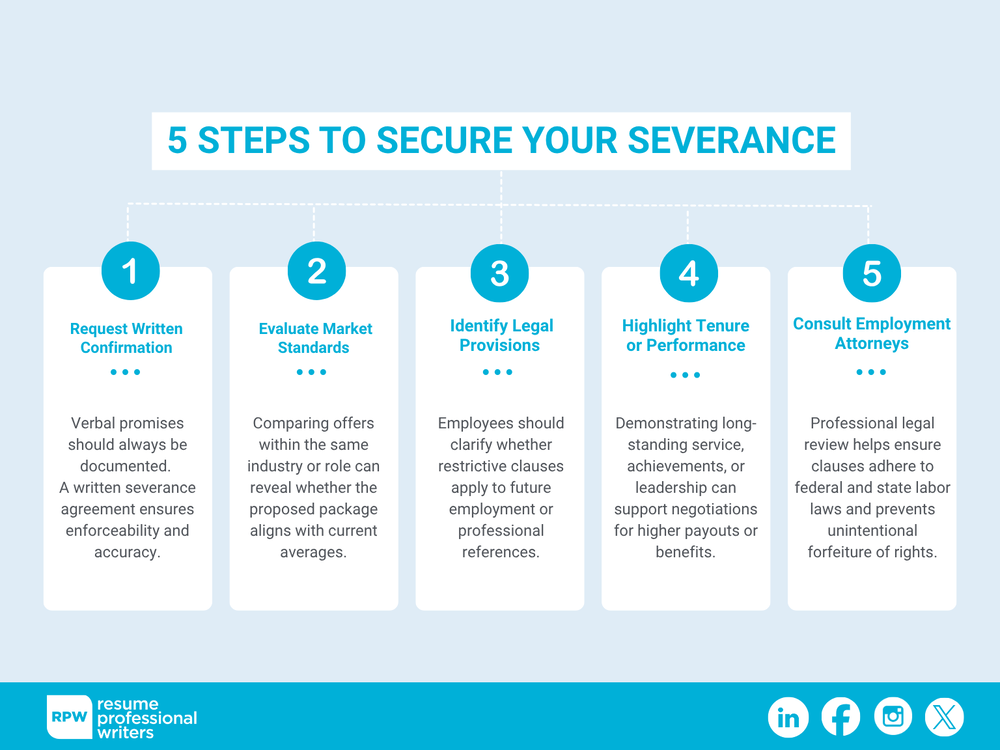
Organizations typically aim to conclude severance agreements within 21 days of termination notification, as per standard practices encouraged by U.S. labor regulations. However, immediate signing is never compulsory. Employees have valid grounds to request additional time for examination or negotiation, particularly in situations involving lengthy service or executive agreements.
Executive and Specialized Severance Agreements
Executives and specialized experts commonly receive enhanced severance arrangements due to the strategic importance of their roles. These agreements extend beyond the typical severance package, usually featuring prolonged payment durations,
broadened non-compete safeguards, alongside fast-tracked equity vesting provisions. Senior executives, financial overseers, or lead engineers dealing with proprietary innovations are generally encompassed under such agreements.
A corporate vice president, for instance, might secure:
- 6–12 months of salary continuation.
- Prolonged healthcare coverage lasting up to a year.
- Extended stock option exercise periods and accelerated vesting timelines.
- Confidentiality or non-disparagement provisions to protect the company’s image post-departure.
While evaluating executive severance contracts, professionals ought to concentrate on:
- Retention of benefits and timelines for premium coverage
- Stock vesting timelines and clauses for equity acceleration
- Reference to departures for “good reason” that permit voluntary resignation with severance if the company reduces salary, changes the role, or modifies responsibilities
For executives, severance transcends mere financial security—it’s about preserving long-term career assets, reputation, and adherence during transitions. Grasping how these specialized agreements diverge from the standard severance package equips leaders to negotiate effectively and protect their professional image.
In addition to financial aspects, executives should also reflect on career branding. Updating LinkedIn profiles or personal branding during this timeframe frequently necessitates meticulous compliance checks with executive transition stipulations.
State and Federal Considerations for Severance in the U.S.
Severance compensation in the United States is influenced by a blend of federal directives and state-level protections. Although the standard severance package isn’t federally mandated, numerous labor laws affect how companies must manage workforce reductions.

•Federal WARN Act
The Worker Adjustment and Retraining Notification (WARN) Act mandates that employers with 100 or more employees provide 60 days’ notice in the event of mass layoffs. Noncompliance may necessitate back pay or benefits equivalent to that period, effectively serving as severance compensation.
•State Regulations
State laws might impose supplementary protections. For instance, California’s labor regulations stress timely payment upon termination, while employers in New York must adhere to notification duties under the state’s mini-WARN Act. Public sector workers also follow distinct severance frameworks governed by civil service regulations or collective bargaining agreements.
•Federal Employees and Military Transitions
Federal employees and military-to-civilian workforce members typically receive specialized separation pay scales dictated by Office of Personnel Management (OPM) guidance. Severance for federal positions usually depends on the duration of continuous service and the highest rate of basic pay, subject to statutory limits.
These overlapping regulations imply that severance can appear quite different based on jurisdiction and employment type. For professionals navigating career changes, understanding how state and federal frameworks interact with the average severance package isn’t solely about compliance—it’s about transforming legal knowledge into financial reassurance and strategic advantage.
How Severance Packages Support Career Transitions
When designed equitably, severance packages alleviate financial burdens and offer impetus for professional reinvention. Beyond the ordinary severance package, many mid-sized to large employers now provide outplacement or job coaching services, equipping employees with practical tools for crafting resumes, interview preparation, and networking outreach. Collaborating with external organizations ensures that departing personnel continue their career progression rather than pausing in transition.
Essential career-support elements frequently encompass:
- Resume enhancement services customized for contemporary hiring systems.
- Professional networking readiness to fortify industry connections.
- Interview practice and coaching to boost confidence and reduce job search duration.
- Placement assistance that links candidates with new opportunities more swiftly.
These resources not only strengthen employer branding but also empower employees to re-enter the job marketplace with confidence. Workers who capitalize on severance-linked career services frequently secure comparable or superior roles within three to six months.
Severance should be viewed not merely as recompense for job loss, but as a springboard for career advancement. By merging financial security with access to job search resources, the average severance package evolves from a simple payout into a conduit toward reinvention and long-term prospects.

Secure Stability After a Layoff
Strategic planning following receipt of a severance package aids in sustaining financial stability and career trajectory. Job seekers should assess their monthly expenditures, health benefits, and upcoming job prospects before making significant financial choices. Redirecting the severance payout into short-term savings accounts ensures liquidity during the job search period, while refining resumes, portfolios, and professional branding enhances re-entry potential.
A well-prepared career document remains vital for reestablishing footing after separation. Many professionals hasten their return with expert resume writers who adapt resumes to align with current hiring trends, quantify accomplishments, and ensure compliance.
with existing candidate tracking systems. Converting severance into possibility demands deliberate effort, proficient storytelling, and willingness to embrace new career avenues.
Frequently Asked Questions
How is severance pay determined?
Employers generally determine severance based on length of service, providing one to two weeks of salary for each year of completed employment. Executives or contractual workers may receive greater sums, often calculated in months of compensation. The overall amount might also take into account unused vacation time or performance bonuses accumulated before separation.
Is severance pay mandated by U.S. regulations?
National law does not obligate employers to offer severance. However, if promised in a formal employment agreement, company guidelines, or union contract, it becomes legally binding. Certain states have advance notice statutes under the WARN Act for large-scale layoffs.
Are severance payments subject to taxation?
Indeed. The IRS categorizes severance pay as ordinary taxable income, liable to federal income tax, Social Security, and Medicare deductions. Employees ought to examine withholding rates to avoid an unforeseen tax liability at the end of the year.
Can workers negotiate their severance agreement?
Yes, in the majority of situations. Employers commonly anticipate some form of negotiation. Employees with longer service or specialized expertise have a stronger position when requesting an increased duration of pay, prolonged healthcare benefits, or the elimination of restrictive provisions like non-compete agreements.
What actions should employees take following the receipt of severance?
Professionals should scrutinize all written terms, verify payment timelines, and confirm ongoing benefit specifics. Updating resumes, preparing for job searches, and managing finances should occur promptly to facilitate a seamless transition to the subsequent opportunity.