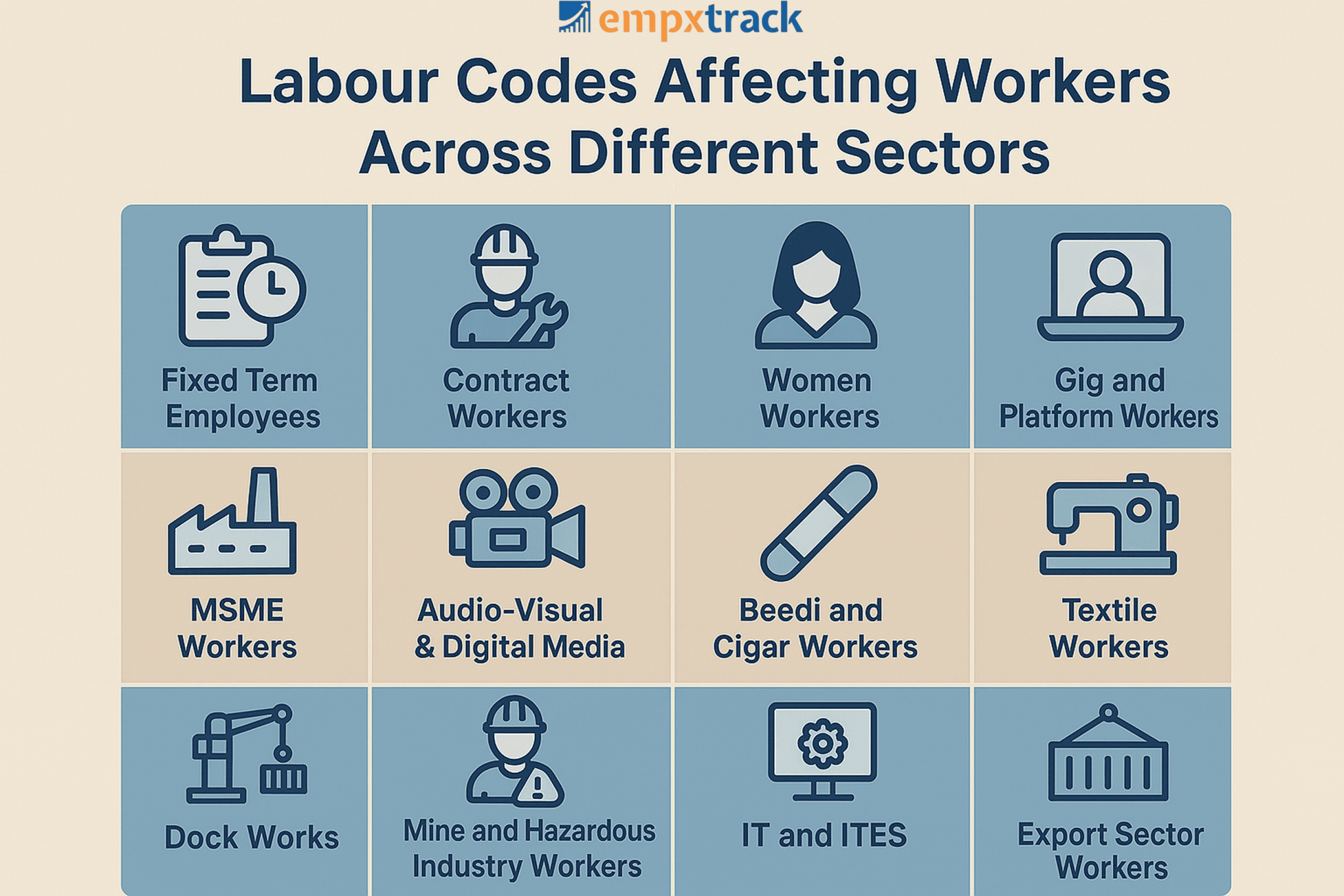
India is prepared to revamp its employment legislation by substituting the 29 current central labour statutes. This initiative aims to rejuvenate India’s workforce and is being labelled a “monumental decision” by the authorities.
The four statutes unifying the existing labour regulations are: the Code on Wages (2019), Industrial Relations Code (2020), Code on Social Security (2020), and Occupational Safety, Health and Working Conditions (OSHWC) Code (2020).
Collectively, these reforms are designed to protect workers’ rights and well-being while simplifying compliance. They also update obsolete provisions and create an effective system that will foster greater ease in conducting business.
This blog examines the implications of India’s new labour codes on employees and enterprises.
How the Labour Codes Will Influence Businesses and Workers
The new regulations will impact both employers and staff. They are geared towards simplifying compliance and regulations for employers while ensuring a standardized wage system for workers, along with enhanced social security measures. This will enhance the working conditions of countless employees across the nation.
For enterprises, the revised labour codes bring both prospects and obligations. Smaller companies may feel the effects of these changes more acutely as the compliance demands and increasing payroll responsibilities might add to their administrative load. They may face short-term adjustment challenges as they acclimatize to the updated regulations.
In the long term, the labour codes are anticipated to have a beneficial impact, aiming to diminish uncertainty and elevate efficiency. However, businesses will need to enhance their payroll systems and bolster their compliance mechanisms to guarantee better transparency and consistent alignment with the new legal requirements.
As these reforms transform the employment landscape, here is a closer examination of the labour codes’ impact on employees.
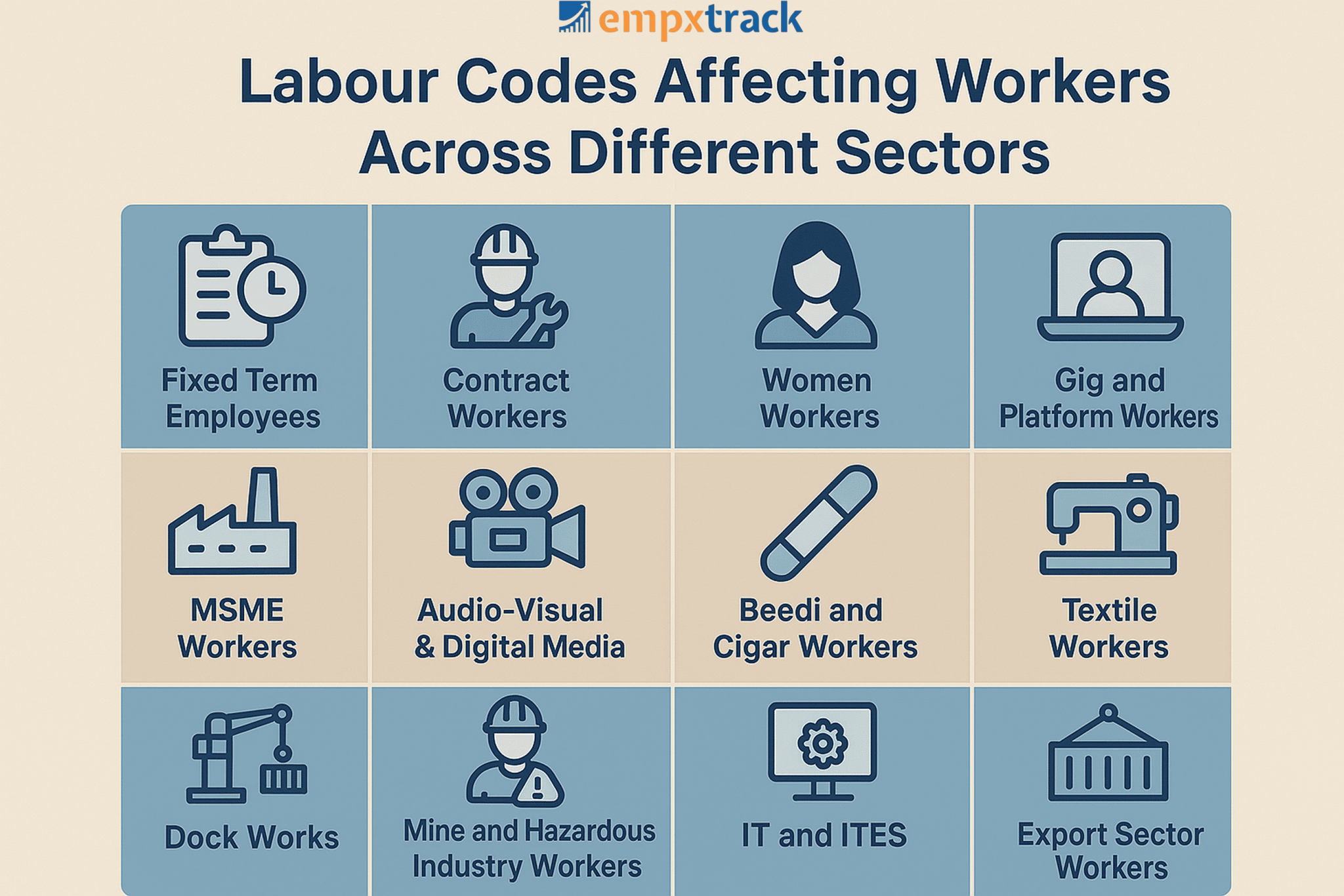
Advantages for Each Worker Category Across Principal Sectors
The enforcement of the four labour codes in India offers some of the most extensive worker protections with focused reforms across vital sectors.
Fixed-Term Employees
- » Fixed-term employees will qualify for gratuity after a year, rather than five.
- » Furthermore, they will earn equal pay as the permanent workforce, which will enhance their earnings and security.
- » Overall, this stipulation encourages direct recruitment and reduces excessive contract usage while providing cost-effectiveness for employers.
Contract Workers
- » Principal employers are mandated to provide welfare provisions such as health and safety measures. Workers will also receive annual health check-ups.
- » In addition, the principal employer is responsible for paying any outstanding wages to the contract worker if the contractor defaults on payments.
- » The legislation now includes a provision for appointing a dedicated authority to offer guidance on essential and non-essential functions.
Female Workers
- » The codes ensure equal remuneration for equal tasks and prohibit gender bias.
- » Women are allowed to work in all types of establishments and during night shifts with safety measures, contingent on their consent.
- » Additionally, the new codes redefine family for female workers by including parents-in-law, ensuring broader dependent coverage and promoting inclusive policies.
- » The new regulations guarantee proportional representation of women in the grievance redressal committee (GRC) for gender-sensitive resolutions.
- » Notably, the new regulations extend maternity benefits, comprising 26 weeks of paid maternity leave, to women in the unorganised sector.
Gig and Platform Workers
- » For the first time, gig workers, platform workers, and aggregators are receiving legal acknowledgment.
- » Consequently, social security coverage now applies to gig and platform workers.
- » Likewise, aggregators will contribute 1-2% of their annual revenue (capped at 5% of payments to those workers).
MSME Workers
- » Employers are required to guarantee a minimum wage and timely remuneration for their staff.
- » Workers will gain access to amenities like drinking water, restrooms, and canteens.
- » Provisions for paid leave, standard working hours, and double wages for overtime.
- » The Social Security Codes, 2020 incorporates coverage for MSME workers and ties its applicability to the count of employees in the unit.
Audio-Visual & Digital Media Workers
- » Digital and audio-visual workers, including journalists in electronic media, dubbing actors, and stunt performers, will henceforth receive full benefits.
- » Furthermore, they will obtain mandatory appointment letters clearly stating their designations, remuneration, and social security benefits.
- » Overtime work should be consent-based and compensated at least double the regular wage rate.
- » Timely payments are assured.
Beedi and Cigar Workers
- » All workers will obtain guaranteed minimum wages and timely payments.
- » Workers performing overtime will do so based on consent and receive at least double the standard wage rate.
- » Working hours will be limited to 8–12 hours daily, with a maximum of 48 hours weekly.
- » Ultimately, workers will qualify for a bonus after completing 30 days of work in a year.
Textile Workers
- » All migrant workers, whether directly hired, engaged through contractors, or self-migrated, are entitled to equal pay, welfare benefits, and PDS portability.
- » They may also submit claims for overdue payments for up to three years, ensuring easier and more flexible conflict resolution.
- » Additionally, there is a provision for double pay for employees who work overtime.
Dock Workers
- » All dock workers will receive formal acknowledgment and legal safeguards.
- » Additionally, the issuance of appointment letters is now obligatory to guarantee access to social security benefits.
- » Provident fund, pension, and insurance coverage will extend to all dock workers, including those hired on a contract or temporary basis.
- » Dock workers will gain access
to suitable working circumstances and protection. They will receive compulsory medical amenities, including yearly health examinations, first aid, clean and sanitary areas for washing, etc.
Miner and Hazardous Industry Laborers
- » Significantly, health and security for every laborer are guaranteed. Employers must provide complimentary yearly health examinations.
- » Certain commuting incidents may be recognized as work-related, as long as they fulfill specified criteria connected to time and place.
- » Each location must have a designated safety committee in charge of overseeing workplace safety and managing hazardous materials appropriately.
- » Women are allowed to work in various types of enterprises, including underground mining, heavy equipment, and dangerous tasks, thus promoting equal employment opportunities.
IT & ITES
- » Salary disbursement by the 7th of each month is now compulsory.
- » Social security coverage is assured through fixed-term employment agreements, and additionally, the provision of formal appointment documents is imperative.
- » Mandatory equal pay for similar work enhances equity in the workplace and further encourages increased female participation in the labor force.
- » Swift resolution of harassment, discrimination, and wage-related issues.
Export Sector Laborers
- » Employees on fixed contracts will be entitled to gratuity, provident fund (PF), and all other relevant social security entitlements.
- » Furthermore, all workers will possess the right to take annual leave after fulfilling 180 days of service in a year.
- » Workers are entitled to prompt wage payments, protection against unauthorized deductions, and exemption from any salary ceiling restrictions.
- » Women may choose to work the night shift, provided they offer their consent, thus creating better opportunities for earning a higher income.
- » Thorough safety protocols such as written consent, overtime compensated at double rates, safe transportation options, CCTV monitoring, and security assistance are mandatory.

Additional Reforms
Alongside industry-specific modifications, India’s new labor codes introduce numerous comprehensive system-wide reforms.
- » National Minimum Wage established to guarantee that no worker receives compensation below the minimal standard of living.
- » Gender-neutral employment and job opportunities to explicitly forbid discrimination, including against transgender individuals.
- » An Inspector-cum-Facilitator model that emphasizes supportive compliance measures and awareness-raising rather than stringent punitive actions.
- » A quicker dispute resolution system via two-member Industrial Tribunals, permitting workers and employers to approach the tribunal directly following conciliation.
- » A singular registration, a single license, and a unified return for all safety and working-condition obligations, thus removing multiple overlapping submissions.
- » Formation of a National OSH Board accountable for developing unified safety and health standards across various sectors.
- » Safety committees are compulsory in establishments with over 500 workers, thereby enhancing workplace accountability.
- » Increased factory applicability thresholds lessen regulatory pressure on small establishments while ensuring comprehensive worker protections stay intact.
- » Firms with up to 299 employees can now dismiss staff without government authorization (the threshold has been increased from 100 to 300).
- » Smaller enterprises gain more flexibility with fewer compliance mandates concerning employment terms.
Why Are Small Enterprises Concerned
Small enterprises have expressed concerns regarding India’s new labor codes. Specifically, the effects of these codes on small businesses regarding costs and compliance cannot be overlooked.
Compliance Strain on MSMEs
Numerous MSMEs perceive that payroll expenses are anticipated to rise due to a broader and better-defined social security framework. Additionally, the implementation of guaranteed minimum wages, designated working hours, double overtime compensation, and paid time off further adds to their financial strains.
According to the Association of Indian Entrepreneurs (AIE), the potential escalation in operational costs for MSMEs is a valid concern.
Furthermore, this comes at a time when companies are already grappling with ongoing challenges such as inflation and surging capital expenses. Thus, more clarity, transitional assistance, and adaptable implementation strategies from the government are vital.
Administrative Preparedness
The intricacies of these new regulations may not be feasible for small entities that lack dedicated HR or legal teams. They may continue to face challenges in comprehending and executing fresh registration, reporting, and record-keeping obligations.
Additionally, obligatory appointment letters and clear stipulations on timely wage payments are expected to compel small businesses to properly formalize worker rolls. They will also need to keep accurate muster and payroll records and upgrade payroll software.
Fear of Penalties
Even with the shift towards a facilitative enforcement model, small enterprises are worried about possible fines or legal repercussions if compliance is deficient during the transition phase.
Consequently, SMEs should be shielded from abrupt regulatory pressure, and the Codes’ execution must remain sensitive to their capabilities. Otherwise, the reforms could inadvertently hinder job creation and deter new entrepreneurs.
Key Insights for HR Leaders
- ● Fixed-term employees receive permanent benefits
- ● Universal minimum wage guaranteed to all
- ● Gratuity granted after 1 year, instead of 5 for fixed-term staff
- ● Required appointment letters for all employees
- ● Gig and platform personnel acknowledged
- ● Annual leave post 180 days of employment in a year
- ● Complimentary yearly health examinations for all workers over the age of 40
- ● Nationwide ESIC coverage, encompassing small and hazardous enterprises
- ● Night shifts permitted for women. Equal remuneration for equal tasks
- ● Migrant employees entitled to fair wages, welfare benefits, and PDS portability
- ● Commuting incidents now eligible for compensation
- ● Safety committees established for workplaces with more than 500 employees
- ● Single registration, single license, single return
- ● Digitalization of registers and documentation
- ● Swift resolution of disputes through two-member industrial tribunals
Reasons Your Take-Home Salary Might Decrease
The administration is anticipated to reveal comprehensive guidelines in the forthcoming weeks. Although companies will need to modify their salary structures to adhere to these fresh rules and regulations.
As per the new guidelines, an employee’s fundamental salary must make up at least 50% of their overall CTC. This modification will subsequently lead to increased contributions since both PF and gratuity computations rely on an individual’s base pay.
Despite these alterations guaranteeing improved retirement benefits for workers, it also means a lower take-home salary, as the heightened contributions will be drawn from the existing CTC per India’s updated labor codes.
Final Thoughts
The execution of the new labor codes signifies a major advancement in India’s labor ecosystem.
While these codes aspire to bolster worker protections and streamline compliance, small and medium enterprises will likely require some time and assistance to adjust to these modifications afterwards.
Ultimately, the effectiveness of India’s new labor codes hinges on seamless enforcement and a cooperative relationship among employers, employees, and the government.
We have also supplied a straightforward & actionable compliance checklist for 2026 for HR and employers.
Commonly Asked Questions
Q1. |
In what way will the new labor codes influence take-home salary? |
| Ans. | The new labor codes mandate that Basic and DA constitute a minimum of 50% of total wages according to the revised definition of wages, resulting in increased PF contributions. Consequently, employees may notice a decline in their take-home salary due to heightened contributions. |
Q2. |
What concerns do small businesses have regarding the new labor codes? |
| Ans. | Small enterprises may worry as it could escalate compliance demands, payroll expenses, and statutory contributions. Moreover, they are also apprehensive about diminished flexibility in hiring and exit processes, potentially increasing their costs. |
Q3. |
Are businesses required to revise all appointments and contracts? |
| Ans. | Numerous sectors will likely have to update their appointment letters and employment agreements to remain compliant. However, whether a complete rewrite is necessary depends on how closely existing documents already correspond with statutory compliance standards. |
Q4. |
Which sectors will experience the most significant impact? |
| Ans. | Typically, sectors with substantial workforces, extensive use of contract labor, or continuous operations will encounter the most significant effects. For example, this includes manufacturing, construction, logistics, e-commerce, retail, IT/ITeS, hospitality, and gig-economy platforms. |
Q5. |
Do the new codes alter termination regulations? |
| Ans. | The updated labor codes in India elevate the requirement for government approval of layoffs from 100 to 300 employees, granting smaller establishments additional flexibility. Nonetheless, employers must still adhere to notice and retrenchment compensation regulations and contribute to a reskilling fund for laid-off workers. |
Q6. |
Can contract workers be engaged in core activities? |
| Ans. | Yes, under India’s updated labor codes, contract workers may be engaged in core functions, albeit with more stringent regulations. |
Q7. |
Are gig and platform workers protected under social security? |
| Ans. | Gig and platform workers are legally recognized and safeguarded under the social security code. |
Q8. |
Must small businesses issue appointment letters? |
| Ans. | Indeed, following the establishment of the four labor codes, all businesses, including smaller ones, are mandated to provide appointment letters. |
Q9. |
Are women permitted to undertake night shifts under the new codes? |
| Ans. | Yes, women are allowed to undertake night shifts, provided they consent and all necessary safety protocols are observed. |