Talent optimization entails the strategic methodology organizations employ to attract, cultivate, retain, and enhance their workforce. Studies indicate that successful talent optimization has a direct effect on the organization’s performance and growth.
To assure sustained expansion, thriving companies utilize the 9 box grid to pinpoint and cultivate top talent.
What is the 9 Box Grid?
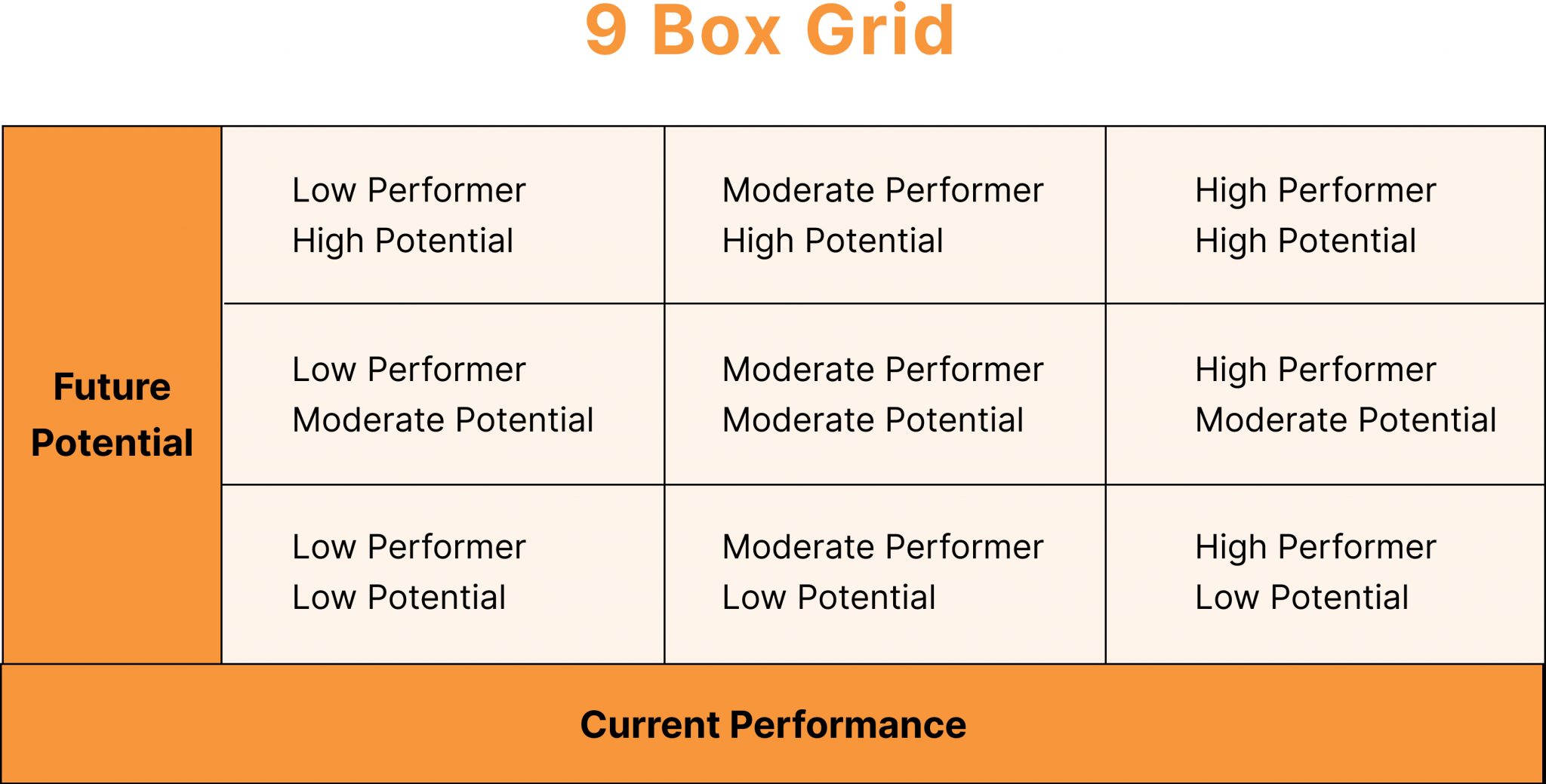
The 9 box grid, often known as the performance-potential matrix, turns talent optimization into a visual task. It serves as a vital tool that evaluates employee performance and potential. It aids leaders in making informed choices regarding talent development and succession planning.
The 9 Elements of 9 Box Grid
Visualize a 3×3 matrix. Along the X-axis, employee performance varies from low to high. Along the Y-axis, potential also ranges from low to high. The outcome? A grid featuring nine unique boxes, each denoting a combination of performance and potential.
This grid classifies employees into categories such as top achievers, emerging talent, and underperformers. Thus, it’s not merely a chart; it’s a blueprint guiding decisions regarding promotions, training, succession planning, and more.
In summary, this framework guarantees a holistic view of the workforce, thereby assisting organizations in recognizing and fostering every employee’s potential.
Role of the 9 Box Grid in Talent Management
Talent management flourishes on clarity and strategy. The grid provides both, becoming an indispensable element of HR processes.
Succession Planning
Organizations depend on the grid to pinpoint successors for pivotal positions. By mapping high-potential employees, management can ensure business continuity.
Performance Management
The 9-box grid aids managers in evaluating employee performance and potential, simplifying the identification of top talent and areas for improvement. By utilizing this 9 grid model, organizations can make well-informed decisions concerning employee development, promotions, and leadership readiness.
Talent Development
It signifies high-potential employees and highlights skill deficiencies. Managers and HR leverage these insights to formulate growth plans and support employees’ career advancement.
Strategic Decision-Making
From promotions to team reorganization, the grid’s insights facilitate strategic talent choices.
Key Advantages of the 9 Box Grid for Performance Management
The 9 grid model aligns talent management with organizational objectives. It ensures that the right individuals occupy the right roles to drive success.
Streamlines Talent Assessment
The grid simplifies talent evaluation by providing a visual framework for assessing employees based on two fundamental factors: performance and potential.
Identifies Top Talent
Managers can swiftly recognize top performers and marginal contributors.
Align Development with Goals
Managers gain clarity about employees’ potential and performance, allowing them to set SMART goals according to individual requirements.
Encourages Objective Reviews
Performance evaluations can often be subjective. Therefore, by utilizing clear metrics, the assessment grid guarantees fairness.
Supports Strategic Decisions
The grid lends support to crucial decisions that affect an organization’s success. For example, promoting high-performing employees, implementing targeted training programs, and making informed hiring decisions.
Encourages Employee Growth
Provides a defined path for the development and career progression of employees.
Aids Succession Planning
Highlights high-potential individuals and prepares employees for leadership positions. It further facilitates effective succession planning.
How to Create and Use a 9 Box Grid for Effective Employee Assessment
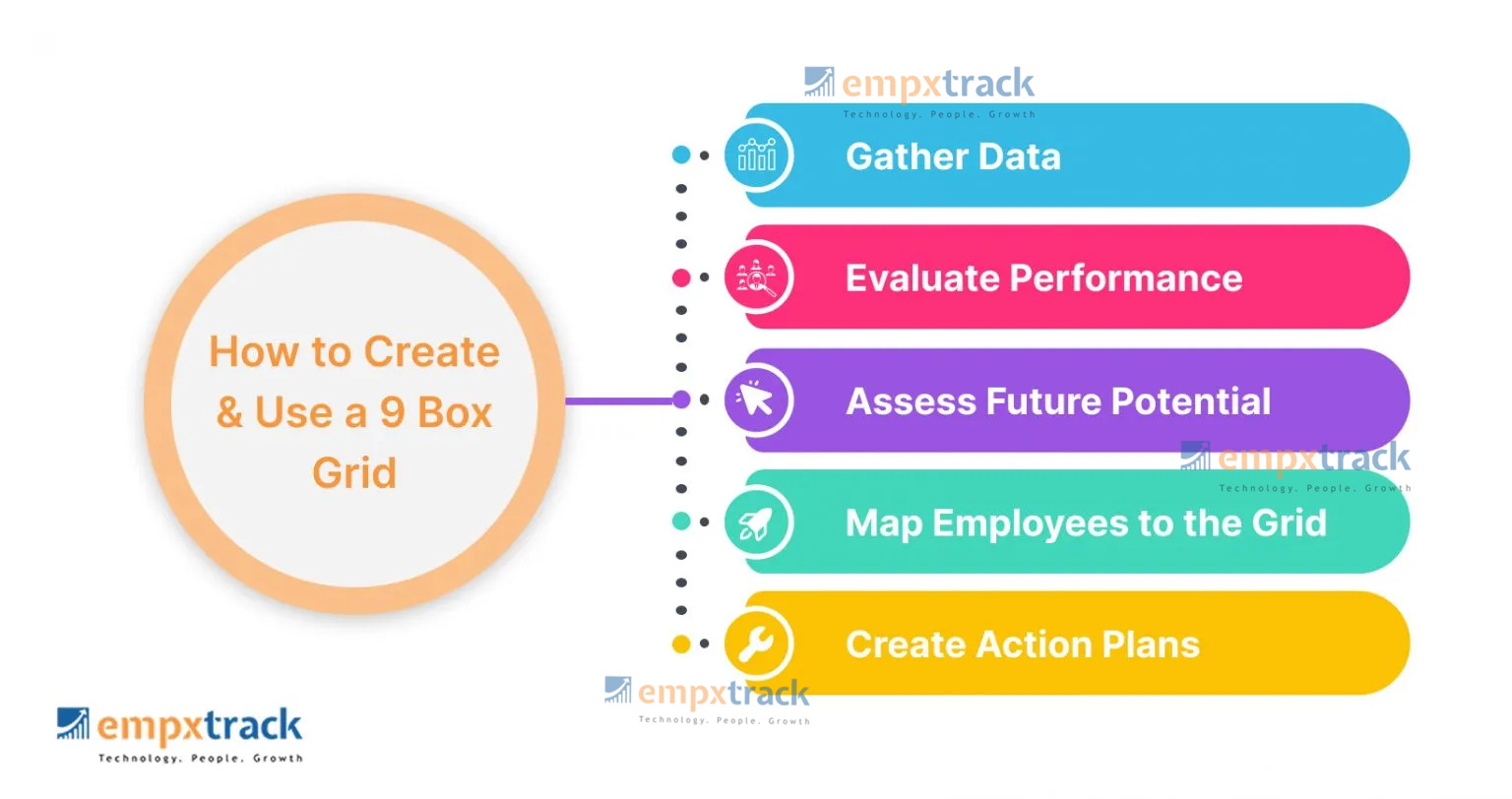
Follow these steps:
Step 1: Gather Data
Commence with performance evaluations, potential assessments, and feedback.
Step 2: Evaluate Performance
Then, assess how effectively employees fulfill their current duties using measurable standards such as KPIs to maintain uniformity. This task is conducted by the employee’s manager and may include a self-assessment.
Step 3: Assess Future Potential
Future potential indicates an employee’s capability to evolve and assume greater responsibilities within the organization. This can be categorized as low, moderate, or high based on attributes such as leadership skills, adaptability, and growth capacity. Standardize this procedure with a 9 box assessment template.
This process is generally undertaken by senior managers, such as department heads and management, as they can better gauge an employee’s potential in current and cross-functional roles.
Step 4: Map Employees to the Grid
Once all employees have been evaluated on both performance and potential, place them in their corresponding grid box.
Step 5: Create Action Plans
After positioning in the grid, implement specific strategies for each category:
Visualizing Talent with a 9 Box Grid Template
A 9-box grid template converts abstract talent concepts into a clear and actionable representation. It facilitates the assessment of performance and potential. Below, we showcase a selection of templates designed to help you optimize the potential of this powerful tool.
Empxtrack’s 9 Box Grid
Empxtrack includes a report that identifies both the current and future potential of your employees. This report updates automatically with real-time performance data, assisting you in making swift and precise decisions. By integrating this built-in tool, Empxtrack streamlines talent management, enhancing employee development and performance evaluation efficiency.
In addition to the 9-box grid, Empxtrack offers a 12-box grid for more in-depth insights into employee performance and potential. This advanced feature enables a detailed assessment of employee capabilities, enhancing talent management with greater accuracy and effectiveness.
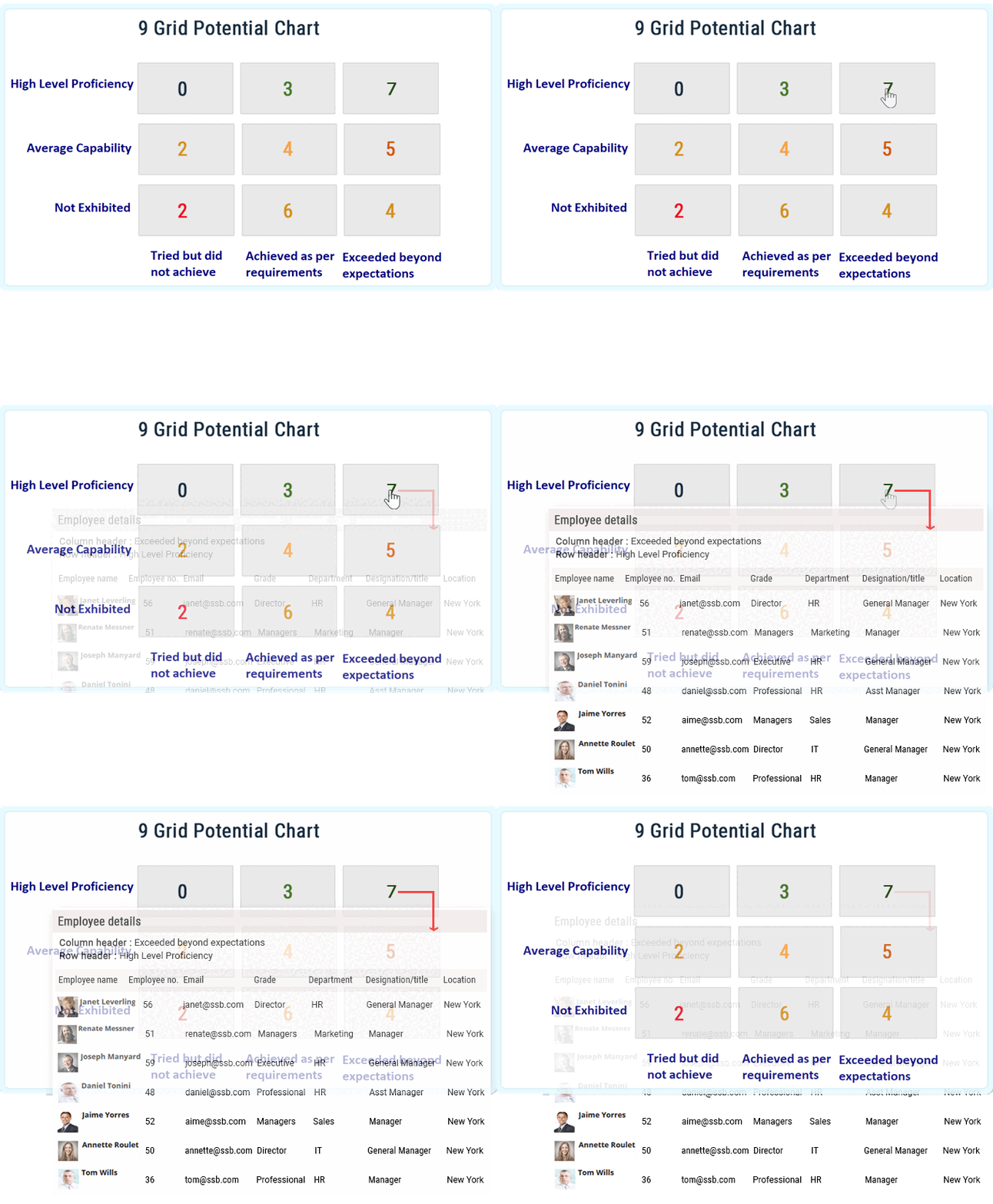
Primary Advantages of Empxtrack’s 9 Box Grid
Empxtrack employs real-time performance metrics for precise, and current insights. Automated updates allow organizations to make quicker, well-informed choices.
Distinct Characteristics consist of:
- Automated reporting featuring real-time employee performance metrics
- User-friendly interface synchronized with other performance management tools
- In-depth reports synchronizing talent management with organizational objectives
Identify High-Potential Individuals (HIPOs)
- » Detect future leaders early in their journeys.
- » Create targeted development plans to cultivate their abilities.
Enhance Employee Retention
- » Acknowledge and reward top achievers to enhance engagement.
- » Establish methods to lower turnover and preserve valuable talent.
Promote Internal Mobility
- » Match employees with positions that suit their strengths, improving job satisfaction.
- » Encourage role congruence to boost organizational efficiency.
Ensure Consistency in Performance
- » Track trends in employee performance to detect areas requiring attention.
- » Offer timely coaching, mentoring, and assistance.
Cultivate a Talent Pipeline for Essential Roles
- » Recognize employees ready for critical positions, thus guaranteeing smooth transitions.
- » Establish a robust pipeline for long-term organizational achievement.
Act on Sudden Performance Variations
- » Tackle performance changes immediately with corrective actions.
- » Assist employees in regaining focus and productivity during difficult periods.
Downloadable 9-Box Grid Template for Personalization
For a practical approach to talent management, the editable 9-box grid free template in Excel provides flexibility to accommodate your organization’s requirements. This complimentary template lets you enter your data, giving you full control over monitoring employee performance and potential.
The template simplifies the task of assessing your team, and it is entirely customizable to align with your needs.
Optimal Approaches for the 9 Box Model
Employ Clear Criteria
Objective metrics are crucial for impartial evaluations. Thus, it’s vital to harmonize performance and potential definitions across teams.
Revise Regularly
As employees develop and roles change, reviewing the 9-box grid periodically keeps the data pertinent.
Encourage Collaboration
Involve various stakeholders in the evaluation process, as diverse viewpoints improve decision-making.
Combine with Succession Planning
Regard the grid as a tool, not the ultimate aim. Utilize it to create a supply of future leaders.
Share Outcomes
Transparency is essential. Therefore, communicate results with employees and emphasize development opportunities.
Tackling Challenges of the 9 Box Grid Model
Like any system, this type of assessment has its drawbacks.
| Obstacle | Resolution |
|---|---|
| Subjectivity Despite attempts, bias can still sway ratings. |
Standardize criteria and involve multiple reviewers. |
| Resistance to Change Some managers may oppose new tools. |
Inform teams about the advantages of the Grid. |
| Action Plan Shortcomings Recognizing issues without solutions can result in frustration. |
Ensure that each box has a corresponding development plan. |
Advancing Beyond the Basics: The Future of the 9 Box Grid
As organizations progress, so does the utility of this type of grid. For example, by integrating AI-driven analytics or merging it with frameworks like the 12-box grid, the opportunities are limitless. Furthermore, its adaptability guarantees the grid remains an essential resource for talent management in an ever-changing business landscape.
Final Thoughts
In conclusion, the 9 box grid is not merely a tool; it’s a strategy. By simplifying talent management, aiding succession planning, and aligning employee development with organizational objectives, it undoubtedly leads to favorable outcomes.
It significantly helps unleash the full potential of your workforce while streamlining talent management and succession planning with clarity and efficiency. Ultimately, the 9 Box Model serves as the groundwork for many talent strategies, making it an indispensable aspect of modern HR practices. Begin today with a 9 box grid excel template.
cost.
Commonly Inquired Questions
Q1. |
What is the 9 Box Grid? |
| Ans. | It is a visual framework utilized to evaluate employees based on their performance and potential. It assists in talent management and succession planning. |
Q2. |
How Do You Employ the 9 Box Grid? |
| Ans. | Supervisors assess employees by conducting performance evaluations and potential appraisals. They then position them on the grid to inform decisions regarding development and succession. |
Q3. |
How Do You Construct a 9 Box Grid in Excel? |
| Ans. | Build a 3×3 table within Excel. Label the axes with “Performance” and “Potential,” categorizing employees accordingly. |
Q4. |
What is the Purpose of the 9 Box Grid? |
| Ans. | This grid is mainly employed for talent evaluation, performance management, succession planning, and strategic decision-making. |
Q5. |
How Does the 9 Box Framework Operate? |
| Ans. | The 9 box model categorizes employees across nine sections based on their performance (ranging from low to high) and potential (from low to high). |
Q6. |
What Does the 9 Box Grid in Talent Management Entail? |
| Ans. | This is a strategic method that utilizes the grid to align workforce talents with organizational objectives. |
Q7. |
What is the 12-Box Grid? |
| Ans. | The 12-box grid serves as an expanded version of the 9-box grid. Furthermore, it offers greater detail by introducing more categories. |
Q8. |
In what Ways is the 12-Box Grid Dissimilar from the 9-Box Grid? |
| Ans. | The 9 box grid emphasizes performance and potential, whereas the 12-box grid delivers more precise distinctions. Thus, it enables organizations to identify specific developmental requirements. |