
Effective interaction transcends the prudent and thoughtful selection of your language. It also includes a thorough comprehension and appreciation of diverse communication methodologies. By recognizing the attributes and roles of a communication approach, we can foster a positive workplace environment where teammates inspire one another towards shared objectives and adapt proficiently to the group’s requirements.

What is Communication Style?
Communication styles refer to the methods people utilize to convey, receive, and interpret information in various contexts. These approaches affect how individuals engage in the workplace, establish connections, and resolve disputes.
The four primary communication styles: assertive, passive, aggressive, and passive-aggressive constitute the cornerstone of most contemporary communication models. Understanding these styles enables professionals to enhance cooperation, avert misunderstandings, and thrive in their careers.
Whether you’re preparing for a job interview, collaborating in a group, or refining your leadership capabilities, understanding how communication styles function can offer you a significant edge.
Why are Communication Styles Important?
Individuals communicating in distinct manners are more inclined to face disputes or miscommunication. It can be simpler to relate with people possessing varied communication styles when we recognize their features and inclinations.
Moreover, aspects such as cultures and contexts may hold different anticipations for communicative methods. Hence, recognizing various communication styles — and showing respect for these — can facilitate more effective interactions.
The 4 Main Communication Styles (Core Framework)
The four communication styles signify the most extensively acknowledged framework in psychology and workplace interaction. Each style reveals how individuals articulate needs, respond to others, and navigate conflicts.
1. Assertive Communication
Assertive communication is an equitable and effective method whereby individuals articulate their thoughts unambiguously while honoring others.
Assertive communicators display confidence without being confrontational. They regard both their own needs and those of others, which makes this style perfect for professional environments.
Examples:
- “I see your perspective, but I’d like to propose an alternative.”
- “Could we review this timeline to ensure quality?”
Key Traits:
- Direct and respectful
- Emotionally perceptive
- Solution-focused
Advantages:
- Fosters trust and collaboration
- Promotes open dialogue
- Enhances workplace relationships
Limitations:
- Demands emotional awareness
- May be uncomfortable for passive individuals
2. Passive Communication
Passive communication sidesteps conflict by repressing personal viewpoints and requirements.
Passive communicators frequently prioritize the needs of others over their own, which can result in long-term discontent.
Examples:
- “Whatever you believe is best.”
- “I’m fine with anything.”
Key Traits:
- Evades confrontation
- Indirect messaging
- Minimal self-assertion
Advantages:
- Preserves short-term harmony
- Mitigates immediate disputes
Limitations:
- Can lead to frustration and burnout
- Decreases visibility and influence
3. Aggressive Communication
Aggressive communication entails expressing thoughts vigorously, often at the cost of others.
This style emphasizes control and dominance, which can harm relationships in professional contexts.
Examples:
- “This is incorrect. Do it my way.”
- “You clearly don’t comprehend.”
Key Traits:
- Commanding tone
- Low empathy
- High control
Advantages:
- Rapid decision-making
- Clear guidance
Limitations:
- Erodes trust
- Creates fear and resistance
4. Passive-Aggressive Communication
Passive-aggressive communication conveys negative emotions in a roundabout manner rather than openly.
This style often appears courteous on the surface but expresses resistance through tone, sarcasm, or behavior.
Examples:
- “Of course, I’ll do it… as I usually do everything.”
- Agreeing verbally but failing to follow up
Key Traits:
- Indirect expression
- Hidden discontent
- Erratic behavior
Advantages:
Limitations:
- Creates ambiguity
- Undermines team trust
Communication Styles Comparison
| Style | Traits | Strengths | Weaknesses |
|---|---|---|---|
| Assertive | Direct, respectful | Fosters trust | Requires confidence |
| Passive | Evades conflict | Maintains peace | Can lead to resentment |
| Aggressive | Dominating | Quick decisions | Undermines relationships | Damages relationships |
| Passive-aggressive | Roundabout | Evades confrontation | Causes misunderstanding |
When to Utilize Each Communication Style
Every communication style has its contextual worth, yet assertiveness stands out as the most effective overall.
- Assertive: Most effective for leadership, collaboration, and decision-making
- Passive: Appropriate for low-stakes situations
- Aggressive: Sometimes beneficial in urgent circumstances
- Passive-aggressive: Typically unproductive

Supplementary Communication Styles in Professional Environments
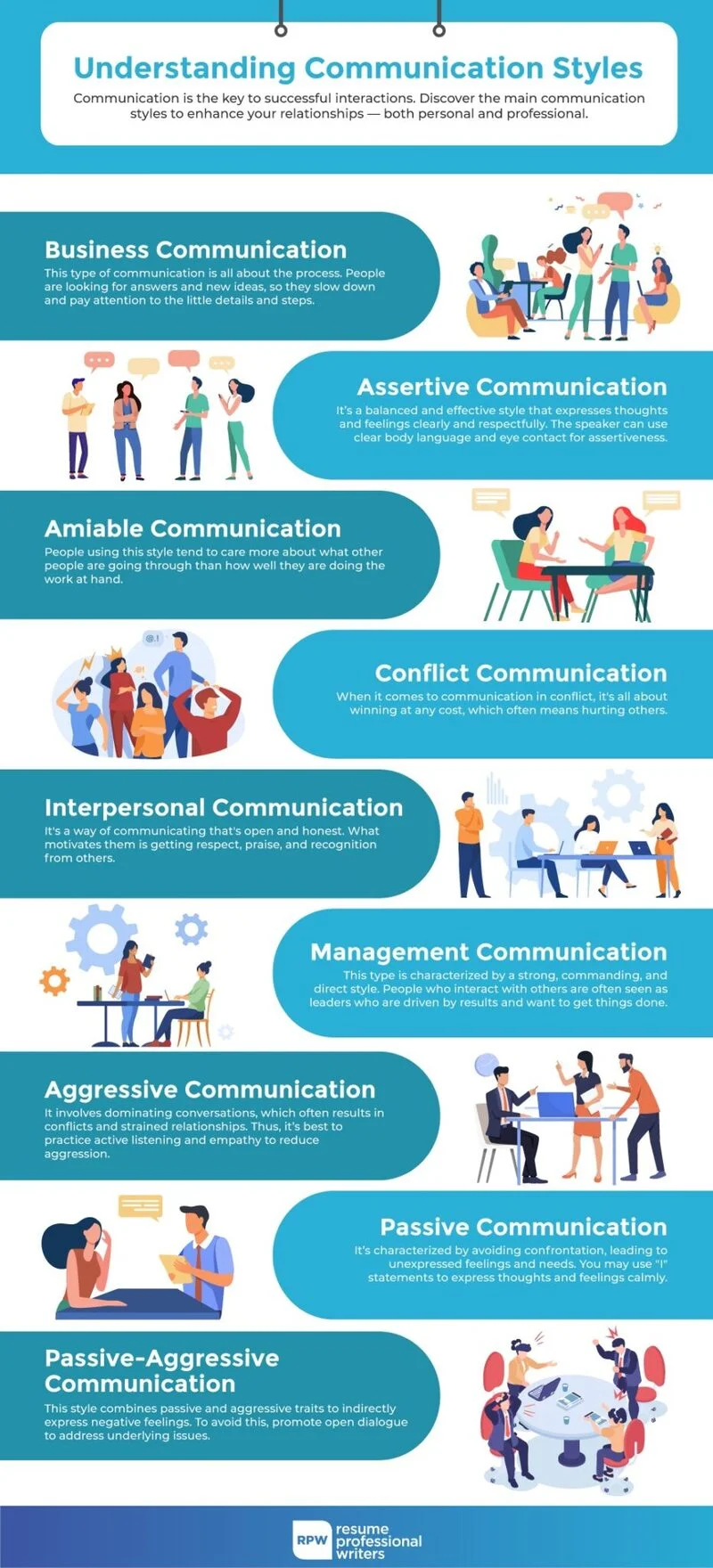
In addition to the four primary styles, your original piece highlights extra types of communication in the workplace. These provide insights into how individuals operate in authentic settings.
Professional Communication Style
This approach is organized and procedure-oriented, concentrating on specifics and precision.
Practitioners of this style emphasize data, workflows, and logical reasoning.
Example:
A project coordinator examines a report methodically, requesting detailed statistics and confirming that every procedure complies with company protocols before giving final approval.
Friendly Communication Style
Amiable communicators prioritize connections and emotional balance.
They appreciate collaboration and generally shun conflict, making them effective team members.
Example:
A team leader reaches out to members individually to confirm everyone feels encouraged before addressing project timelines.
Conflict-Centric Communication Style
This style revolves around winning arguments, frequently at the expense of relationships.
While it may yield results in competitive settings, it can induce stress.
Example:
In a meeting, a participant asserts their strategy is correct and disregards others' contributions without discussion.
Interpersonal Communication Approach
This style highlights connection, encouragement, and drive.
It proves to be highly effective in collaborative and supportive workplace cultures.
Example:
A manager acknowledges an employee’s advancements, provides constructive criticism, and inspires them to pursue further improvement.
Leadership Communication Style
Managers who communicate effectively are straightforward, organized, and results-focused.
They often lead teams and emphasize action over dialogue.
Example:
A department head sets clear objectives, delegates tasks with timeframes, and anticipates regular updates on progress from the team.
For easy access to this information, feel free to download the infographic below:
Communication Approaches in the Workplace
Communication styles have a direct impact on efficiency, collaboration, and leadership. Your original framework outlines four types of workplace communication:
Analytical Communicator
Analytical communicators depend on data and reasoning, focusing on facts instead of subjective viewpoints.
Functional Communicator
Functional communicators favor organization and sequential processes.
Intuitive Communicator
Intuitive communicators concentrate on overarching ideas and consequences.
Personal Communicator
Personal communicators emphasize connections and emotional engagement.
Frequent Communication Errors to Evade
Numerous professionals face challenges in communication due to preventable errors.
1. Evading tough conversations
This results in passive communication and persistent issues.
2. Overpowering discussions
Aggressive communication diminishes collaboration.
3. Being vague or roundabout
Passive-aggressive communication leads to misunderstandings.
4. Overlooking emotional context
Efficient communication necessitates emotional awareness.
Ways to Enhance Your Communication Style
Enhancing communication necessitates mindfulness and practice.
Step 1: Recognize your default style
Monitor how you react during conflicts or discussions.
Step 2: Cultivate assertiveness
Concentrate on conveying…
articulate ideas distinctly and courteously.
Step 3: Enhance active listening
Listen to comprehend, not merely to reply.
Step 4: Regulate emotions
Manage tone, body posture, and responses.
Communication Skills for Resume and Career Success
Communication abilities rank among the most sought-after skills in the workplace.
Instances of communication skills:
- Oral communication
- Written communication
- Active listening
- Presentation abilities
Resume illustrations:
- “Collaborated efficiently with cross-departmental teams”
- “Presented clear information to stakeholders”
- “Exhibited strong interpersonal communication abilities”
Frequently Asked Questions
1. What are the four communication styles?
The primary communication styles are assertive, passive, aggressive, and passive-aggressive.
2. Which communication style is the most effective?
Assertive communication is the most proficient in professional environments.
3. Why do communication styles matter?
They influence relationships, collaboration, and professional achievements.
4. How can I enhance my communication skills?
Focus on clarity, active listening, and emotional intelligence.
5. What are instances of communication styles?
Instances of communication styles include assertive communication, passive communication, aggressive communication, and passive-aggressive communication. Each style illustrates how individuals convey thoughts and react to others.
6. Which communication style is the most effective?
Assertive communication is deemed the most effective style as it harmonizes confidence with respect, enabling individuals to convey ideas clearly without undermining others.
7. How do communication styles impact teamwork?
Communication styles influence teamwork by shaping how individuals exchange ideas, solve disputes, and cooperate. Assertive communication fosters teamwork, while passive or aggressive styles can lead to confusion.

Enhance Your Interview Responses with Professional Resume Writers
Every individual possesses a distinct communication style, making it crucial to accurately identify and comprehend. Adapting successfully to each style will better prepare you for professional engagements.
This raises the question: how do we implement the appropriate communication skills during our scheduled job interviews? You might be a candidate eager to elevate your career. In any case, effective communication tactics and styles are indispensable. Resume Professional Writers’ career development specialists can enhance your interview responses with their industry knowledge and exceptional opening statements in job interviews. With this job search resource, you can capture the interviewer’s interest right from the start! Inquire now.