What is the distinction between internal and external job titles? It varies depending on whom you consult.
Some organizations utilize identical internal titles for their external job advertisements. Other firms maintain two separate versions—one for internal job descriptions and another for external listings. Regardless, the job titles you select influence who discovers your positions online (and applies to them).
Let’s explore further.
What is the distinction between internal and external job titles?
Internal job titles are linked to compensation tiers, job codes, or requisition ID numbers. Your HR department likely employs internal titles to monitor various levels within the same position. Internal job titles form part of an internal job description that details an employee’s regular responsibilities.
External job titles are utilized outwardly for job advertisements to promote roles on career sites and job boards. They are more suited for SEO and tend to perform better when kept concise (1 to 3 words and under 20 characters). External titles (post-hire) may also differ from the title on the job listing you applied to.
3 instances of internal versus external job titles
There are various scenarios for employing internal versus external job titles. Here are 3 instances:
For example, your Finance department might possess several internal titles for one position, such as:
- AP Assistant I
- AP Assistant II
- AP Assistant III
- AP Assistant IV
- and so forth
These variations of the internal title each come with their own job code and likely differ in requirements, responsibilities, and salary scales.
Some hiring supervisors may copy and paste those titles into their job listings, while others might opt for the external title “AP Assistant” in their advertisements (omitting “I, II, III, IV, etc.”) for simplicity (and better searchability).
Job hunters are likely not searching for “AP Assistant IV” on Indeed or LinkedIn. Therefore, in this scenario, I suggest removing the “IV” and using the external title “AP Assistant.” This will enhance your visibility in job board searches and make it easier for more candidates to locate your listings (and apply).
Another illustration:
Some companies get imaginative with their job titles, which can be entertaining. However, it doesn’t always lead to increased applications. Here are some internal titles that job seekers aren’t likely searching for (even if they sound appealing):
- Colon Lover — “Colon Lover jobs” receives zero searches per month on Google. “Copywriter jobs” receives 3,100.
- Sales Rockstar — “Sales Rockstar jobs” receives zero searches per month on Google. “Sales Representative jobs” receives 3,900.
- Happiness Hero — “Happiness Hero jobs” receives zero searches per month on Google. “Customer Service Representative jobs” receives 2,200.
In this scenario, keep the humorous and creative titles like “Chief Geek” (CTO) and “Money Maestro” (Accounting Manager) for internal purposes once a person is hired. However, use the “search-optimized” external titles to gain more visibility for your postings.
And here’s one more instance of internal versus external job titles:
In software roles, sometimes the more elaborate (specific) external job titles aid candidates in comprehending what they’re applying for. In this instance, the internal titles frequently align with the external titles.
For instance, numerous companies utilize “Junior Python Developer,” “Senior SQL Developer,” or “Java Developer” for both internal and external job titles, rather than just “Developer.”
Since many different varieties of “Developers” exist, you’ll want to specify your external postings, and you can align your job codes/compensation details with these internal titles as well.
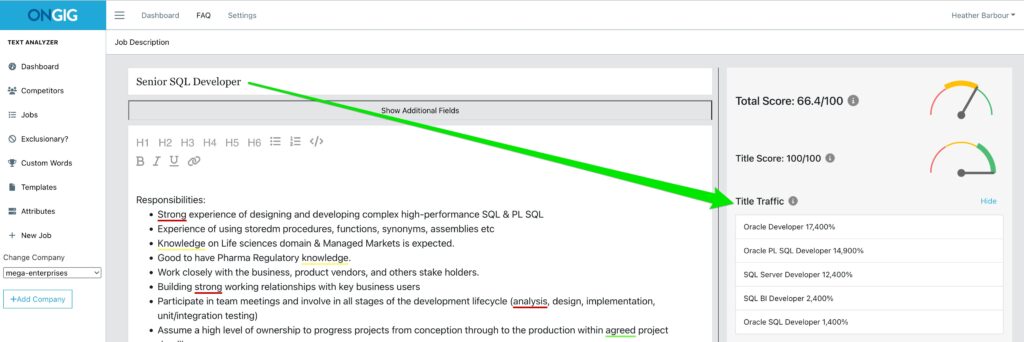
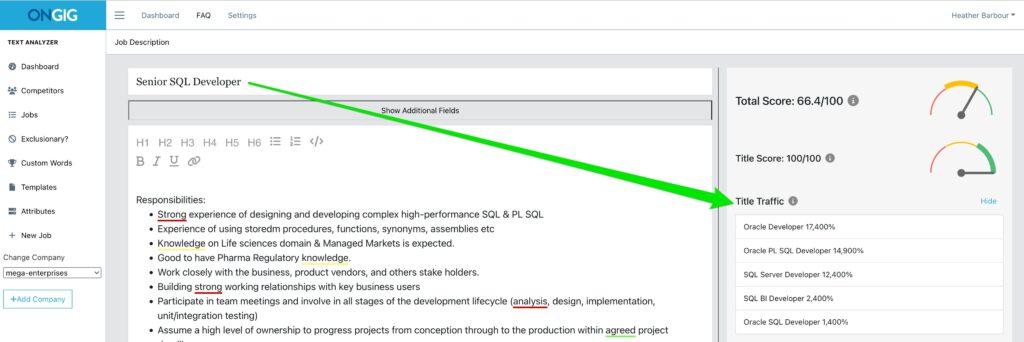
Thus, if you do decide to alter your external titles, Ongig’s title traffic feature provides suggestions based on titles candidates search for on Google:
Moreover, if you need additional job title inspiration, Job Titles: The Definitive Guide encompasses best practices on job titles, including lists of titles categorized by hierarchy and departments. Note: These are incorporated into Ongig’s Text Analyzer software.
The Impact of Job Titles on Your Career Advancement
Understanding how job titles, whether internal or external, can influence your career is crucial. Let’s examine how these titles shape your professional journey, create opportunities for advancement, and facilitate your growth.
Initially, the job titles you hold within an organization are significant. They indicate your standing in the company, whether you are just beginning your career or occupy a higher role. Thus, progressing from simpler jobs to more prominent ones, these titles guide the direction of your career. As you advance, the responsibilities and skills required for your job title typically evolve, which also impacts how you learn and improve in your role.
However, it’s also essential to consider job titles outside your organization. They hold considerable importance in the broader job market. Various industries and organizations may refer to similar jobs by different names. Therefore, being aware of these titles outside your workplace assists individuals in identifying the right opportunities for career advancement.
Why I composed this:
Ongig’s mission is to develop effective and inclusive job descriptions. Assisting you in deciding when to use internal versus external job titles to attract exceptional talent (and garner more applications) is part of that mission. If you wish to learn more about Ongig’s software, please request a demonstration.