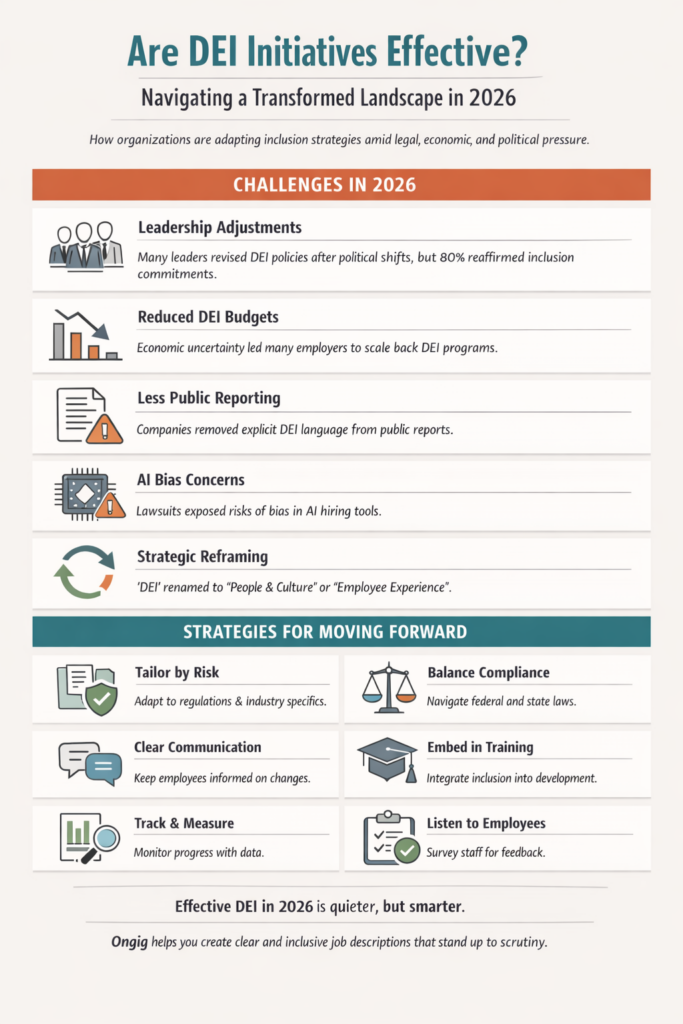
Federal executive mandates in early 2025 eliminated agency-level diversity schemes and compelled private organizations to justify their hiring protocols. In spite of legal pressures, entities did not forgo their inclusion initiatives. Instead, they transitioned these schemes away from HR rhetoric and incorporated them into fundamental operations.
Leaders are now swapping extensive public commitments for precise, internal metrics. They are emphasizing the operational aspects of equity, such as broadening the talent pool via skills-focused recruitment, while employing more subdued, deliberate terminology in their external job advertisements.
1. Executive Support for DEI Programs
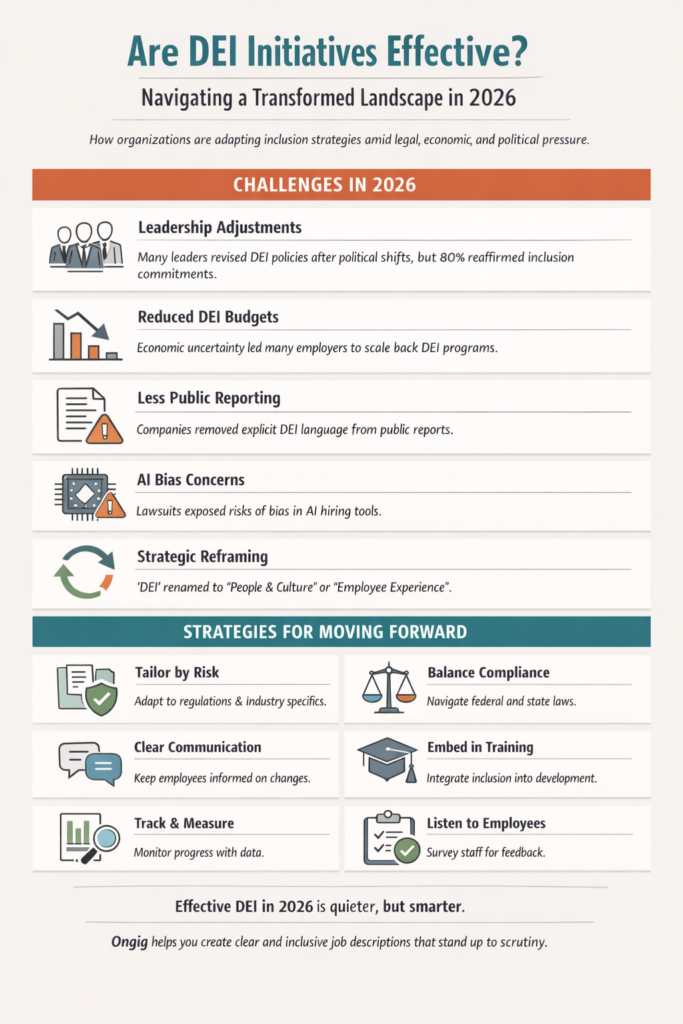
According to Gravity Research, 40 organizations publicly announced DEI adaptations following the inauguration. Many altered their DEI frameworks promptly after President Trump reassumed office, although 80% reiterated ongoing dedication to inclusion, belonging, or accessibility in public declarations.
An examination of 1,000 corporate filings from January 2023 to May 2025 uncovers a notable decrease in the term “DEI.” Companies are replacing divisive labels with neutral, business-oriented language to shield their internal initiatives from external legal or political scrutiny. This transformation allows leadership to maintain emphasis on retention and productivity metrics without inviting the examination that now accompanies specific diversity-related terms.
2. Decreased Financial Allocations for DEI Programs
In 2025, numerous employers began retracting from overtly visible diversity, equity, and inclusion (DEI) programs. A blend of economic instability and financial hardships has led diversity initiatives at organizations – often perceived as a “nice to have” rather than a “necessity” – to be the first to be eliminated:
In early 2025, Google eliminated its aspirational hiring targets for underrepresented groups to conform with a changing legal and political environment. The company restructured its internal divisions, reducing DEI-oriented personnel and excluding specific diversity goals from its annual reports. Internal mandates now instruct teams to swap terms like “inclusion” with broader terminology, such as “build for all.” To further diminish risk, Google stopped observing cultural events, such as Pride and Black History Month, on company calendars. These actions represent a shift towards “risk mitigation” and operational efficiency over race-focused initiatives.
Meta
Meta terminated its dedicated DEI division in January 2025, reassigning its Chief Diversity Officer to focus on accessibility and engagement. The organization halted programs aimed at recruiting underrepresented candidates and curtailed its supplier diversity initiatives to avoid legally “sensitive” areas. This shift replaces demographic-specific objectives with neutral, consistent hiring practices aimed at reducing bias for all employees regardless of background.
3. Clarity in Reporting
Harvard Law School Forum indicated that organizations are altering the way they address DEI. Numerous firms have eliminated or reduced explicit DEI terminology in public reports as legal and litigation threats climbed. While boards have largely ceased disclosing specific gender and race statistics publicly, evidence implies that many entities are embedding these objectives within internal governance and oversight frameworks.
Reports concerning workforce demographics and executive compensation incentives also saw a sharp decline. Companies are steering away from public quotas. Instead, they are reframing these initiatives as “talent development” or “employee engagement” to protect internal priorities from external critique. This transition signifies a shift from visible, demographic-focused pledges to controlled, data-driven human capital management.
4. Monitoring for Algorithmic Bias
As many as 98.4% of Fortune 500 firms employ AI-driven recruitment tools in their hiring practices. However, several lawsuits were instigated due to AI biases in hiring. In July 2024, a federal judge determined that AI vendors could be held liable for discrimination, not merely the employers utilizing their tools. The groundbreaking Mobley v. Workday case achieved class certification, potentially encompassing millions of applicants.
While EEOC guidance on AI recruitment was rescinded when President Trump took office in January 2025, anti-discrimination laws remain unchanged. Presently, except for particular jurisdictions like New York City, there is no uniform federal requirement for regulatory or independent audits of AI hiring systems.
5. DEI Undergoes Strategic Rebranding
S&P 500 corporations eliminated the acronym “DEI” from their filings by 68% this year, but this represents not a withdrawal—it is a strategic rebranding. Organizations are extracting explicit labels and renaming divisions to “People & Culture” or “Employee Experience” to evade being caught in the crossfire of current cultural conflicts. By adopting neutral expressions like “opportunity strategy,” leaders embed diversity efforts into core operations, where they are less vulnerable to targeting.
Per a report from the Harvard Law School Forum on Corporate Governance, this transformation directly responds to a dual-edged legal risk: while new executive orders from the Trump administration instruct federal agencies to identify “egregious and discriminatory” programs and recommend possible litigation against publicly traded corporations, eliminating these initiatives entirely creates another set of dangers. As noted in a fact sheet by the Leadership Conference on Civil and Human Rights, organizations that retract these efforts risk breaching existing anti-discrimination laws if unfair employment barriers persist.
This dual pressure clarifies why board oversight of these programs increased from 48.4% to 86.8% among Russell 3000 firms. While public discourse is being utilized to “lessen risk,” internal governance is tightening to navigate a climate in which the administration has nullified long-standing requirements for federal contractors to undertake affirmative action. Entities are no longer considering diversity a public relations undertaking but as a critical risk-management function that mandates board-level compliance for survival.
Confronting the Pushback
Thus, despite this recent resurgence in DEI efforts, how can HR and DEI leaders reinvigorate their DEI dedication and tackle the backlash?
Let’s explore some strategies:
- Customized diversity, equity, and inclusion initiatives. Organizations now must take into account their regulatory landscape, status as federal contractors, industry exposure, and state-level protections. In an interview with HR Dive, Noreen Farrell, executive director of Equal Rights Advocates, emphasized that enduring
- National regulations ought to inform HR’s workplace policies. Grounding inclusion initiatives in national law safeguards them against legal disputes. Laws such as the Civil Rights Act, the Equal Pay Act, and the Americans with Disabilities Act create the minimum standard for equitable employment. Entities that synchronize their approaches with these foundational civil rights statutes develop a more defensible stance against fluctuating executive mandates.
- To maintain operations, firms must consult legal counsel to balance adherence between new federal mandates and state regulations. If a corporation operates across multiple states, it cannot apply a uniform policy for all. Engaging a legal professional aids leaders in navigating this combination of laws to avoid litigation at the state level. By concentrating on the legal requirements specific to each state, companies can sustain their programs while evading legal complications.
- Be open with staff about how your organization is modifying its DEI strategy in light of the present legal and political landscape. Frequent internal communications should clarify why terminology is changing (legal safeguards), what remains constant (core principles and programs), and how employees can continue engaging with and deriving benefits from these initiatives under their revamped operational structures.
- Continue educating your team on inclusion, but refrain from using “DEI” as an isolated term. Instead, integrate these teachings into your current professional growth programs. For instance, introduce unconscious bias as a component of “effective recruitment” and frame inclusive leadership as “developing high-performing teams.” You might also consider renaming Employee Resource Groups (ERGs) to “employee engagement communities” to keep them vibrant without making them a target.
- Collect information on your present diversity, equity, and inclusion status to create a baseline and monitor progress over time. Evaluate metrics in your hiring procedures, promotional practices, or employee engagement across various demographic groups. This information can direct focused interventions and resource distribution for maximum effect.
- Regularly conduct DEI employee surveys. Inquire whether employees are content with the company’s diversity initiatives and if there is room for enhancement. Your staff’s feedback will inform your efforts to request additional resources or abolish ineffective practices.
Why I authored this:
By 2026, the efficacy of inclusion efforts will be evaluated by outcomes instead of public commitments. Organizations are ensuring their practices can endure legal scrutiny by emphasizing data and adherence.
For HR executives, implementation now surpasses messaging in importance. To establish a system that withstands examination, you must utilize precise job terminology and concentrate on quantifiable hiring results. Ongig aids this transition by assisting you in crafting superior job descriptions and eliminating biased terms. This guarantees your recruiting efforts remain effective, scalable, and legally sound in the existing landscape. Reach out to schedule a demo.
Acknowledgments:
- 5 Insights That Shaped DEI in 2025 — And What to Anticipate in 2026 (by Gravitas Research)
- Google discontinues its DEI-focused hiring objectives; Here’s the reason (People Matters)
- Meta terminates DEI programs (TechCrunch)
- AI Hiring Bias: Actual Instances, Legal Ramifications, and Prevention (by Responsible AI Labs)
- President Trump Takes Steps to Reverse DEI Initiatives (by Harvard Law School Forum on Corporate Governance)
- 2026’s DEI emphasis? Rendering talent programs resilient to scrutiny (by HR Dive)