
What are some sought-after positions that don’t necessitate background checks?
Concise response: Fields that frequently forego formal background checks include food service and hospitality, gig-economy delivery (DoorDash, Uber Eats, Instacart), construction and skilled trades, personal services (cleaning, lawn maintenance), freelance creative endeavors, and certain warehouse and light manufacturing roles. Even within these industries, identity verification is commonplace. Apart from no-check jobs, ban-the-box regulations, along with EEOC guidelines now safeguard applicants with records in over 35 states and more than 150 cities.
Positions that don’t require background checks are present but are less common than search results indicate — and the right context is more crucial than the list itself. The majority of U.S. employers conduct some form of pre-employment assessment, even if they don’t label it as a formal “background check.” The fundamental query for most individuals isn’t “where can I work to completely avoid checks?” — it’s “where do I have the optimal chance of getting hired if I possess a record, a gap in my work history, or a credit concern I’d prefer not to discuss?”
This article explores the 2026 landscape of background checks, the sectors that truly bypass formal checks, the legal safeguards available for applicants, and how to present yourself when a check is unavoidable.

Reasons Some Jobs Don’t Mandate Background Checks (and Reasons Many Do)
Even in 2026, numerous jobs that forgo background checks are prevalent in service, gig, and creative industries. Employers often bypass formal screenings for three pragmatic reasons:
•Expenses and Timelines
A typical pre-employment background check costs between $20 and $80 per candidate and usually takes 3 to 7 business days. For positions with high turnover and slim margins per hire (food service, hospitality, gig delivery), the return on investment does not warrant the expenditure.
•Urgency in Hiring
When a kitchen requires a chef the next day, the manager isn’t going to wait a week for a check. The position gets filled immediately, frequently with a shorter probation period instead.
•Legal and Compliance Liability
Some employers have discovered that conducting checks they cannot justify exposes them to claims under the Fair Credit Reporting Act and state ban-the-box regulations. For roles and sectors where jobs generally do not require background checks, omitting the check can sometimes be the safer option—mitigating legal risk while still focusing on capabilities, references, and immediate job compatibility.
Reasons many jobs DO necessitate checks:
•Industry Oversight
Healthcare, education, finance, transportation, and government positions nearly always require checks — at times mandated by federal law.
•Insurance Mandates
Employers maintaining liability or fidelity insurance often must verify clean records as a prerequisite for coverage.
•Trust-Based or Fiduciary Positions
Positions managing finances, customer data, or vulnerable communities have standard screening prerequisites.
What “No Background Check” Actually Signifies in 2026
Be cautious with language. Most U.S. employers conduct at least one of these even when they promote “no background check required”:
- Identity authentication (Form I-9 — federally mandated for all employers)
- E-Verify (compulsory in some states; optional in others)
- Reference evaluations (informal, not a formal “background check”)
- Substance testing (distinct from a criminal record assessment)
- Driving record assessment (for any position involving driving)
The term “no background check” frequently indicates “no formal criminal history assessment.” It seldom implies no verification of any kind. Even in roles that do not necessitate background checks, employers may still confirm identity, references, or essential qualifications. Properly setting that expectation helps applicants avoid surprises during onboarding.
Sectors Where Formal Background Checks Are Truly Less Frequent
The subsequent sectors hire extensively while employing reduced or bypassed formal checks. Many of these positions fall within jobs that don’t require background checks, where employers lean more on identity verification, references, or skills demonstration. Volume and salaries differ; we reference BLS Industries at a Glance data for leisure and hospitality and the associated industry pages for the latest national statistics.
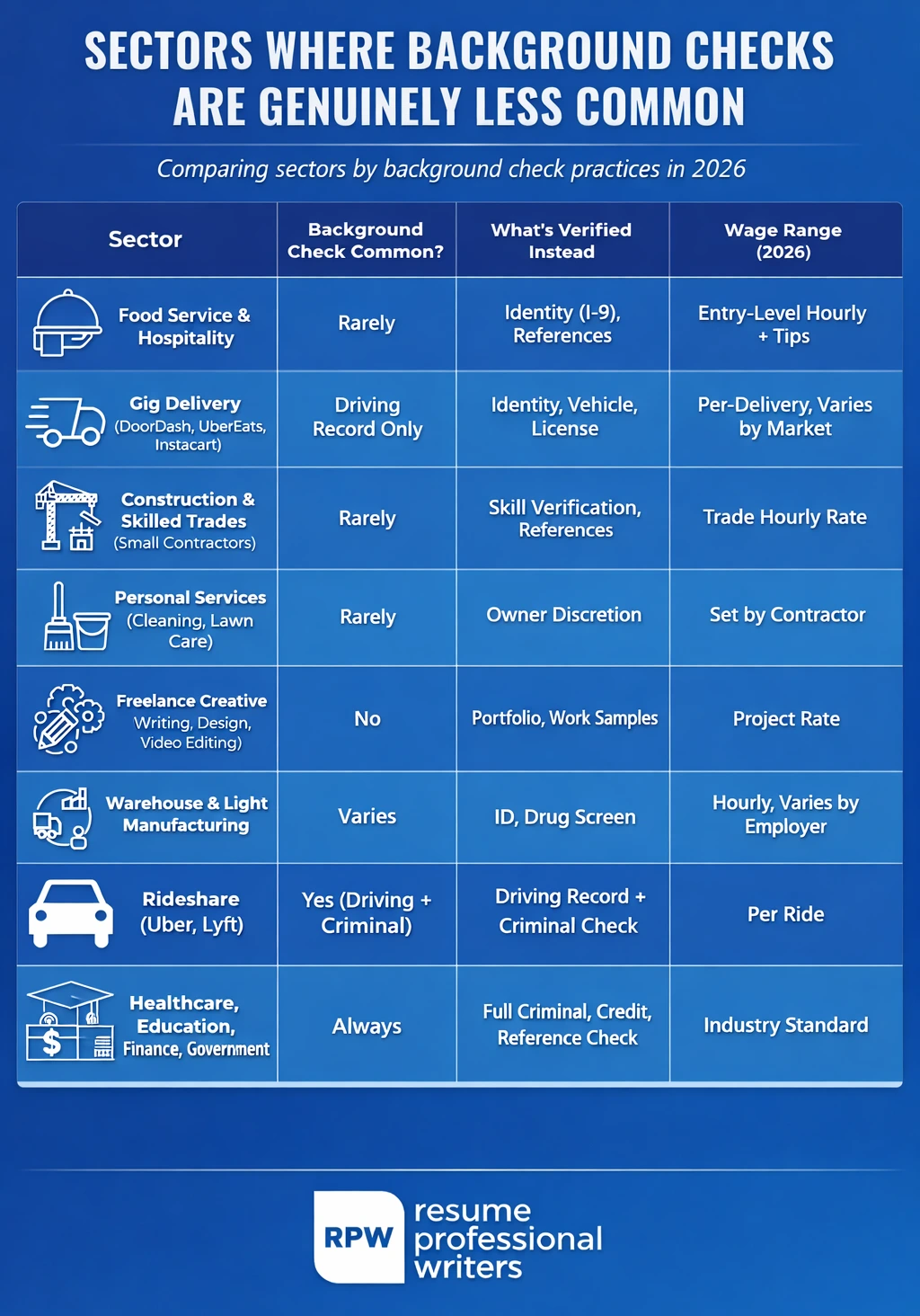
Food Service and Hospitality
Servers, line cooks, bartenders, hosts, dishwashers, and cashiers. Elevated turnover and shift-oriented hiring render formal checks infrequent. Identity verification is essential; criminal record assessments generally are not.
Gig Delivery and Rideshare Operations
DoorDash,
Uber Eats, Instacart, Amazon Flex, and GrubHub. These services conduct their own internal evaluations (driving history, identity), but the majority of roles do not necessitate background examinations since workers are regarded as independent contractors. Note: rideshare driving (Uber, Lyft) does necessitate a driving history and a criminal examination on most platforms, even though it’s also gig employment.
Construction and Skilled Trades
Construction workers, framers, painters, drywall installers, and landscapers typically fall within the category of positions that do not demand background checks. Numerous small contractors recruit through referrals and bypass formal verifications. Larger commercial projects and unionized roles frequently require checks.
Personal Services
Housekeeping, lawn maintenance, in-home pet care, and personal organizing. Independent contractor and small business endeavors where the decision to hire is solely the owner’s responsibility.
Freelance Writing, Design, and Digital Content
Most freelance assignments — copywriting, graphic design, video editing, podcast production — typically do not entail any formal vetting. Clients assess work samples rather than backgrounds.
Warehouse and Light Manufacturing (Varies)
Certain warehouse and light-industrial employers have transitioned to a simplified hiring structure and forgo formal background checks. Larger firms and Amazon distribution centers generally still perform checks. Confirm with each employer.
What the Law Actually States (Fair Opportunity Hiring)

If you possess a record, you have greater legal protection in 2026 than many applicants recognize. Individuals pursuing jobs that do not require background checks—or positions where checks are limited—also have enhanced protections against unjust rejection than ever before.
Ban-the-box regulations prevent employers in respective jurisdictions from inquiring about criminal history on the initial job application. More than 37 U.S. states and over 150 cities or counties currently have some variation of these regulations. For individuals seeking jobs that do not require background checks, this legal framework helps to provide fair access to opportunities without earlier disqualification. The U.S. EEOC also enforces guidelines on the use of arrest and conviction records. Employers are obligated to consider the nature of the offense, the time elapsed, and job relevance before disqualifying an applicant.
The Fair Credit Reporting Act (FCRA) regulates how employers conduct and utilize background-check information. Employers must:
- Obtain your written consent prior to performing a check.
- Supply a copy of the report and a “summary of rights” if they contemplate an adverse action.
- Allow you a chance to challenge inaccuracies before making a final rejection.
Should an employer overlook these measures—even for positions that do not require background checks—they are infringing upon federal law. In such instances, you possess the right to lodge a complaint with the Federal Trade Commission (FTC) or pursue legal recourse to safeguard your employment rights.
What to Do If a Background Check Will Be Challenging to Pass
Three effective strategies:
1. Disclose proactively, in writing, following the offer but prior to the check.
Don’t lead with it; don’t conceal it. Present it factually: what occurred, how long ago, what you’ve done since. Hiring managers tend to respond more favorably to straightforward disclosures than to surprises during the process.
2. Obtain the records yourself first.
Request your own background-check report (Checkr, Sterling, and several state agencies provide this directly to consumers). Inaccurate records are common; you have time to contest them before an employer retrieves a report.
3. Cultivate references that can attest to current behavior.
Two professional references who’ve collaborated with you in the past year and can attest to your dependability are more valuable than any formal examination. Include them in your application materials and relate your story upfront.
How to Position Your Resume for No-Check or Fair-Chance Positions

The resume itself does not need to reference background-check history; it should primarily showcase what you offer. Three principles:
1. Emphasize skills and recent accomplishments.
A skills section positioned near the top featuring concrete achievements (tools, certifications, measurable results) redirects the recruiter’s focus from history to capability. If your work experience is limited—your first job, returning after a lengthy hiatus, or transitioning from informal to formal employment—our guide on creating a resume without previous work experience covers what to include in place of traditional…
experience section.
2. Incorporate any relevant certifications or training.
Forklift, CDL, ServSafe, OSHA, CPR, food-handler certifications — anything that indicates you’ve engaged in professional development recently. These serve as more compelling indicators than a spotless record since they are future-oriented.
3. Utilize professional references wisely.
A reference sheet featuring two or three current supervisors or colleagues, including phone numbers and express consent, fulfills the “screen for trust” role typically served by a background check.
Our industry-specific keyword lists outline the certifications and skills that recruiters search for in various sectors. Moreover, if you’re crafting a cover letter to accompany your resume, our guide on composing a cover letter from scratch outlines the structure that is most likely to secure an interview.
The principle of emphasizing pertinent work experience applies regardless of whether your professional history is inconsistent — whatever you’ve accomplished that aligns with the desired role should be prominently displayed, with ample detail. Some of the most formidable fair-chance candidates rely heavily on transferable skills like administrative experience, which spans many of the no-check sectors mentioned above.

The Expanding Second-Chance Hiring Movement
An increasing number of U.S. employers have openly pledged to fair-chance hiring. HR Dive’s coverage of Jobs for the Future’s acquisition of the Dave’s Killer Bread second-chance hiring initiative illustrates how mainstream the movement has become — Dave’s Killer Bread, Greyston Bakery, and an extensive network of over 34 enterprises that have completed the Second Chance Corporate Cohort training, including Dick’s Sporting Goods, General Motors, Union Pacific Railroad, Cisco, Koch Industries, and Gap.
These companies actively seek candidates with records and have established screening processes that take into account the nature of the offense and the time since it occurred, instead of outright denying based on a record. If a record is your worry, specifically target this group rather than confining yourself to no-check sectors.
Frequent Errors Made by Job Seekers
1. Misrepresenting or omitting information on the application.
A check will eventually reveal it, and the disqualifying factor will be the deception, not the record. Provide what is necessary, when it is required.
2. Declining the background check.
If an employer states that they will conduct a check and you refuse, the application will be discarded. Participate in the process; don’t resist it.
3. Focusing solely on “no-check” jobs without exploring fair-chance employers.
Many excellent employers will hire you despite a record. Limiting yourself to no-check sectors restricts your access to higher-paying opportunities.
4. Not obtaining your own records beforehand.
You can ascertain exactly what an employer will observe — it prevents any unexpected surprises.

Receive Assistance in Revising Your Resume for Fair-Chance Hiring
If you’ve been applying for months without receiving callbacks, your resume is likely causing more harm than the screening process. A second opinion from someone who reviews resumes full-time can quickly identify the gaps — layout issues that disrupt ATS parsing, absent keywords for your target sector, sections that emphasize gaps you’d prefer to downplay.
Should you wish for our team to revise your resume, we will assess your current document and let you know precisely where it is failing to secure interviews. No pressure, no obligation — and we assist applicants from every professional background. (If you’re contemplating the decision, our analysis on whether resume writing services are worthwhile discusses cost, ROI, and the red flags of services that over-promise.)
For additional job-search strategies across various pillars, our career library contains guides for cover letters, interview preparation, and salary negotiation.
Commonly Asked Questions
Which jobs don’t necessitate background checks in 2026?
Most roles in food service, hospitality, gig delivery (DoorDash, Instacart, Uber Eats), construction, freelance/creative fields, and small business personal services typically do not involve formal background checks. Nevertheless, all U.S. employers must validate your identity and work eligibility (Form I-9), and many conduct drug tests, reference verifications, or driving record checks even when they do not apply a formal criminal background check.
Are employers permitted to bypass background checks legally?
Yes, in the majority of instances. Background checks are not mandated at the federal level for most positions. Certain industries (healthcare, education, finance, transport, government, childcare) have legal or regulatory obligations that require these checks. For other fields, opting out of a check is a choice the employer can freely make, provided they do not exhibit discrimination in deciding when to conduct one.
What is ban-the-box, and is it relevant to private employers?
Ban-the-box regulations prevent employers from inquiring about criminal records on the initial job application — the aim is to postpone the revelation until later in the hiring process to ensure candidates receive a fair chance. More than 35 U.S. states and over 150 cities have established some form of these rules. The scope differs — some are applicable solely to public-sector recruitment, whereas others pertain to private employers above a specified size.
Can a background check uncover dismissed or expunged charges?
Typically no, provided the expungement was executed properly. A charge that has been dismissed but not expunged may still show up in certain reports. Mistakes are frequent, so it’s wise to obtain your own background-check report (Checkr, Sterling, your state attorney general’s office) to understand precisely what employers will access — and contest inaccuracies before an employer requests a report.
Where can I locate fair-chance employers?
Seek out employers that have publicly endorsed the Fair Chance Pledge, large businesses with defined second-chance hiring initiatives (Target, Starbucks, Dave’s Killer Bread, Greyston, JPMorgan Chase, Microsoft), and local nonprofits collaborating with fair-chance hiring programs. Search for “fair chance hiring [your city]” or consult your state’s reentry workforce-development office for an active employer listing.