
What aspects does a security officer’s job description encompass today?
Concise Response: A security officer safeguards individuals, property, and resources at a designated site. Primary responsibilities include overseeing the premises, managing CCTV systems, regulating access at entrances, reacting to alarms, and recording incidents in reports. Most states mandate a security guard license, and a number of employers favor CPR/First Aid qualifications. Median yearly salaries hover in the high-$30,000s, with armed and healthcare/corporate personnel at the upper end of the spectrum.
A security officer job description goes beyond a mere list of responsibilities — it serves as a framework for the protection of individuals, assets, and reputation. From observing CCTV footage and enforcing access restrictions to reacting to alarms and recording events, this position necessitates alertness and flexibility. The context may vary: hospitals prioritize patient safety, retail outlets emphasize theft prevention, and corporate environments focus on confidentiality.
This article examines sector-specific variations, the abilities that employers highly regard, tips on creating a resume that navigates applicant tracking systems, and what the 2026 job market indicates for individuals entering or progressing in this profession.

Core Duties and Responsibilities Delineated in a Security Officer Job Description
A security officer’s daily tasks focus on prevention, monitoring, and response. Typically, the role encompasses six fundamental duties:
• Patrolling and Surveillance
Conducting regular foot or vehicle patrols within designated areas, inspecting doors, windows, perimeters, and restricted zones for indications of unauthorized entry or damage.
• CCTV Oversight
Monitoring video feeds from a control center or portable tablet, identifying unusual behavior, and communicating with responding personnel on-site.
• Access Regulation
Confirming identification at entry points, distributing visitor badges, escorting contractors, and enforcing zones limited to badge or keycard holders.
• Response to Incidents
Addressing alarms, medical crises, disputes, or security violations — adhering to established protocols and collaborating with local law enforcement or emergency services as necessary.
• Documentation
Recording every shift’s activities, compiling incident reports for any irregular occurrences, and keeping logs that could be utilized in future investigations or legal actions.
• Engagement with Customers and Visitors
In most environments, officers are the initial point of contact for visitors — providing directions, addressing inquiries, and de-escalating minor grievances fall within their responsibilities.
The U.S. Bureau of Labor Statistics anticipates an average of 162,300 openings for security guards and gaming surveillance officers annually from 2024 to 2034, primarily due to replacement hiring rather than new roles, indicating consistent demand and ongoing opportunities. Candidates who comprehend the security officer job description and tailor their skills and resumes to meet employer expectations will be optimally positioned to acquire these positions.
Duties by Sector: Corporate, Retail, Healthcare, and Event Security
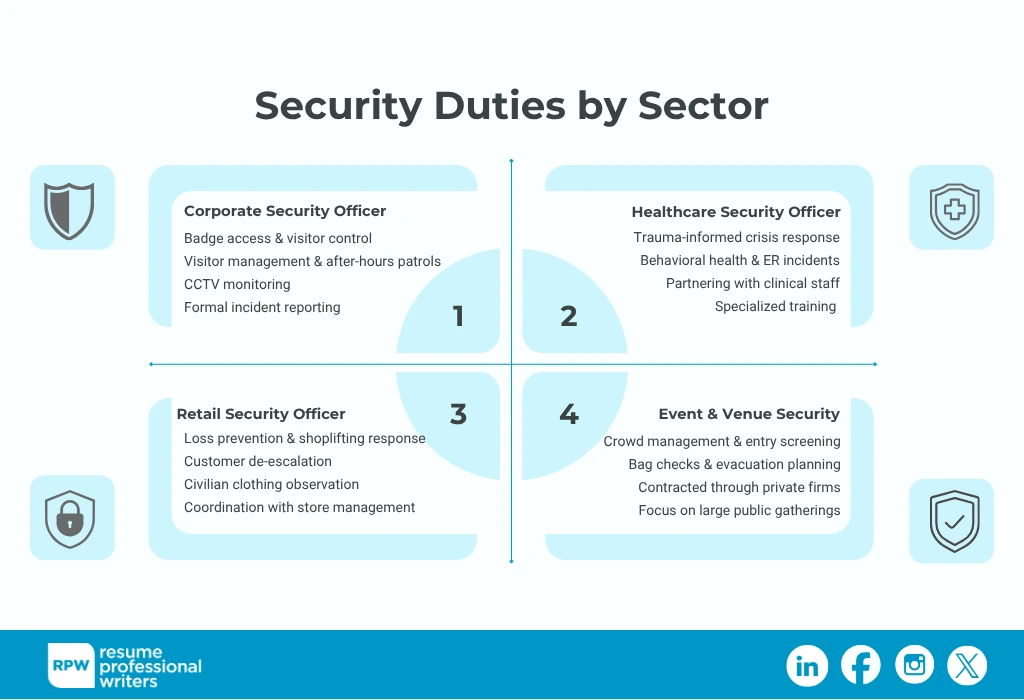
The primary responsibilities listed above are widely applicable, yet sectors highlight distinct skills and introduce specific obligations:
Corporate Security Officer
A significant portion of time is devoted to badge-based access management, visitor oversight, after-hours patrols, and CCTV monitoring from a centralized operations hub. Detailed written reports are crucial to the role — executives and legal teams depend on precise incident documentation.
Retail Security Officer
Strong focus on loss prevention, responses to shoplifting incidents, and conflict resolution. Officers often wear civilian attire, observe customer behavior, and work closely with store management. A retail security officer may spend the majority of their shift on the sales floor rather than at a security checkpoint.
Healthcare Security Officer
Hospitals necessitate trauma-informed training, managing de-escalation with patients in distress, and collaborating with medical staff. Officers regularly handle behavioral health emergencies, domestic incidents arriving via the emergency room, and post-visit disputes. Data from the U.S. Bureau of Labor Statistics on workplace violence in healthcare reveals that healthcare and social assistance personnel experience some of the highest rates.
incidences of workplace violence injuries across various U.S. sectors, which is the reason hospitals allocate substantial resources toward specialized security training.
Event and Venue Safety
Extensive public events transition the duty towards crowd control, baggage inspections, entry-point evaluations, and emergency exit management. Event personnel generally engage on a contractual basis with private security companies rather than being employed directly by the venue.
Being precise about the sector in your curriculum vitae is crucial — recruitment managers in different industries seek varied terminology and experiences.
Essential Skills for Security Officer Positions in 2026
Employers evaluate security officer candidates for a standard blend of abilities across numerous industries:
• Situational Awareness and Surveillance
Observing anomalies — an unfamiliar car, an ajar door, an individual behaving anxiously near a prohibited area.
• Oral and Written Communication
Documenting precise incident accounts, delivering clear radio transmissions, diffusing tense discussions.
• Physical Preparedness
Capability to stand or stroll for extended shifts, react swiftly during emergencies, and successfully complete the employer’s medical evaluation. Most roles do not demand athletic prowess — they necessitate endurance.
• Technological Proficiency
Contemporary access-control systems, CCTV technology, and incident-reporting applications. Applicants familiar with platforms like Genetec, Milestone, or AMAG have a competitive advantage.
• Composure Under Stress
The most frequently mentioned quality by hiring managers. Officers who transform a minor issue into a full-blown crisis incur costs for employers in terms of reputation, legal liabilities, and staff turnover.
• Customer Service Focus
Officers are often the initial point of contact for a visitor. Impolite, unfriendly, or excessively confrontational officers hurt the employer’s image even if they adhere to protocol.
Qualifications that Enhance an Application
Criteria differ by state and industry, but the following qualifications consistently appear in job advertisements:
- State security guard license (required in most states)
- CPR and First Aid accreditation
- Armed license (for positions that necessitate it — consult state regulations)
- ASP or PR-24 baton training (for relevant fields)
- De-escalation credentials (Verbal Judo, CPI, or equivalent)
- ASIS International Physical Security Professional (PSP) — for career growth
How to Craft a Security Officer Resume That Secures Interviews

Most security officer resumes do not pass the applicant tracking system assessment — not due to lack of experience, but because the structure disrupts parsing or the terminology fails to align with the job advertisement. LinkedIn’s March 2026 U.S. Workforce Report tracks healthcare and corporate hiring as two of the most active sectors as they approach mid-2026 — and these are precisely the corporate-level and healthcare-level security officer positions where compensation is the highest, and where ATS-driven recruiting is most competitive.
Your security officer resume is almost definitely being parsed by software first. This is also where generic AI resume creators often fail candidates. A ChatGPT-generated security officer resume might specify plausible-sounding responsibilities, but it will lack knowledge that a Verbal Judo credential is vital for healthcare security, that ASIS PSP qualifications promote corporate careers, or that retail security resumes must focus on loss prevention while hospital security needs trauma-sensitive language.
Based on our experience reviewing resumes within the security field, candidates who receive interview invitations in the corporate and healthcare sectors are those whose resumes embody sector-specific standards, which is exactly what AI generators lack context for. Three actionable adjustments:
1. Utilize the precise job title from the advertisement
If the advertisement states “Security Officer,” use “Security Officer” — not “Security Specialist” or “Protective Services Professional.” Parsing systems typically match exact terms, and recruiters look for the designations they’re filling.
2. Reflect the advertisement’s keywords in your skills section
If the job description highlights “CCTV,” “access control,” and “incident reporting,” those precise phrases should be included in your resume. Our keyword lists by role cover the most frequent terminology in the security industry; the advertisement itself is the definitive reference.
3. Quantify your experiences
“Oversaw the facility” is ambiguous. “Patrolled a 140,000-square-foot corporate campus, reacting to an average of 12 alarm events per shift” is precise. Incorporate figures wherever applicable: campus dimensions, response durations, shift allocations, incident counts.
For a comprehensive exploration, we dissect selecting the appropriate resume format individually — in most instances, reverse-chronological is the most reliable for a security officer resume interfacing with ATS parsing.
Sample Security Officer Resume Summary
A compelling professional summary resides at the beginning of the resume, conveying to the recruiter in 3–4 sentences why you are the ideal candidate. Here’s a before/after comparison:
Before (Generic):
Seasoned security officer with excellent observational skills and dedication to safety. Looking for a position to safeguard individuals and property.
After (Specific):
Certified security officer with six years in a Class A corporate campus, overseeing access control for 2,400 daily badge-ins and averaging under 90 seconds for response time to CCTV-flagged incidents. CPR-certified, state-licensed, and proficient with Genetec Security Center and Milestone XProtect. Eager to leverage corporate security proficiency in a healthcare sector role.
The revised version highlights scope, details specific systems, and indicates sector intent. Our guide on crafting a powerful professional summary further elaborates on the structure.
Security Officer Resume Bullet Points: Before/After
Security responsibilities can appear monotonous on paper. The solution remains consistent — start with scope, incorporate a figure, and conclude with the result.
Weak: Oversaw CCTV systems.
Strong: Monitored a 48-camera CCTV system spanning three buildings; flagged and documented 14 unauthorized access events over a 12-month duration.
Weak: Reacted to alarms and incidents.
Strong: Responded to an average of 8 alarm events per shift with a sub-90-second response period, coordinating with local law enforcement on two burglary investigations that resulted in arrests.
Weak: Compiled reports.
Strong: Generated daily activity reports and 35+ formal incident reports over 18 months; reports were referenced in two civil cases and a workers' compensation claim.
The pattern across these examples remains constant — every item justifies its presence by quantifying what you achieved. If you’re reconstructing your bullet points from ground zero, our extensive guides on optimal resume bullet points per job and 60 impactful accomplishments for a resume navigate the structure with examples from various industries.
What Security Officers Earn in 2026
The same BLS Occupational Outlook statistics indicate median annual earnings for security personnel and casino surveillance officers running in the upper $30,000s as of the latest survey. Compensation varies considerably by industry and locale — armed personnel and those in healthcare, corporate, or financial environments typically earn at the higher end of the spectrum. Regional differences in cost of living also contribute to significant pay disparities. If you’re aiming for one of the higher compensation brackets, our security industry resume professionals can align your qualifications, post types, and incident-response experience to meet the hiring expectations at that level.
Career advancement trajectories follow predictable patterns:
| Level | Title | Typical Years to Reach | Credentials That Help |
|---|---|---|---|
| Entry | Security Officer / Guard | 0 (with state license) | State guard license, CPR/First Aid |
| Mid | Lead Officer / Shift Supervisor | 2-4 | ASIS PSP, de-escalation training |
| Senior | Operations Manager | 5-8 | ASIS CPP, incident command training |
| Lead | Director of Security | 8-12 | ASIS CPP + management/MBA, executive protection |
| Exec | VP / Chief Security Officer | 12+ | CPP + ISACA CISM (if cyber-physical) |
Certifications like the ASIS PSP (Physical Security Professional) or CPP (Certified Protection Professional) can expedite your climb up the professional ladder, guiding you into positions that oversee entire security frameworks instead of isolated sites.
Get a Security Officer Resume Built by a Specialist
An effective security officer resume harmonizes two aspects: passing the ATS parser and being comprehensible to a recruiter who may allocate less than 10 seconds for the initial review. Achieving both requires practice — and an additional perspective.
If you’ve submitted applications for numerous security officer roles without securing interviews, the concern typically lies within the resume, not your qualifications. Our team is dedicated to reviewing resumes and can identify the precise reasons why yours is being filtered out.
out. If you would like us to have our team reconstruct your resume using ATS-validated formatting and security-industry terminology, we are pleased to review it. No pressure, no commitment.
If you are exploring options first, our guide on selecting the appropriate resume writing service details what to inquire about prior to making a decision.
Frequently Asked Questions
What is the primary role of a security officer?
The primary role of a security officer involves safeguarding individuals, property, and assets in a designated area. This entails monitoring the site, overseeing CCTV and alarm mechanisms, managing access at entrances, addressing incidents, and recording all activities in written reports. Specific responsibilities may vary based on the sector — corporate, retail, healthcare, and event security each prioritize different activities.
What abilities are required to be a security officer?
Essential abilities encompass situational awareness, effective written and oral communication, physical stamina for extended shifts, technological proficiency with access-control and CCTV systems, composure under pressure, and a focus on customer service. Most states additionally mandate a security guard license, and many employers favor candidates with CPR/First Aid certification. Advanced positions typically require de-escalation training and ASIS-industry credentials.
What distinguishes a security officer from a security guard?
The terms are frequently used interchangeably, but there is a subtle distinction. “Security guard” usually denotes entry-level, single-site positions focusing on observation and documentation. “Security officer” serves as a broader term that suggests enhanced responsibility, accreditation, or supervisory capacity. Job listings may not always adhere to this distinction, so it’s advisable to examine the actual responsibilities described rather than relying solely on the title.
How can I create a resume for a security officer position?
Begin with your state security license and certifications listed at the top. Include a professional summary that specifies the sector you have experience in, the scale of the site, and the systems you have utilized. In the experience section, quantify all details — site size, response times, incident frequency, shift duration. Align your skills section with the posting’s keywords, maintain a single-column reverse-chronological format, and refrain from using tables or text boxes that could impede ATS parsing.
Is becoming a security officer a valuable career choice in 2026?
A career as a security officer provides consistent employment — the BLS estimates approximately 170,000 job openings annually through 2033 — and a clear advancement pathway into supervisory and directorial positions. Compensation greatly varies across sectors, with armed, healthcare, and corporate roles generally offering higher salaries. The work may be physically taxing and sometimes require overnight shifts, but the entry barriers are lower than in many fields (most states require merely a license and a clean background check), and certifications like the ASIS PSP or CPP can significantly enhance career prospects.