HR metrics are vital to any organization. They are regarded as the foundation of intelligent decision-making processes. Disregarding these metrics may result in potential difficulties. It can lead to extensive ramifications, including inefficiencies, elevated turnover rates, and unmotivated employees.
According to Gallup, 85% of workers globally are disengaged from their jobs, resulting in a cost of approximately $8.8 trillion each year for businesses. HR metrics can assist leaders in comprehending and devising strategies to enhance employee engagement and retention.
In this article, let us examine why HR metrics have transitioned from being an option to a necessity.
What Are HR Metrics?
HR metrics are data points that assist organizations in evaluating the effectiveness of human resource operations. These metrics are crucial for comprehending workplace trends and managing talent strategically to enhance business performance. The metrics accordingly empower organizations to refine their human capital strategies and foster business success.
A broad spectrum of areas is encompassed in Human Resource metrics. These include performance, recruitment, employee engagement and retention, learning and development, compensation, among others. HR metrics enable organizations to make judicious decisions, streamline their operations, and elevate the overall positive employee experience.
Importance of HR Metrics
HR metrics are more than just figures on a spreadsheet. They are essential for any HR team and critical for an effective workplace. By utilizing these metrics, organizations can align their strategies with business objectives. Furthermore, companies can evaluate the impact of their HR practices on business performance.
Several additional significant advantages of monitoring the appropriate HR metrics include:
Enhanced Employee Retention
The employee turnover rate aids HR teams in pinpointing early indicators of discontent among staff. By scrutinizing this metric, HR professionals can develop targeted approaches, such as development programs, to bolster employee retention and engagement.
Improved Decision Making
HR professionals can analyze data to gain insights into aspects like employee productivity and job satisfaction. These insights further enable them to recognize areas requiring improvement and implement targeted strategies.
Measuring the ROI and HR Initiatives
HR metrics also assist HR in evaluating the ROI of their initiatives and programs. HR can gauge success by assessing metrics pertaining to talent acquisition costs, employee performance, and training effectiveness. Additionally, these metrics provide deeper insights into the overall health of the organization.
Better Workforce Planning
Human resource metrics such as absenteeism rates, succession planning rates, or internal mobility rates offer valuable insights for workforce planning. These insights support forecasting staffing needs and identifying talent gaps at the earliest opportunity.
KPIs vs Metrics: What’s the Difference?
KPI and Metrics may be used interchangeably, but they differ. Both are utilized to gauge employee performance. It can be stated that all KPIs are metrics, but not every metric qualifies as a KPI.
Key Performance Indicators, or KPIs, assess performance against specific business objectives. KPIs serve as strategic indicators that facilitate the advancement of the company. They provide a high-level perspective. Examples of KPIs are sales growth and customer retention, while for metrics, it’s the total number of sales and the quantity of customers obtained within a year.
Metrics gauge the effectiveness of specific business activities or processes. In contrast to KPIs, they are pertinent to distinct business areas and possess a lower-level perspective. Metrics tend to be tactical or operational.
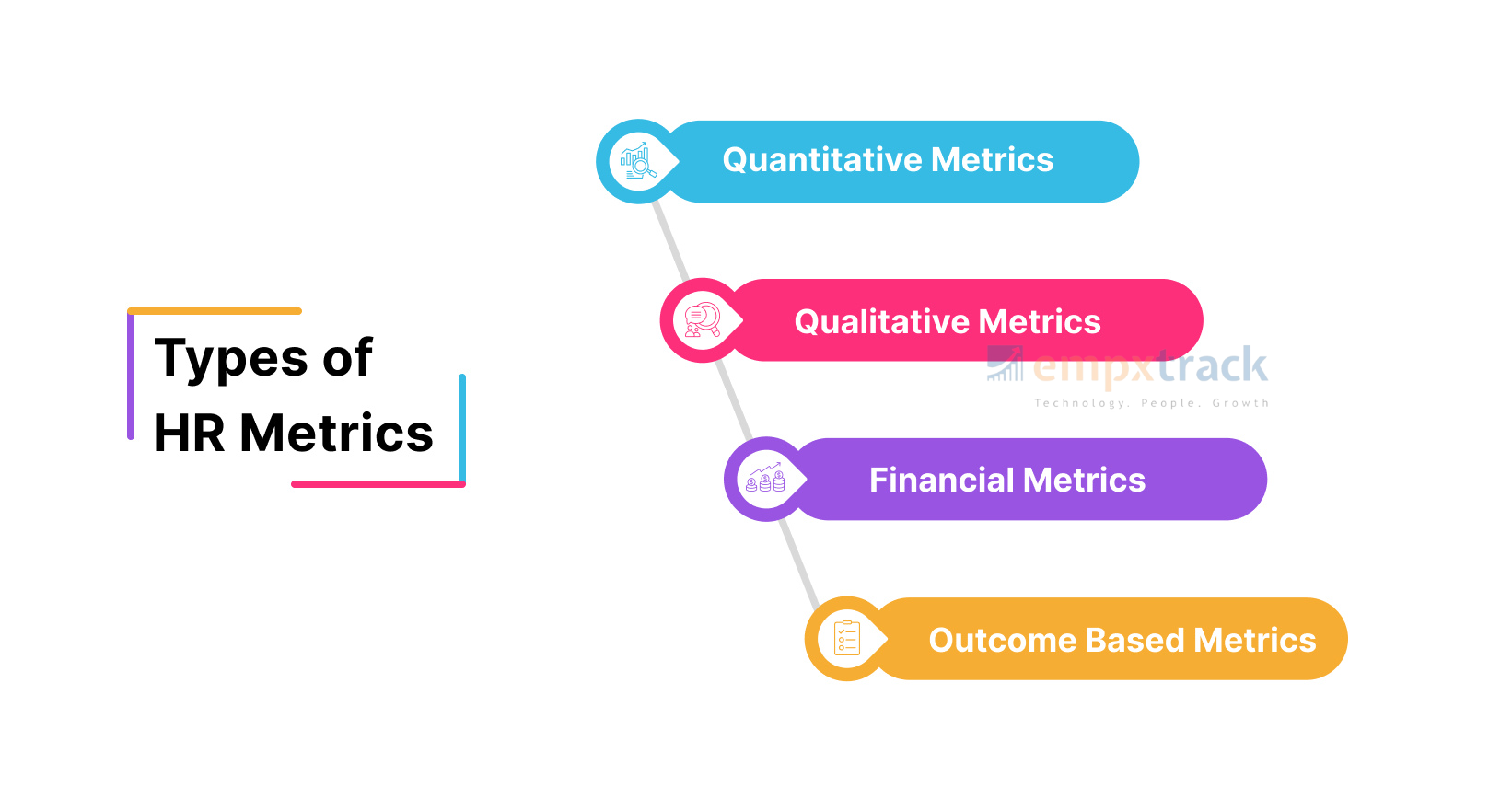
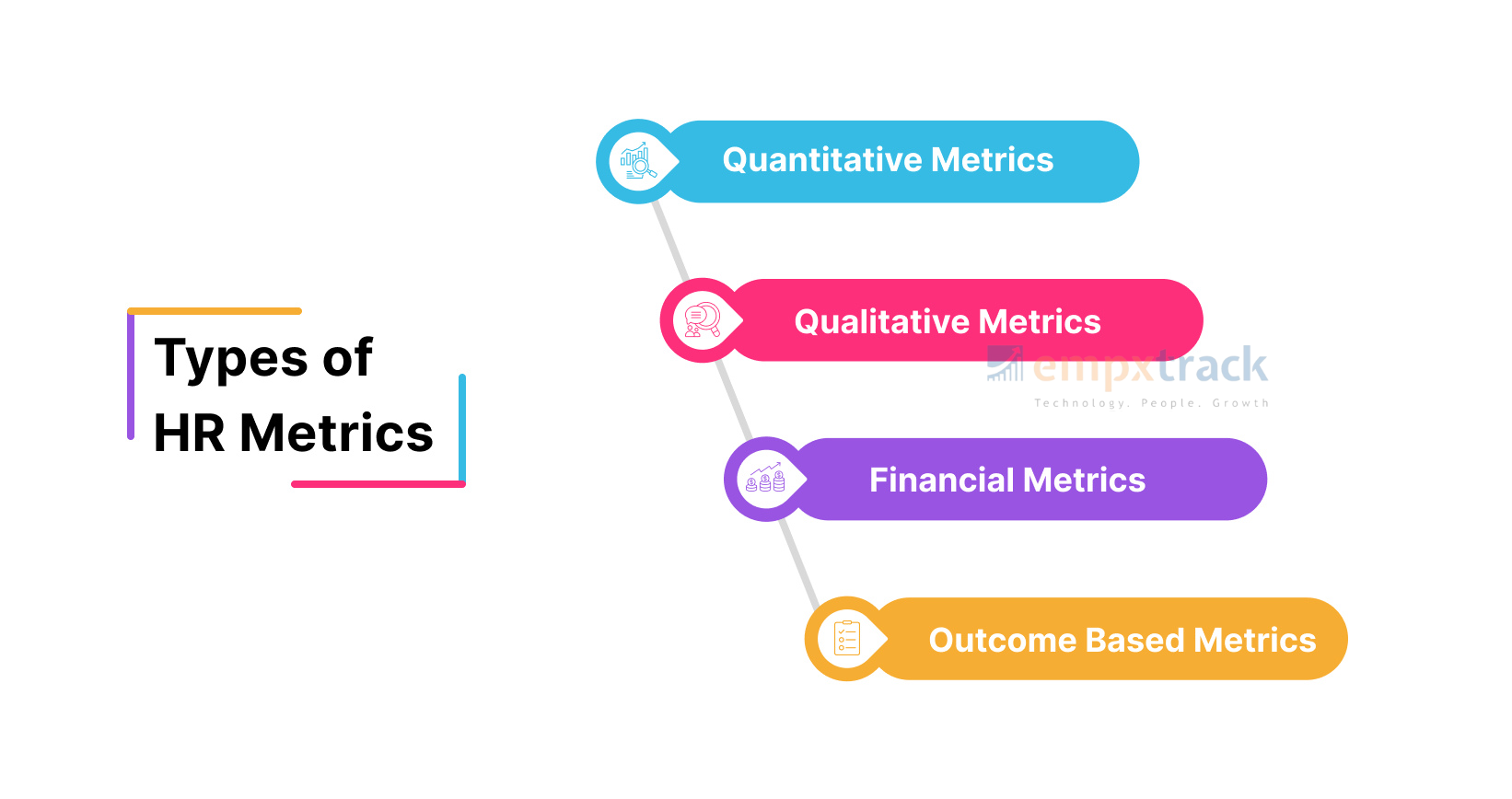
Types of HR Metrics
Quantitative Metrics
This type of metric emphasizes figures and data gathered through surveys and questionnaires. They provide measurable outcomes to track advancements over time. For instance, to gauge employee turnover, you can apply this straightforward formula:
Formula: (Number of employees who departed ÷ Average number of employees) × 100
This will yield the percentage of employees who have exited an organization over a specified time frame, relative to the total workforce.
Organizations can leverage this data to pinpoint areas for enhancement and optimize HR strategies. Regular monitoring is crucial for improving employee retention, streamlining recruitment, and enhancing overall workplace performance.
Qualitative Metrics
The focus of qualitative HR metrics is on perspectives, experiences, and feedback rather than numerical data. These metrics are collected through interviews, surveys, and discussions.
They measure intangible aspects, such as employee well-being and trust between the team and leadership.
Financial Metrics
This metric centers on the financial implications of HR’s functions. It covers costs per hire, ROI for training initiatives, and savings generated from employee retention strategies. Financial metrics empower HR to juxtapose costs and benefits. With this data, HR can make educated selections and invest in human resource programs that will yield optimal results.
Outcome Based Metrics
Outcome-based metrics are associated with a specific initiative or program. They indicate whether a particular result has been achieved. These metrics evaluate the outcomes of what succeeded and what did not, as well as whether you have achieved a desired result. HR can thus readily identify areas necessitating improvement and address them.
Key HR Metrics to Identify in 2026
HR metrics encompass a broad array of domains. They enable data-driven decision-making and assist in enhancing employee engagement, performance, and retention.
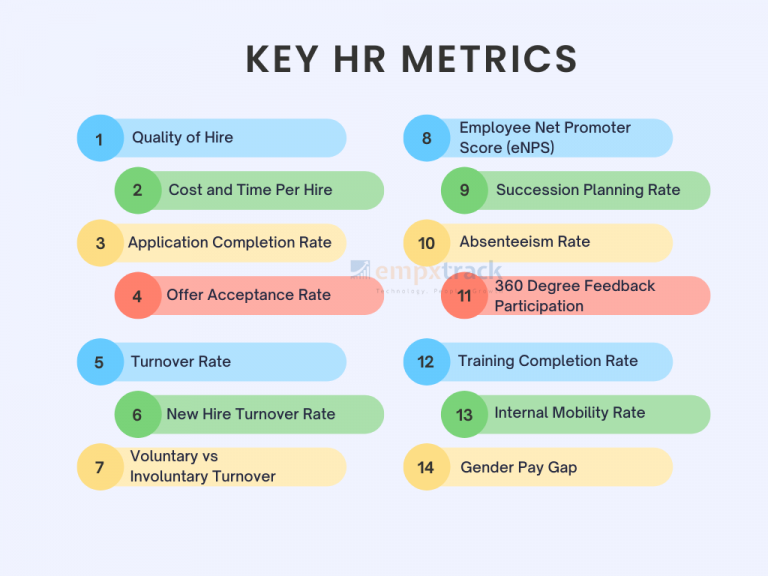
Some of the crucial HR metrics are outlined below, along with their formulas. Let’s delve into and investigate the key metrics for 2026.
Recruitment HR Metrics
1. Quality of Hire: This metric enables HR to assess how the new employee performs relative to the company’s standards. With this, they can evaluate the efficiency of the recruitment process.
The low
The quality of hire score indicates the necessity to enhance the recruitment methodology.
Formula: (Average performance rating of new recruits) ÷ (Average performance rating of all personnel)
2. Cost and Time Per Recruitment: This metric helps monitor the average cost incurred in hiring each employee, encompassing advertising expenses and internal HR resources.
The elevated cost implies that recruitment endeavors require optimization, achievable by improving the application process or enhancing the sourcing methods.
Formula: (Total recruitment expenses) ÷ (Number of new hires)
3. Application Completion Rate: This measures the proportion of applicants who finalize the entire application form. A low percentage signifies that the candidate may have faced difficulties while completing the form.
Formula: (Completed applications) ÷ (Total initiated applications) x 100
4. Offer Acceptance Rate: This HR measurement reflects the number of candidates who accept the job offer, providing insight into the appeal of the offer and the candidate’s experience. A low acceptance ratio may indicate candidate dissatisfaction. To address this, organizations can reconsider the compensation packages or the recruitment process.
Formula: (Accepted offers) ÷ (Total offers made) x 100
Retention HR Metrics
The retention metrics offer insights into employee engagement and contentment. Organizations can enhance the employee experience by concentrating on these measures, which subsequently lead to reduced turnover and improved employee commitment.
5. Turnover Rate: This evaluates the frequency with which employees exit the organization over a specified timeframe. A low employee turnover implies strong employee involvement, while a high turnover signals the opposite.
Formula: (Number of employees who departed during the period) ÷ (Average total employees) x 100
6. New Hire Turnover Rate: This pertains to the employees who leave the organization within their first year. This metric also highlights potential challenges in onboarding or role expectations. A low new hire turnover rate signifies an effective procedure, while a high turnover rate indicates deficiencies in onboarding and misalignment in job descriptions.
Formula: (Number of new recruits who left within the first year) ÷ (Total new recruits) x 100
7. Voluntary vs Involuntary Turnover: This metric distinguishes between voluntary (resignation) and involuntary exits (termination). A high rate of voluntary turnover indicates employee dissatisfaction with workplace culture, signaling a need for enhancements in performance management.
Formula: (Voluntary exits ÷ Total exits × 100), (Involuntary exits ÷ Total exits × 100)
8. Employee Net Promoter Score (eNPS): This HR metric gauges employee happiness by determining whether they would endorse the company as an excellent workplace. A high score reflects strong employee satisfaction.
Formula: % Promoters – % Detractors (based on survey feedback)
Performance HR Metrics
This category of HR metric evaluates individual and team performance. It encompasses key performance indicators (KPIs), performance evaluations, and goal attainment. Utilizing these metrics, HR can pinpoint top-performing employees, identify potential improvement areas, and assess the efficiency of the evaluation process.
9. Succession Planning Rate: This indicates the organization’s preparedness to occupy a vital role by grooming potential personnel. A high succession planning rate signifies readiness for internal promotions, thus ensuring continuity in leadership. In contrast, a low rate reveals a lack of emphasis on nurturing internal talent.
Formula: (Number of positions with a succession strategy) ÷ (Total key roles) x 100
10. Absenteeism Rate: This measures the frequency of unscheduled absences. This helps to identify and mitigate issues related to attendance and workforce dependability in the future. A high absenteeism rate may suggest low morale, stress, or health issues.
Formula: (Total unscheduled absence days) ÷ (Total working days) x 100
11. 360 Degree Feedback Participation: This monitors the engagement of employees in a holistic feedback program that includes input from peers, subordinates, and supervisors. A high participation level indicates that the company fosters transparency and development. In contrast, a low participation rate highlights the necessity for improved communication and accessibility.
Formula: (Number of employees engaged in feedback) ÷ (Total employee count) x 100
Growth and Development HR Metrics
Fostering employee growth and advancement is crucial for the long-term triumph of the organization. This metric assists in evaluating the company’s dedication to employee education and career progression. Consequently, employees can be assured that they will receive the necessary support for development.
within the organization.
12. Training Completion Ratio: This gauge evaluates the fulfillment of designated training programs, reflecting employee involvement in compliance training and skills enhancement. A elevated training completion ratio indicates that employees are devoted to learning and personal development. Conversely, a diminished ratio implies that training may lack engagement or availability, which can be subsequently rectified by modifying training techniques.
Formula: (Number of completed training modules) ÷ (Total assigned modules) x 100
13. Internal Mobility Ratio: This serves as a measure of career advancement opportunities. It quantifies the rate at which employees move to various positions within the establishment. A high rate of internal mobility signifies clear career advancement options within the organization. A low rate points to the necessity of refining the internal recruitment process.
Formula: (Total internal transitions/promotions) ÷ (Total employees) x 100
Additional Key Metrics
14. Gender Wage Disparity: This measure observes the variations in average compensation between genders to assist organizations in monitoring pay equity. A minimal or nonexistent gender wage gap indicates just pay practices, fostering an inclusive and fair work environment.
Formula: (Median male wage – Median female wage) ÷ Median male wage x 100
Utilizing HR Metrics for Enhanced Decision-Making
Align with Larger Objectives
To enhance the efficacy of HR metrics, align them with the organization’s broader aims. Begin by identifying critical organizational goals and ascertain which HR metrics most effectively gauge progress toward them. Furthermore, evaluate areas necessitating enhancement and systematically design metrics to cater to those specific requirements efficiently.
Monitor Relevant HR Metrics
The list of HR metrics is perpetually expanding. Staying abreast of all might be unnecessary and burdensome. Thus, it is advisable to focus on tracking only the key metrics. Therefore, the initial step is determining the objectives you aim to achieve through HR metrics. For instance, if your goal is to minimize turnover or enhance employee retention. Once recognized, HR can choose metrics that will aid in monitoring progress.
HR Metrics Require Context for Significance
Hiring demands differ among organizations. Hence, it is essential to consider HR metrics within the larger organizational framework. Various elements such as company size, sector, and profitability significantly influence the interpretation of these metrics. For instance, comparing recruitment expenses at a tech startup with those at a manufacturing facility would be impractical due to their distinct needs. Instead, HR teams ought to evaluate metrics within the suitable context to derive insightful conclusions and make educated choices.
Maintain HR Metrics’ Relevance and Currency
HR must periodically review and refresh metrics to ensure their relevance. When evaluating HR metrics, organizations should consistently ask, “Are these figures aligned with our strategic objectives?” Moreover, arrange regular assessments to remain proactive regarding issues and adapt to changing industry trends.
Summary
HR metrics enable organizations to gain a deeper understanding of their workforce, enhance employee experiences, and propel business achievement. By monitoring crucial data points, HR teams can make knowledgeable decisions, tackle challenges, and foster a more engaging workplace. As companies evolve, utilizing HR metrics is vital for enduring success.
Commonly Asked Questions
Q1. |
What is an example of a qualitative HR metric? |
| Ans. | The qualitative HR metric is based on descriptive data such as survey feedback. Examples of qualitative metrics include employee engagement and job satisfaction. |
Q2. |
What constitutes HR KPIs? |
| Ans. | HR KPIs are strategic measures used to evaluate how effectively HR aligns with an organization’s objectives and gauge HR’s impact on realizing its strategy. |
Q3. |
Which key HR metrics should every organization monitor? |
| Ans. | Every organization should monitor crucial HR metrics such as time to hire, hiring costs, employee engagement, employee satisfaction, and revenue per employee. |
Q4. |
What is an HR metrics dashboard? |
| Ans. | An HR metrics dashboard is a business intelligence resource. It aggregates and showcases pivotal HR data, enabling HR teams and executives to evaluate performance and make data-informed decisions to enhance workforce management. |
Q5. |
How do HR metrics differ from HR analytics? |
| Ans. | Both HR metrics and HR analytics serve as pivotal instruments for assessing the effectiveness of HR practices. HR metrics are explicit measurable indicators utilized to monitor and evaluate HR effectiveness. Conversely, HR analytics entails the process of gathering, scrutinizing, and interpreting HR information to extract insights and make informed decisions. |
Q6. |
What challenges does HR face in using HR metrics? |
| Ans. | A primary challenge that HR encounters when utilizing HR metrics is ensuring the quality, integration, and precision of data from diverse sources. HR metrics are dynamic and thus require ongoing observation to track modifications. |
Q7. |
What are HR performance indicators? |
| Ans. | HR performance indicators are quantifiable assessments that evaluate the effectiveness of human resource initiatives and their impact on business outcomes. These indicators broadly encompass domains such as recruitment, training, employee satisfaction and retention, among others. |