Your career portal is the applicant’s initial interaction with your employer brand.
As per Employ’s Job Seeker Nation Report, 71% of job hunters anticipate an application process to require less than 30 minutes.
In contrast, 35% will abandon an application if it appears overly lengthy or intricate.
Career portals that are cumbersome and difficult to navigate can inadvertently deter highly skilled candidates.
What Constitutes an Excellent Career Portal in 2026 (Criteria Section)
Branding, headlines, narrative, job search UX, EVP, and benefits still hold significance when creating your career portal.
By 2026, features like personalization, a mobile-centric experience, and hybrid/remote work options are additional vital elements that many candidates evaluate prior to applying.
AI/Personalization
Candidates now anticipate the same customized experience on a career portal that they receive from Netflix or Amazon. AI on career sites is no longer limited to chatbots. It’s about job matching, content suggestions, and dynamic candidate journeys.
Nevertheless, Phenom’s State of Candidate Experience: 2025 Benchmarks Report revealed that 87% of Fortune 500 companies did not utilize AI and automation to extensively personalize career portals.
This indicates that organizations still have a significant journey to achieve genuinely candidate-friendly sites. What distinguishes the best career portals in 2026 is the candidate’s perception that the site was crafted for them and not merely a standard job board. Specifically, candidates seek contemporary career portal features such as:
- AI-enhanced job matching that highlights relevant roles based on skills or browsing habits
- Intelligent search that autocompletes, proposes, and filters without additional clicks
- Candidate-type segmentation (students vs. experienced, in-store vs. corporate) as a foundational form of personalization
- Resume upload or profile creation that retains candidate information for future alignment
- Chatbot or conversational AI that responds to inquiries 24/7 without a recruiter
Mobile-First Perspective
Mobile is no longer merely about a responsive design. Candidates anticipate searching, applying, and following up entirely from their smartphones.
The standard in 2026: under 3 minutes to apply, auto-completing forms, and no abrupt transitions to a third-party ATS with a different interface. On-site retail and hourly employees, in particular, are applying from mobile. A cumbersome mobile experience directly affects your applicant count.
Hybrid/Remote Work Indicators
In 2026, remote work has become a baseline expectation that candidates assess prior to applying.
Career portals omitting flexible work options easily lose candidates to rivals.
Gen Z applicants investigate company social media and career portals specifically to assess employee feedback and organizational culture before deciding to apply.
The 10 Outstanding Career Portal Examples
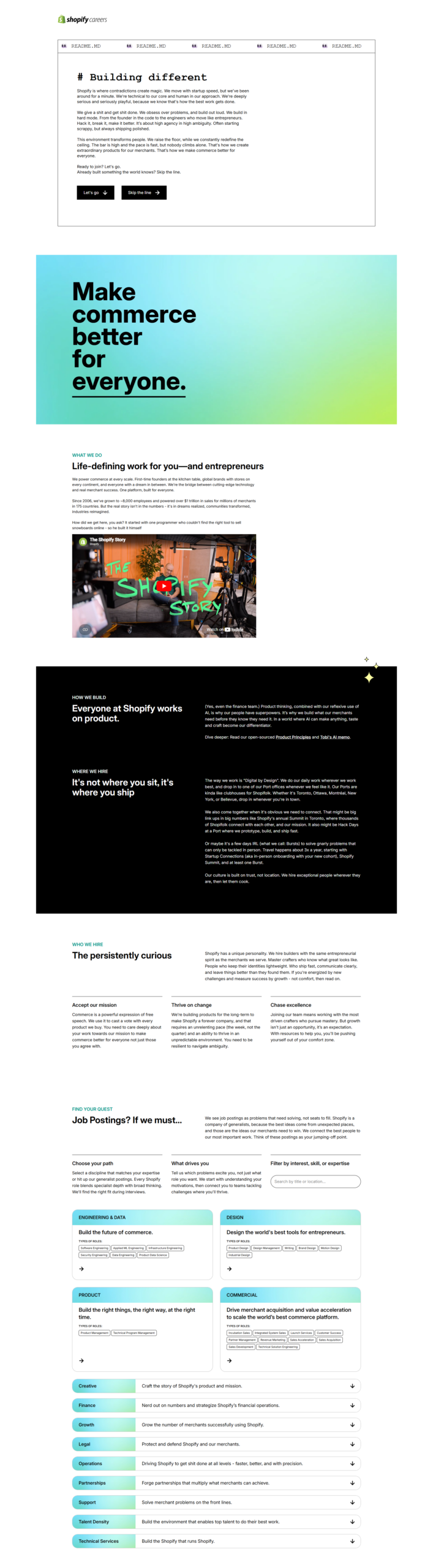
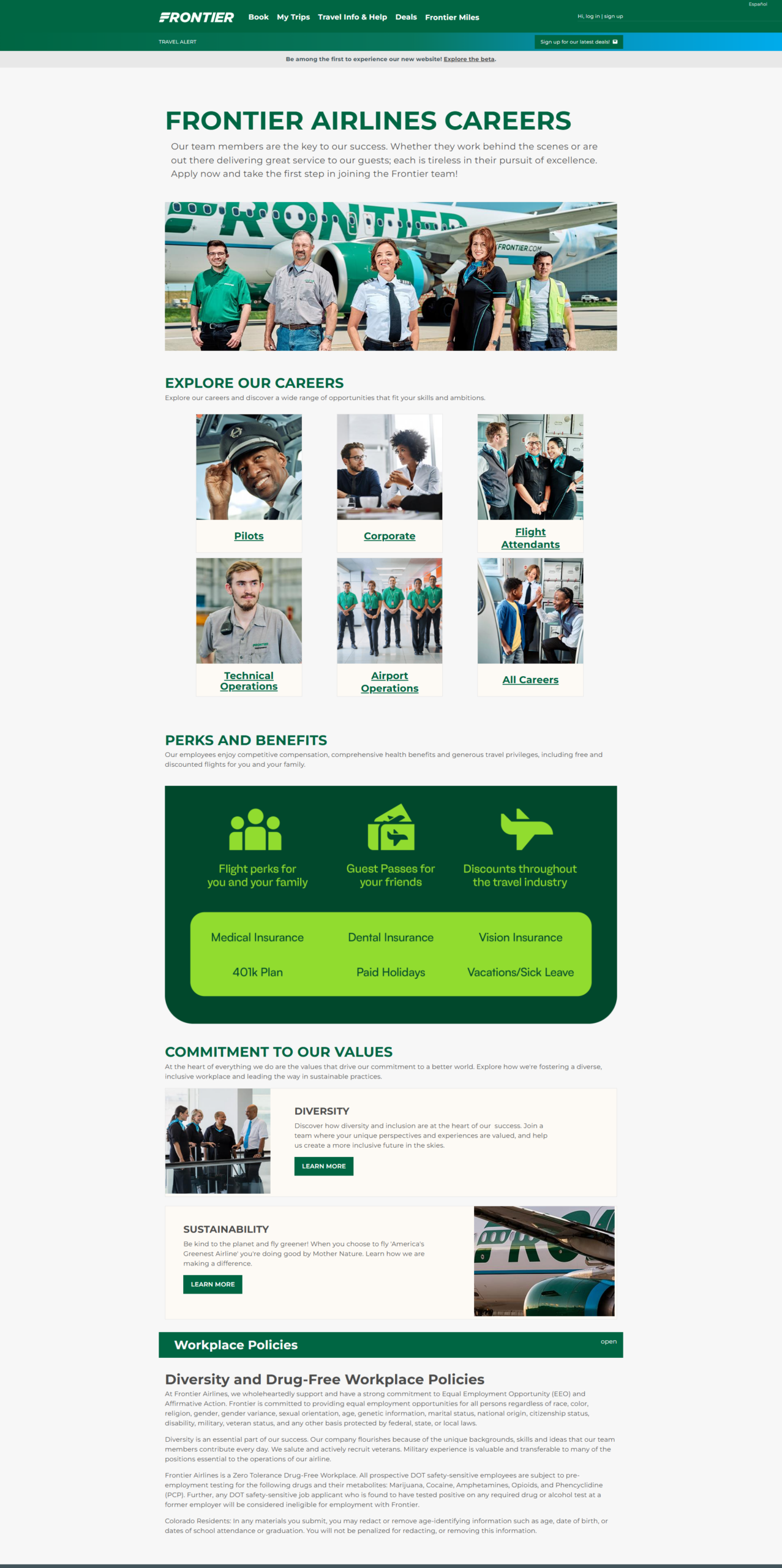
- EVP is emphasized throughout the entire candidate process: “We care and we get things done” and “Digital by Design”.
- “Skip the line” CTA for highly-qualified candidates. This uncommon initiative prequalifies applicants and indicates that they are seeking only truly skilled individuals.
- “We view job posts as challenges that need resolution, not positions to occupy,” recontextualizes job advertisements in a manner not found on other career sites on this list.
- “Shopifolk” as the employee label cultivates an internal community identity and brand uniqueness.
- Social proof based on merchant contributions, not company size: “$1 trillion in sales for millions of merchants in 175 countries.”
- Job search and navigation remain swift and straightforward on mobile, without inundating candidates with dense navigation or excessive redirects.
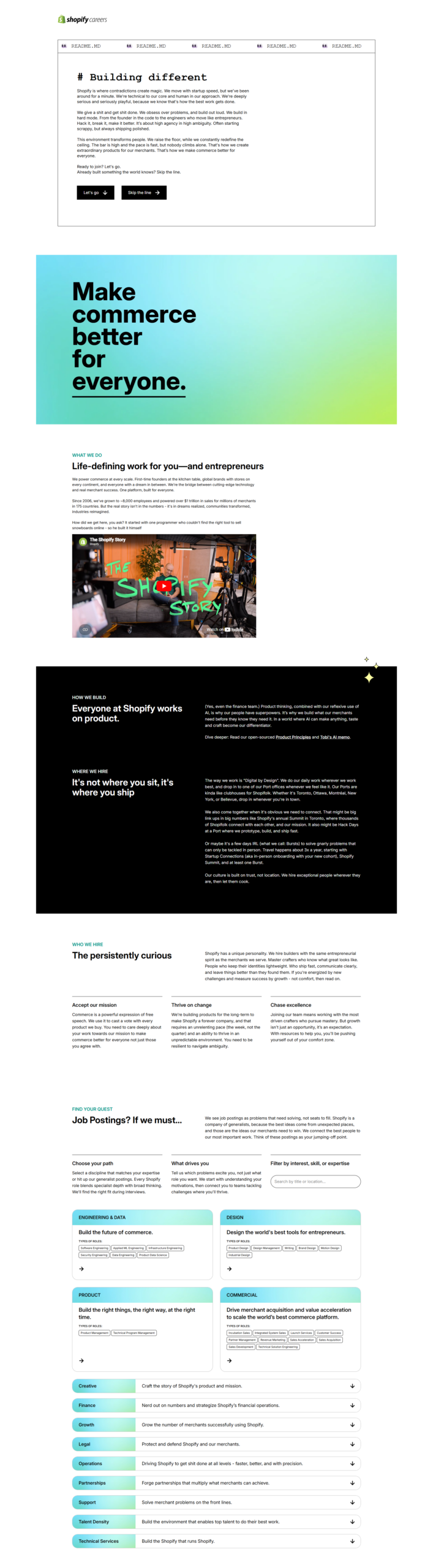
- Powered by Ongig’s Career Site Builder, which facilitates tailored candidate experiences at the platform level.
- Candidates can explore roles, filter openings, and complete applications seamlessly from mobile without losing functionality.
- Strong employer credibility highlighted upfront: 16M+ subscriptions, 80+ nationalities, Fast Company’s Most Innovative Companies.
- Employer brand content expresses culture throughout: the language learning mission (“mutual understanding through language”) is consistently conveyed from the hero section into job listings.
- Individual job listings clarify location flexibility.
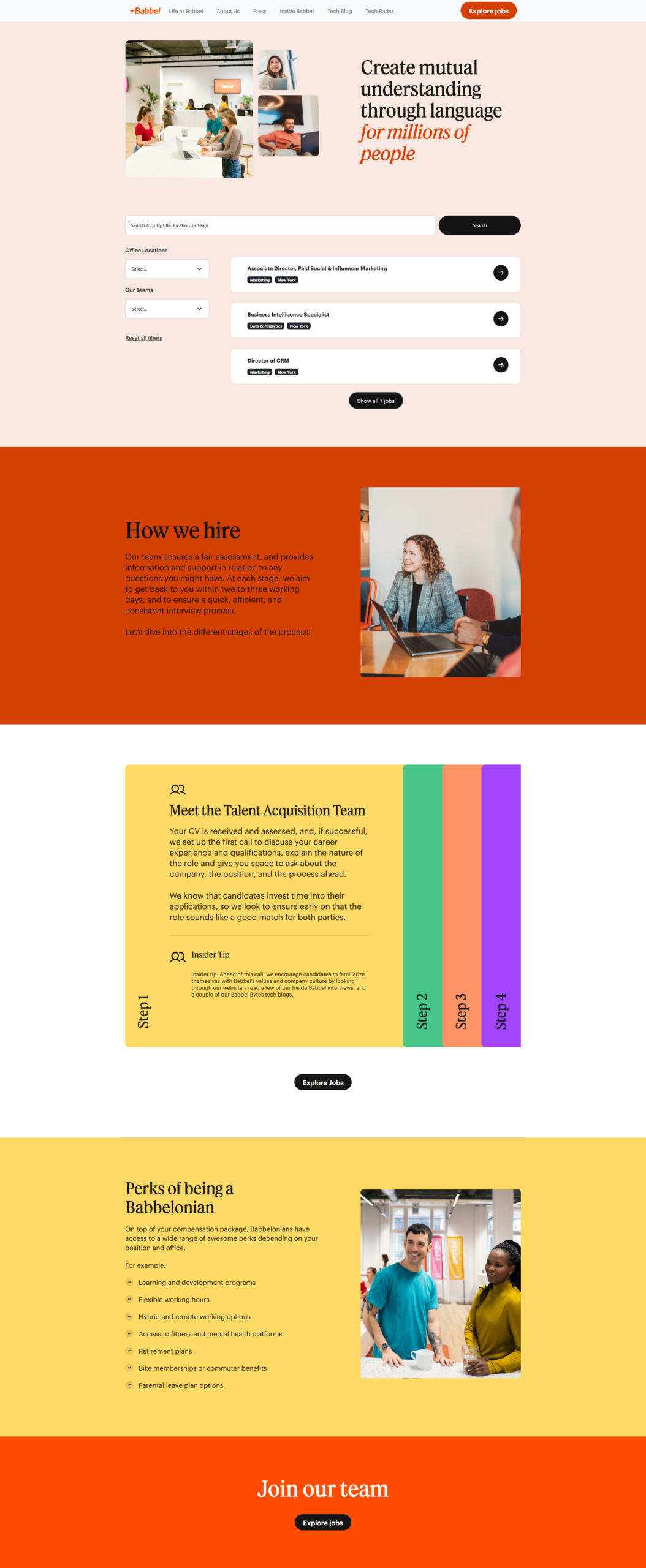
- Role segmentation by department (Pilots, Flight Attendants, Technical Ops, Corporate, Airport Ops) ensures candidates land directly in the relevant area. Candidates do not waste time sifting through job postings.
- Diversity and sustainability positioning are prominently displayed, indicating the employer’s genuine commitments rather than mere compliance checkboxes.
- “America’s Greenest Airline” sustainability identity is evident throughout the careers page. It’s uncommon to see an environmental brand principle explicitly woven into employer branding.
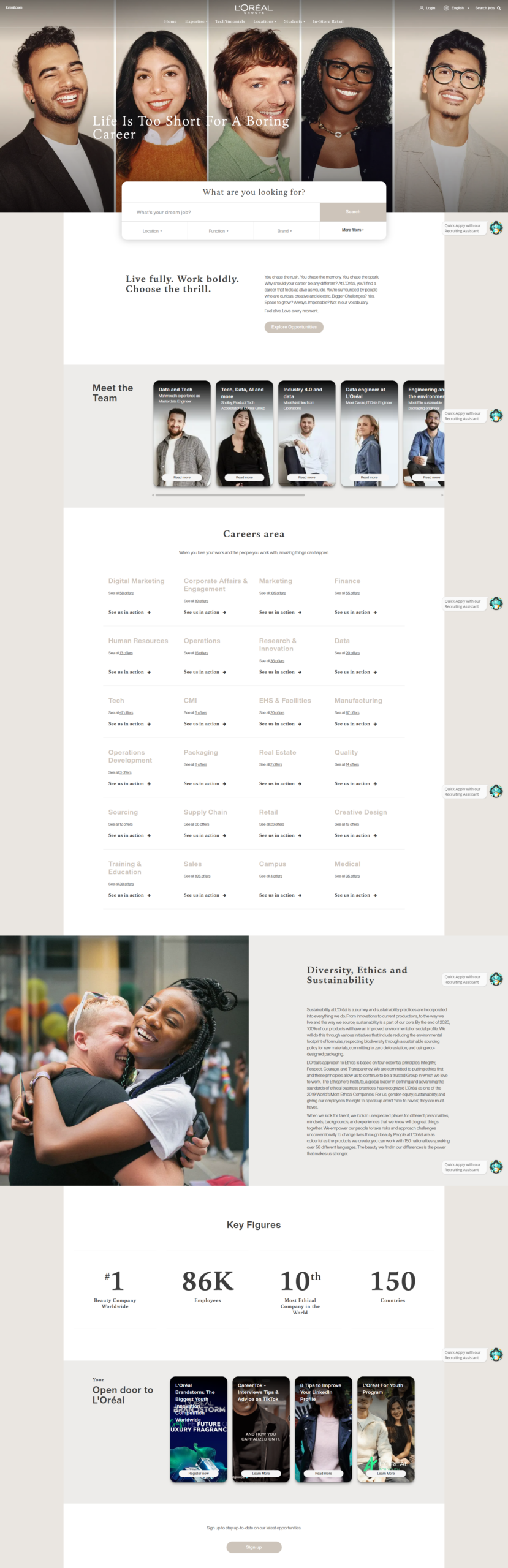
- Segmented candidate journeys across roles and levels, including employment type and contract type. There are also specific pathways for students and in-store retail applicants.
- Multi-brand structure: candidates can explore L’Oréal Paris, Lancôme, Kiehl’s, and other sub-brands as distinct employer identities within one platform, which is rare and beneficial for a conglomerate.
- Candidates can browse roles across regions and brands. They can easily upload resumes directly from their mobile devices.
- Global roles categorized by region. Flexibility presentation is role-dependent.
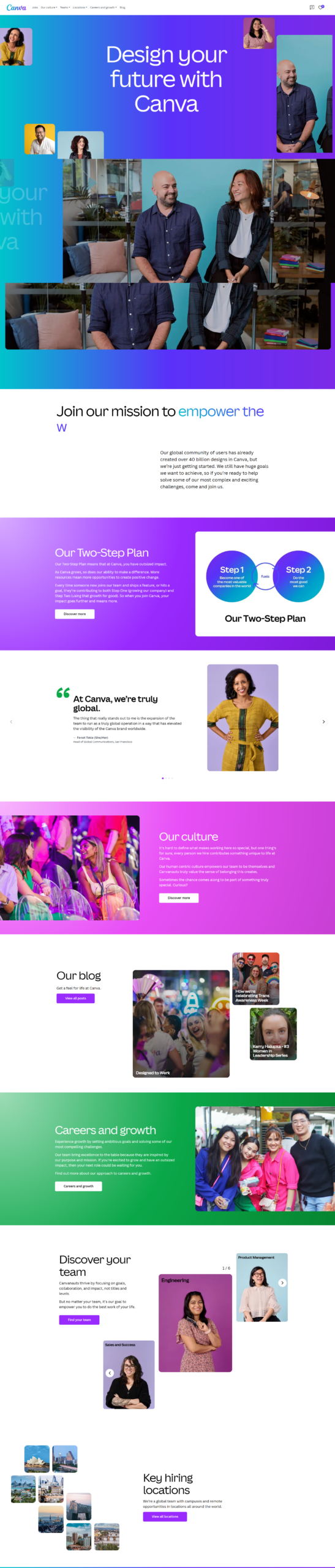
- The EVP is consistently integrated throughout the candidate experience: “Shape your future with Canva,” “Ambitious Goals,” and “Canvanauts” can be found in all sections of the site.
- Dedicated team pages (Engineering, Product, Design, Sales, Marketing, Operations, and Finance) feature unique pages with authentic employee images, named quotes, and context specific to each role. Aspirants can investigate their specific function prior to applying.
- While the site has a visually engaging design, the career portal remains user-friendly on mobile devices. Content areas and job discovery pathways adapt seamlessly to smaller displays.
- The application and search procedure adheres to a three-step or fewer standard, devoid of any third-party ATS redirects that could disrupt the experience.
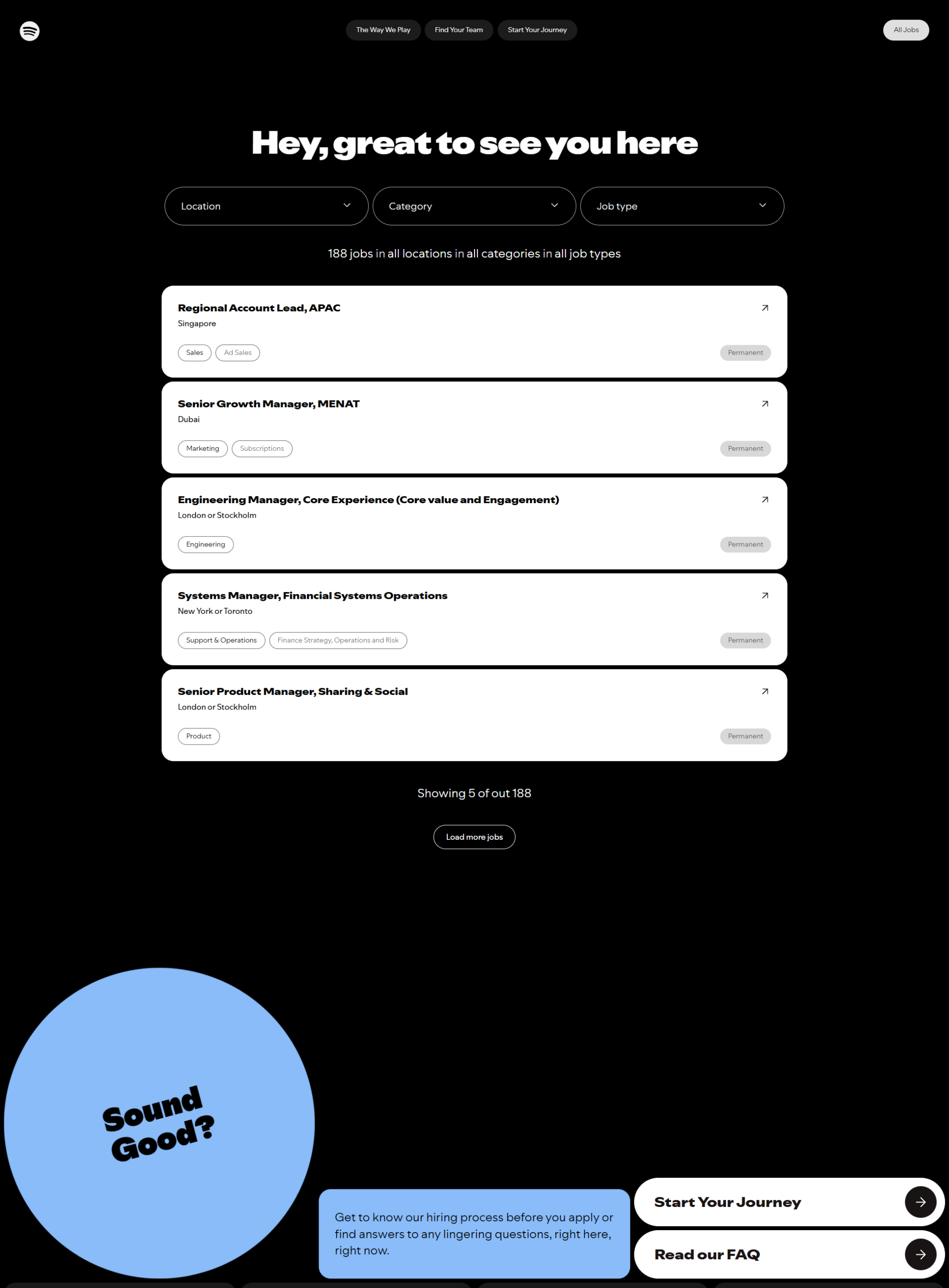
- Spotify’s brand-specific language (“Hey want to join us”, ‘Werk, werk, werk,’ and ‘Hey, you can do this’) creates a cohesive feel rather than a corporate vibe, enabling candidates to instantly grasp the company’s character before applying.
- The Start Your Journey page on the career site outlines a detailed hiring process: from application to decision, along with FAQs addressing other candidates’ inquiries.
- Job listings are organized based on location or department.
- The Way We Play page underscores Spotify’s principles, which also connect to the Culture and employee benefits pages.
- Job filters function effectively on mobile devices.
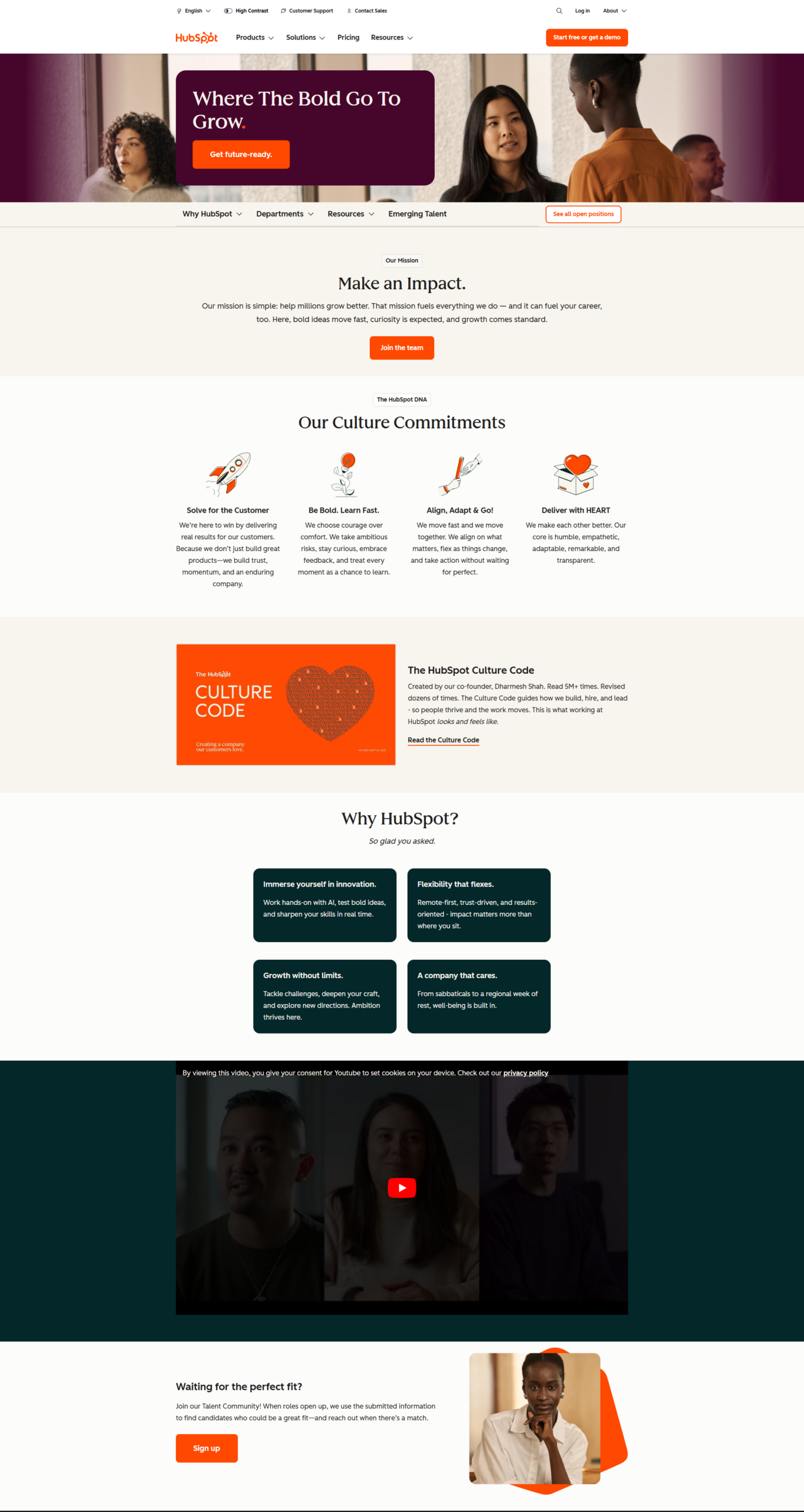
- HubSpot emphasizes cultural fit among employees, as the company’s mission and culture commitments are prominently showcased at the top of the career site.
- Remote-first strategy with their Flex philosophy, stating, ‘It embodies a flexible, intentional approach that balances independence with clear expectations and prioritizes outcomes over time or location.
- Each department also has its own dedicated career page: every team showcases its unique work philosophy and projects for better understanding before candidates apply.
- “Work directly with AI, test innovative ideas, and enhance your skills in real time” is highlighted on the careers homepage as a fundamental EVP component. AI proficiency is positioned as a development opportunity for all roles, not just in engineering.
- A talent community registration is also offered for candidates who are not ready to apply yet.
- The career site ensures a lightweight, easily scan-able experience, even on mobile devices, allowing candidates to explore roles effortlessly.
- The career site is straightforward and well-optimized for mobile. Minimal clicks are required to apply.
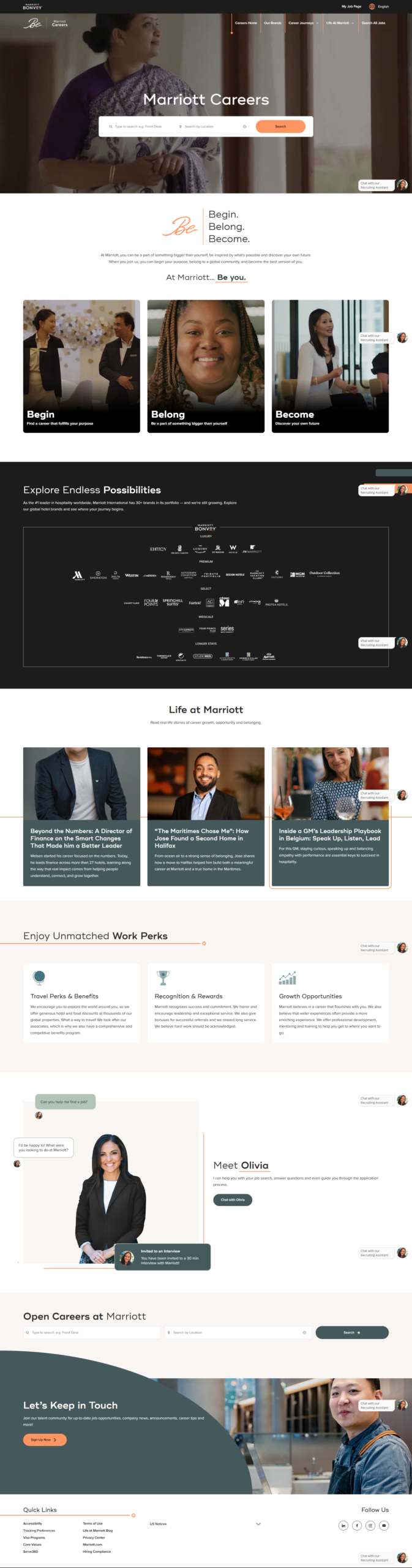
- “Begin. Belong. Become.”: each term corresponds to a specific phase of the employee journey (start strong, feel connected, reach potential) and is consistently represented throughout every section of the site.
- Multi-brand career structure: 30+ hotel brands possess their own career landing page under a united platform, so a candidate interested in W Hotels experiences a completely different interface compared to one looking at Ritz-Carlton or Courtyard. This serves as the hospitality equivalent of L’Oréal’s multi-brand segmentation.
- Career journey categorization transcends job type: Hotel Jobs, Corporate Jobs, Flex Talent Solutions, and Early Careers present distinct pathways with specific content, not merely filtered search results; the Flex Talent Solutions track for temporary and gig-style positions is unique.
- The tile-based navigation compresses neatly on mobile devices.
- Marriott’s AI chatbot Olivia is directly embedded on the career homepage. She assists candidates through the application process, responds to inquiries, and schedules interviews.
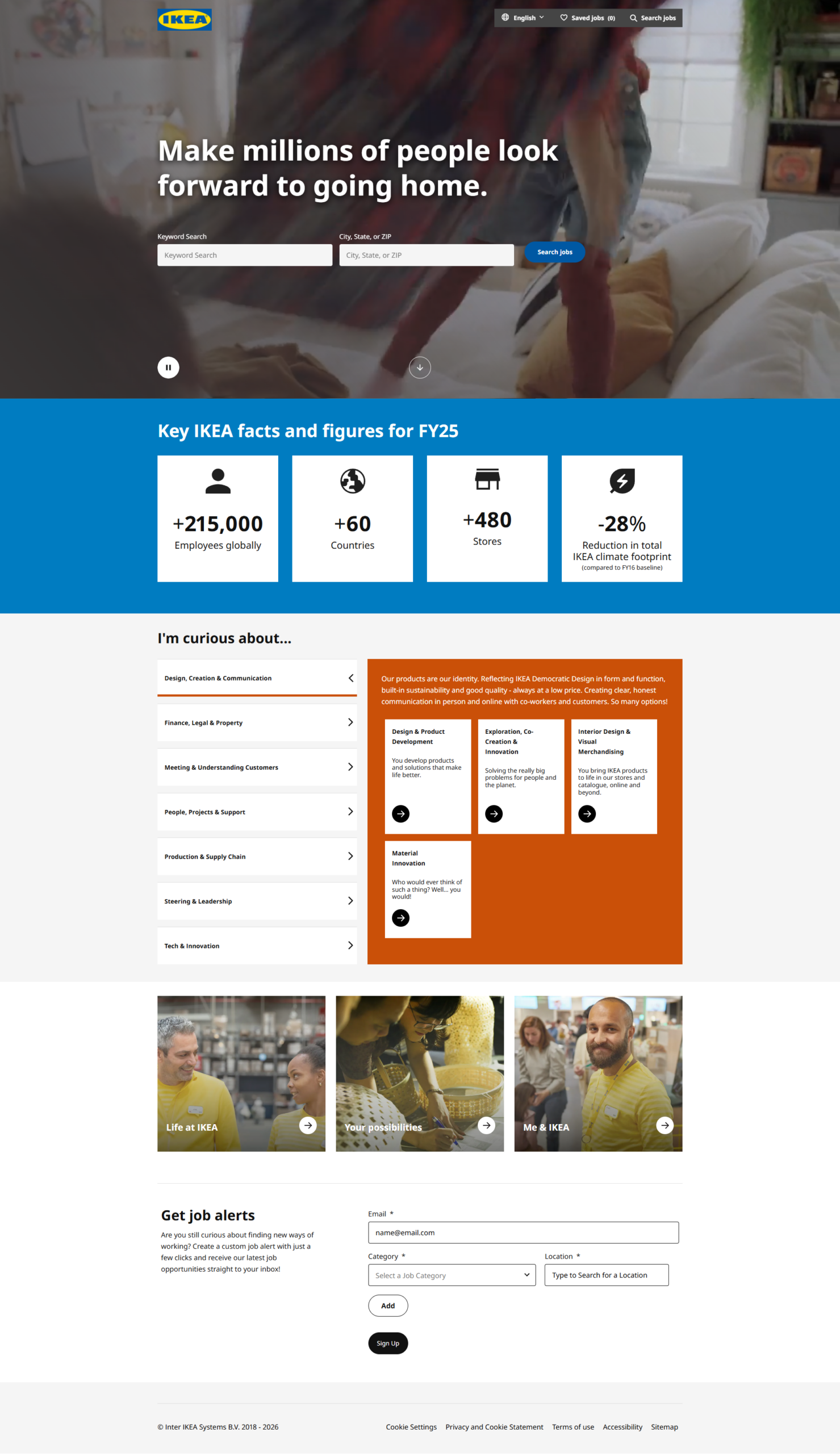
- “Make millions of individuals anticipate returning home” serves as a powerful headline, linking the product mission directly to the employer brand.
- Function-first job navigation: 30+ distinct job families are organized under six categories (Design & Creation, Finance & Legal, Meeting Customers, People & Projects, Production & Supply Chain, Technology) accompanied by brief descriptions for each category.
- Clear, fast-loading tile navigation collapses effectively on small screens; job search is prominently displayed above the fold and operates smoothly on mobile devices. No third-party ATS redirect interferes with the experience.
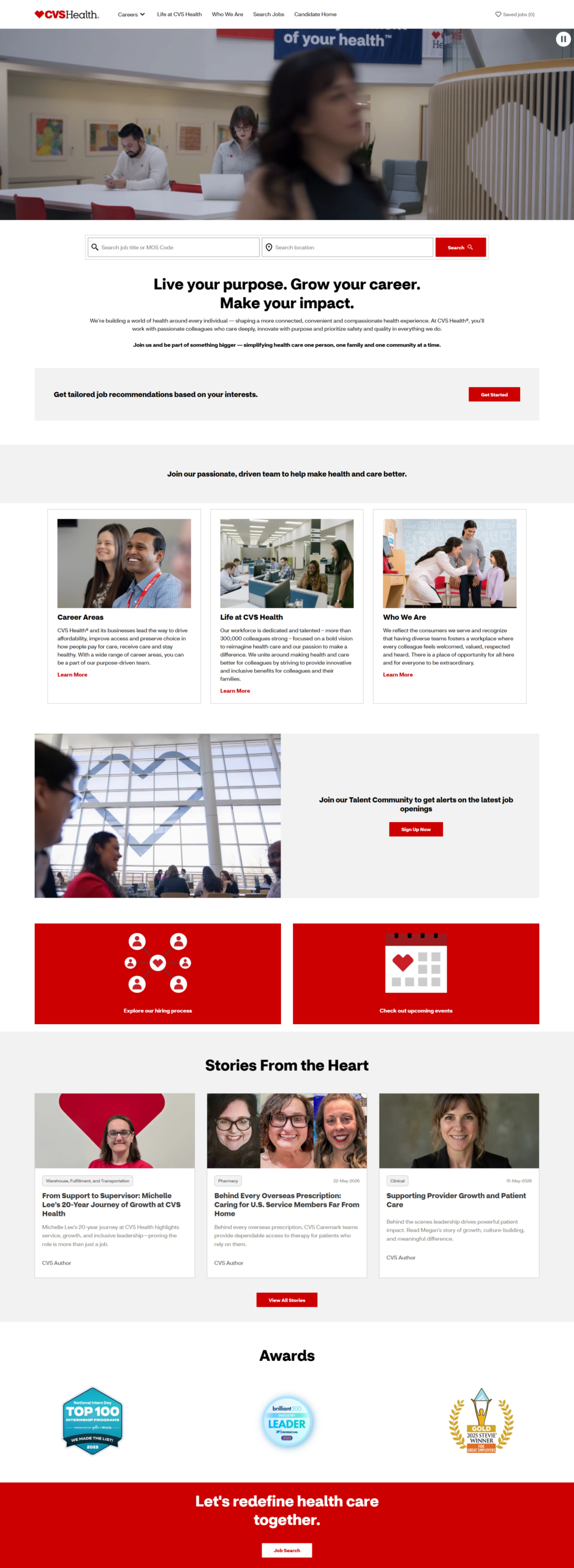
- “300K+ colleagues
- “Reinventing health care” and “We’re constructing a universe of wellness around every consumer” convey scope and intent instantly. Aspirants can swiftly grasp the organization’s magnitude and vision prior to viewing any job postings.
- The accolades wall stands out as one of the most thorough on this list: 2026 Where You Work Matters Platinum Employer, LinkedIn Top Companies 2025 and 2026, 2025 CandE Award Winner for Candidate Experience, and Stevie Award for Great Employers are all showcased on the homepage.
- Content about community impact is precise and verifiable: CVS Health Foundation, Health Zones addressing social determinants of health, and Project Health Events are elaborated with actual program names and results, not vague “we give back” rhetoric.
- AI-driven job matching, tailored suggestions, and talent community sign-up are accessible on the site; the talent community call-to-action is easily visible for candidates who are not yet inclined to apply — retaining them in the pipeline without mandating an application.
- Clear tile-based navigation adapts seamlessly on mobile devices.
What You Can Adapt for Your Own Career Site
- Start with mission-related proof points before the job search field — Babbel’s 16M+ subscriptions, 80+ nationalities, and Fast Company ranking provide candidates with motivation to apply before they encounter an open position.
- Spotify is among the few organizations on this list that openly reveals how AI is incorporated in hiring; candidates are increasingly skeptical of opaque screening processes, and a single declaration of transparency distinguishes you.
- Visually differentiate your candidates from the homepage. If your workforce has distinct paths, ensure a store associate and a finance director do not sift through the same search results. Shopify’s department tile navigation (Engineering & Data, Design, Product, Commercial) serves as simple yet effective examples.
- L’oreal’s categorization by department, location, and brand results in a highly personalized career experience.
- Narrate your origin tale. Shopify’s snowboard developer and Canva’s Lego-block analogy, framing all provide candidates a relatable entry point into the organization before they see a single job opening.
- Highlight employee narratives or testimonials to offer candidates insight into what it’s like to be part of your company. Marriott’s ‘Life at Marriott’ shares stories about career advancement, opportunities, and belonging.
- Utilizing chatbots can decrease the time spent addressing candidates’ initial inquiries. If a chatbot isn’t feasible, a careers FAQ section serves as a solid alternative.
- Implement a Talent Community/Network sign-up to capture qualified candidates and maintain the candidate pipeline.
Why I composed this
Corporate career pages are a vital aspect of your online recruitment strategy. The aim is to captivate and engage candidates, guiding them toward your job vacancies. Ongig’s Career Site Builder assists employers in creating impressive career sites featuring a drag-and-drop builder, AI-driven search, instant microsite pages, and dynamic job descriptions.
Acknowledgments:
2025 Job Seeker Nation Report (by Employ)
State of Candidate Experience: 2025 Benchmarks Report (by Phenom)