
The domain of account management is evolving into a vibrant marketplace. Distinguishing oneself is not merely a choice; it’s an imperative. For individuals aiming for account management positions, it is essential to showcase their distinct account management abilities that employers desire. Failing to convey these strengths clearly puts candidates at risk of being unnoticed in this fiercely competitive arena where hiring executives prioritize both technical and interpersonal proficiency.
This guide is designed for individuals pursuing careers in account management, including those transitioning from sales, marketing, or customer service, as well as leaders seeking executive roles. It delves into the crucial account management competencies that employers prioritize, the impact of these abilities on client outcomes, and tactics for effectively featuring them on resumes and during interviews. Mastering these account management competencies will empower job seekers to boost their career opportunities while positioning themselves as invaluable resources for employers.

What Makes Account Management Skills a Vital Business Function?
Account management acts as the link between a company and its clients. Unlike fleeting sales transactions, account managers concentrate on nurturing enduring partnerships that yield recurring revenue and enhanced client satisfaction. Candidates with proficient account management skills contribute significantly to:
- Client Retention: According to LinkedIn’s Future of Skills report, relationship management ranks among the most sought-after soft skills that employers demand, underscoring its pivotal role in organizational achievement. This role necessitates balancing client requirements with corporate aims. While sales personnel may close deals, account managers guarantee client success by tracking performance, addressing issues, and offering customized solutions. This interaction highlights the strategic value of account managers, who enhance retention rates, cross-sell opportunities, and customer lifetime value.
- Increased Revenue: In industries such as IT, finance, and marketing, where continuous service delivery is essential, account managers are perceived as advisors rather than mere transactional intermediaries. They demonstrate the capacity to think critically and tailor solutions to evolving client demands to ensure satisfaction and encourage the purchase of additional products or services.
- Brand Advocacy: Robust account management not only minimizes churn but also bolsters the organization’s reputation by building client trust. For career professionals, honing specialized skills in this area lays out clear pathways for progression into leadership, consulting, or executive-level business development roles.
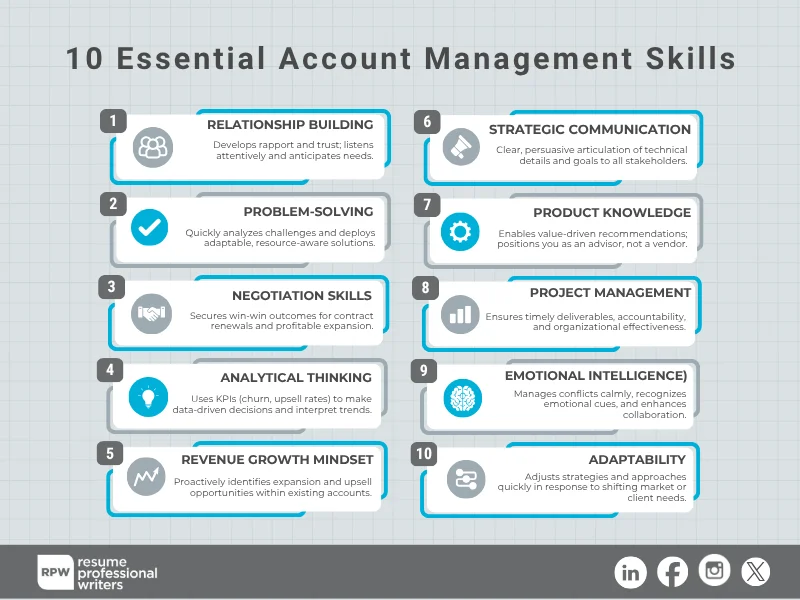
10 Essential Account Management Skills Every Professional Requires
- Relationship Building – Account managers thrive by fostering trust and rapport with clients. Employers seek individuals who listen intently, respond consistently, and anticipate client expectations. Strong client relationships enhance retention, which directly influences profitability and long-term contracts.
- Strategic Communication – Effective and compelling communication across emails, presentations, and meetings is vital. Account managers must blend technical detail with accessible language to ensure that both internal stakeholders and clients grasp progress and goals.
- Problem-Solving – Clients frequently face challenges that necessitate immediate resolutions. Successful account managers swiftly assess situations, collaborate with pertinent teams, and implement flexible strategies that fulfill the client’s requirements without jeopardizing organizational resources.
- Product and Industry Knowledge – Grasping the company’s offerings and industry dynamics enables account managers to deliver pertinent, value-driven suggestions. This expertise cultivates client trust and permits professionals to function as advisors rather than simply vendors.
- Negotiation Skills – Whether securing contract renewals or cross-selling products, negotiation is crucial. Competent account managers discover solutions that align organizational profit margins with client satisfaction, ensuring mutually beneficial outcomes.
- Project Management – Overseeing timelines, deliverables, and cross-departmental teams aids in fulfilling commitments. Strong project management skills exhibit accountability and organizational capability, both of which foster client trust.
- Analytical Thinking – Evaluating account performance through KPIs such as retention, churn, or upsell rates enables account managers to make informed, data-driven decisions. Employers appreciate professionals who can monitor, interpret, and respond to trends.
- Emotional Intelligence (EQ) – Clients react positively to account managers who pick up on emotional signals, maintain composure in stressful situations, and handle conflicts adeptly. EQ improves collaboration while making interactions more constructive and pleasant.
- Revenue Growth Mindset – Beyond preserving existing accounts, account managers must identify avenues for expansion. Leveraging cross-selling and upselling necessitates the capability to align business objectives with client aspirations.
- Adaptability – Given shifting markets and evolving client expectations, adaptability is vital. Account managers who welcome flexibility and modify their strategies remain essential during uncertain times or organizational transformations.
How to Display Account Management Skills on a Resume
To be distinguished in this competitive domain, professionals must skillfully present their account management competencies and other pertinent abilities on their resumes. Here are some techniques:
- Quantify Achievements: Resumes that effectively showcase account management skills incorporate measurable results and industry-specific language. Employers examining applications through Applicant…
Tracking Systems (ATS) give precedence to candidates who showcase both role-specific proficiency and measurable impact. The strategic arrangement of keywords frequently dictates whether applications succeed in passing automated screening.
- Exhibit Concrete Results: Instead of merely enumerating skills, job hunters need to demonstrate how their account management capabilities have resulted in significant achievements. Instances may involve enhanced retention rates, heightened client satisfaction ratings, or revenue growth achieved via value-oriented account strategies. Incorporating metrics—such as retention rates, growth rates, or contract renewal durations—bolsters credibility and sets candidates apart from rivals relying on generic descriptions.
- Combine Hard and Soft Skills: Furthermore, resumes should exhibit a mixture of hard and soft skills. For example, fusing expertise in project management tools with exceptional interpersonal communication indicates adaptability. Customizing resumes to resonate with industry focuses like healthcare compliance, IT systems integration, or financial portfolio advancement demonstrates to employers a tailored fit.
Training, Certifications, and Tools for Elevating Account Management
Numerous employers favor or necessitate professionals possessing certifications that affirm account management competencies. These qualifications not only elevate resumes but also strengthen trust with clients and peers. Here are several vital domains to take into account:
- Certifications: Options recognized by the industry, such as Certified Professional Sales Leader (CPSL), Strategic Account Management Association (SAMA) certification, or training programs in customer relationship management (CRM) platforms like Salesforce or HubSpot.
- Training Opportunities: Job seekers also gain from instruction in data analytics, presentation prowess, and negotiation tactics to reinforce their fundamental skills.
- Technical Tools: Proficiency in CRM systems allows account managers to accurately monitor client needs, anticipate trends, and generate comprehensive reports essential for executive decision-making. As more organizations adopt AI-powered analytics in client relationships, candidates who showcase both technical adaptability and interpersonal skills maintain competitive advantages.
Committing to training and certifications signals a dedication to professional development. Employers view continuous learning as a sign that professionals embrace evolving practices and sustain relevance in changing sectors. Merging formal qualifications with tangible achievements creates a more robust position for promotions or higher-level career prospects.
Career Prospects for Account Managers
The career path for account managers is robust throughout the United States, particularly within industries that heavily depend on customer loyalty and recurring revenue. According to the U.S. Bureau of Labor Statistics, employment in advertising, marketing, promotions, and related sectors is expected to expand steadily. Coupled with the growing significance of digital platforms and subscription-based business models, the necessity for proficient account management capabilities continues to increase.
Salary ranges fluctuate based on factors such as geographic area, industry specialization, and responsibility levels. For instance, account managers in the technology domain might receive significantly higher compensation than those in nonprofit sectors due to revenue-generating expectations. Senior account managers and directors additionally benefit from performance-related incentives linked to retention, cross-selling, and customer satisfaction outcomes.
Advancement opportunities within account management lead to executive roles like Client Services Director, Business Development Director, or Vice President of Customer Success. Many account managers also leverage their experience into entrepreneurship, consultancy, or leadership roles in customer-oriented organizations. This profession attracts individuals with both strategic acumen and people-centric ambition, rendering it one of the most dynamic career paths in the current employment landscape.

Master Skills That Propel Client and Career Success
Success in account management hinges on the capability to juggle trust-building, analytical reasoning, and long-term planning. By honing communication, negotiation, and adaptability as core competencies, job seekers align with the specific attributes employers are keen to identify.
Impressive resumes and compelling interview anecdotes frequently serve as the determining factor in landing valuable opportunities, and many professionals accelerate their progression by investing in ATS-optimized resume crafting services that enhance their strengths and meet employer demands. Invest in your future by mastering your account management capabilities today!
Frequently Asked Questions
What are the most essential account management skills?
The most essential account management competencies encompass relationship cultivation, communication, problem-solving, negotiation, and project management. These skills empower professionals to retain clients, boost revenue, and secure a competitive edge for employers.
How can job applicants emphasize account management skills on a resume?
Job candidates should incorporate quantifiable achievements, such as enhancing client retention rates or expanding accounts through upselling. Including both interpersonal abilities and technical knowledge, like CRM platform familiarity, ensures resumes align with employer expectations.
Are certifications obligatory for careers in account management?
Though not compulsory, certifications such as SAMA membership or CRM training bolster credibility and appeal to employers. Credentials indicate a commitment to professional growth and equip applicants with specialized insights.
What does the career forecast look like for account managers?
Account management represents a sought-after career with opportunities proliferating across technology, healthcare, finance, and marketing sectors. The increasing need for client retention in subscription-based business models propels heightened chances and enhanced compensation for professionals excelling in this arena.
How do account managers differ from sales representatives?
Sales representatives concentrate on closing transactions, while account managers oversee relationships post-contract signing. Account managers prioritize client satisfaction, retention, and revenue growth, positioning them as vital to long-term business success.