You’re not lagging behind on AI agents. You’re being marketed copilots and led to believe they’re agents. Almost every hiring tool now includes one, and most are chatbots that only engage when you click.
A genuine agent is distinct: it adopts a target, performs the tasks, and adjusts independently — the disparity, for a company, between software that assists and software that alleviates the mundane tasks from your desktop.
This guide elucidates what AI agents in recruitment truly are, their distinctions from automation tools, and how to recognize authentic ones.
What Are AI Agents in Recruitment?
AI agents in recruitment are software systems that independently execute multi-step recruiting tasks — sourcing, screening, outreach, scheduling, administration — towards a target you establish, adjusting as they proceed, with human supervision rather than constant human involvement. Unlike a tool that awaits a prompt, an agent takes action.
It’s helpful to envision agents at the pinnacle of a hierarchy, as most “AI” tools reside lower:
- Assistive AI proposes and summarizes — a résumé outline, a draft.
- Copilots perform a task when you request — compose this message, locate these candidates.
- Semi-agentic systems manage multi-step workflows proactively, under your oversight.
- Autonomous agents take ownership of a process end to end and adjust, escalating to you when judgement is required.
The catch: numerous vendors label a copilot as an “agent.” The evaluation is whether it acts independently towards a target or waits for you to initiate. Agents are the forefront of AI recruiting more generally — the juncture where AI transitions from assisting to executing.
AI Agents vs. Traditional Recruitment Automation: What’s Actually Different
If you’re already utilizing recruitment automation, it’s reasonable to inquire what an agent contributes. The distinction lies in autonomy and adaptability. Picture three tiers:
- Rule-based automation executes if-this-then-that logic. A candidate applies ? an email is sent. A stage changes ? a task is generated. Dependable, yet it only performs exactly what you scripted, and it doesn’t reason.
- Generative AI comprehends and creates — a job description, a summary, an outreach draft — but it waits for your cue and your evaluation at each step.
- AI agents merge both and introduce a third element: they pursue a goal across multiple stages, determine the next steps, and adjust when something shifts — without being instructed each time.
A rule-based recipe sends a follow-up on the third day regardless of its relevance. An agent decides whether to reach out, through which channel, with what message, based on the candidate’s actions — then amends the record afterward.
Automation eliminates the clicks. An agent removes the decision and the clicks for routine work, delegating judgment to you. That’s why agents amplify where automation levels off: automation accelerates the same step; an agent completely takes the task off your hands.
How AI Agents Work Across the Recruitment Lifecycle
Agents aren’t a singular feature; they’re a collection of specialists, each managing a segment of the recruiting workflow. Here’s how they correspond to the lifecycle, utilizing Recruiterflow’s AI-native layer, AIRA, as an example.
Sourcing.
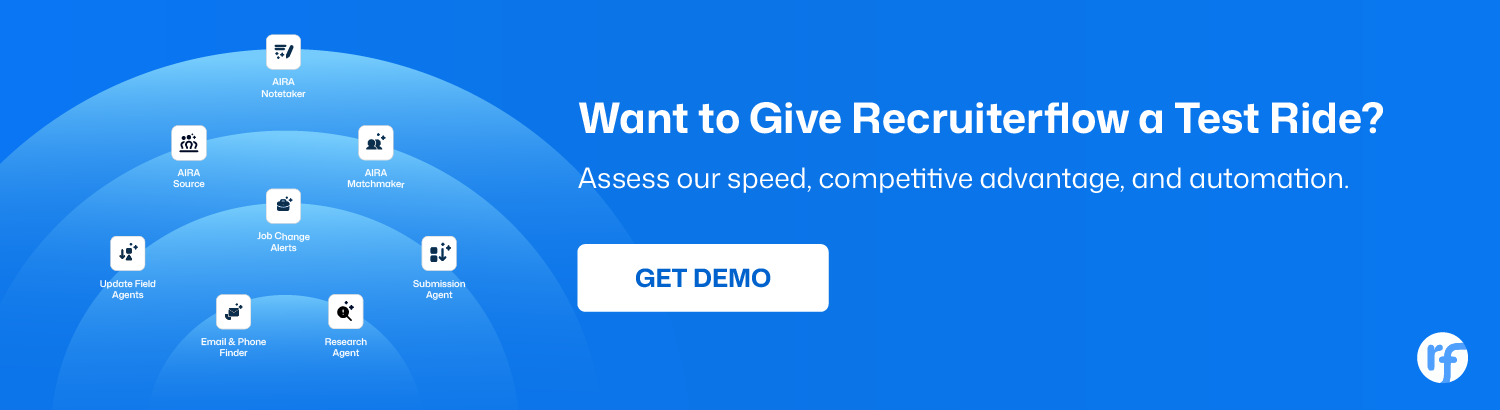
A sourcing agent analyzes a role and highlights the most suitable candidates — including passive ones already existing in your database — rather than waiting for you to create a Boolean string. AIRA Source and Matchmaker prioritize your own CRM first, where the majority of placements actually originate. (More on candidate sourcing here.)
Screening.
A screening agent assesses and ranks candidates against the role, managing a volume a human cannot — highlighting the few worthy of your time.
Outreach.
Instead of a sales tool appended, multichannel sequences (Sequences 2.0) operate email, LinkedIn, and SMS natively, with AIRA composing openers from genuine candidate signals — a job change, a previous role — so outreach at scale still appears one-to-one.
Interviewing and notes.
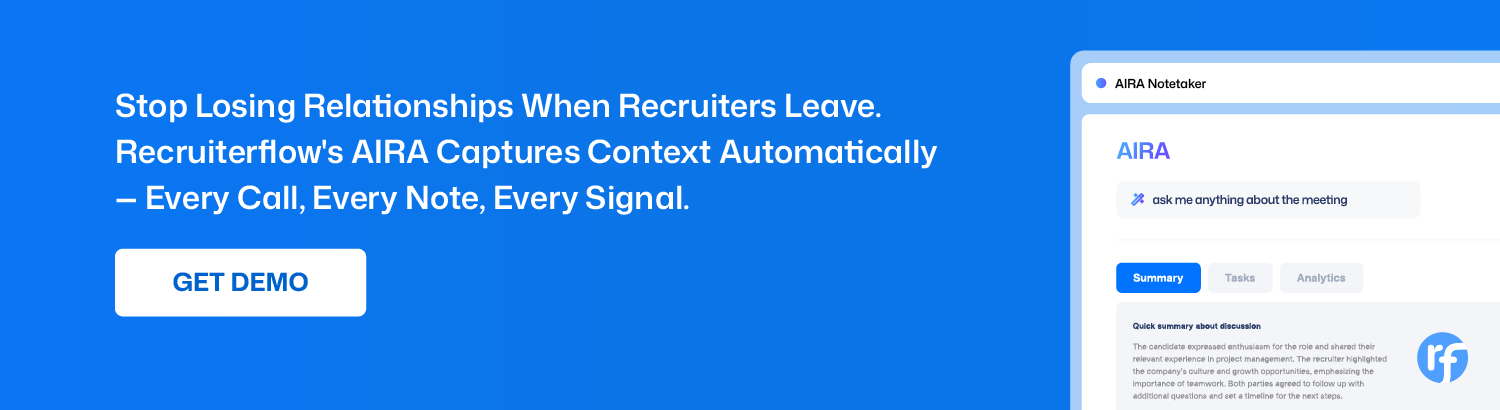
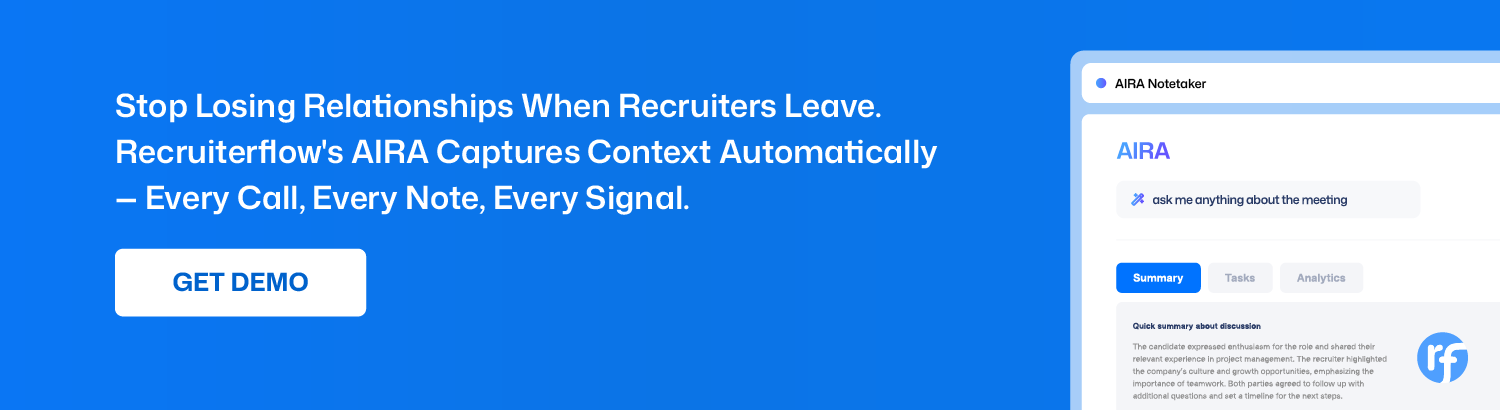
AIRA Notetaker joins the discussion, records the summary, and updates the CRM automatically — converting a conversation into a structured record without post-call administration.
Admin and the database.
The silent workhorses: AIRA Update Field Agent maintains current records; Job Change Alerts notify when someone in your database transitions — a live placement signal most firms overlook; the Submission Agent drafts client-ready reports.
No individual agent operates the desk. Collectively, they eliminate the tasks that were never the recruiter’s actual responsibility.
Top Use Cases for Recruitment and Executive Search Firms
The agentic tools making headlines — Paradox, Eightfold, Workday’s agents — are designed for enterprise in-house teams hiring at a high volume.
For a recruiting or search firm, the high-value applications appear different:
- Reviving a stagnant database. About 71% of placements come from candidates already in your CRM. A job-change agent monitors for the moment a prior candidate becomes available and highlights it — transforming a static database into a dynamic pipeline.
- Eliminating the administrative burden. Notetaking, CRM updates, submission drafts — the tasks that consume roughly
40% of a recruiter’s week — allocated to agents, yielding 10–15 hours.
- Rapid sourcing and screening without sacrificing the specialty. Agents manage the top-of-funnel volume, allowing consultants to concentrate on fit and relationships instead of Boolean strings.
The role of agents is determined by the desk:
- High-volume, lower-complexity positions (contract, frontline) benefit from extensive automation — agents oversee most of the process.
- Executive and retained search values discernment. In this context, agents assume a supportive function: the Research Agent gathers insights on a company and develops a shortlist prior to any outreach, and AIRA Notetaker records every interaction throughout an extended mandate — while the consultant leads the search, makes client introductions, and maintains the relationship.
The evidence lies in actual desks. Andiamo, a niche tech search agency, utilized AIRA Notetaker and agents to submit at double the speed and amplify revenue by 4× — without increasing headcount.
How to Assess and Integrate AI Agents in Your Organization
Given that “agent” is among the most exaggerated terms in recruitment technology currently, assessment largely revolves around discerning fact from fiction. A few inquiries can differentiate a genuine agent from a rebranded copilot:
- Does it execute or merely recommend? Inquire about a workflow it manages from start to finish without a human having to initiate each step. If every action requires a click, it’s a copilot.
- Is it embedded or added on? An agent attached to a legacy system accesses only fragments. One integrated into your ATS and CRM possesses complete context — every candidate, client, and interaction — which makes its decisions effective.
- How extensive is the agent suite? A solitary chatbot does not constitute an agentic platform. Seek agents across sourcing, screening, outreach, notes, and administrative tasks that utilize the same data.
- Where is the human involvement? The appropriate response is never “nowhere.” Agents should handle predictable tasks and elevate judgment calls — closing, sensitive discussions, final determinations — to you.
- Designed for firms or for corporate TA? The majority of agentic tools are tailored for internal, high-volume recruitment. Ensure the workflows align with how a firm actually operates: job orders, submittals, client management.
For integration, start discreetly. Choose one high-impact, low-risk task — notetaking or follow-ups are excellent initial agents — demonstrate the time saved, and then broaden. Maintain a human verifying any client- or candidate-facing activities while you establish trust.
Our recruitment best practices guide provides insights into the operational rhythm surrounding it.
The Verdict
AI agents represent a genuine transformation in recruitment technology — not because they replace recruiters, but because they effectively eliminate tasks that were never meant for recruiters. Firms that succeed with them will be those that select true agents over rebranded copilots, preserve human discernment, and operate everything from the system where the work already resides.
Recruiterflow has been paving the way for this since 2023, when it delivered agentic AI prior to the term being coined.
Common Inquiries
Will AI agents supplant human recruiters?
No. Agents assume tasks, not recruiters. They manage sourcing, screening, notetaking, and follow-up that occupy a recruiter’s week — but they cannot secure a candidate, interpret unspoken nuances, earn a client’s trust, or decide on a borderline fit. Recruiters who excel will delegate the mundane tasks to agents and dedicate the freed-up time to those distinctly human activities. Surveys support this trend: approximately 52% of talent leaders intend to implement autonomous AI agents — as adjuncts to recruiters, not replacements.
What are the most effective AI agents for recruitment in 2026?
It varies based on your role. For enterprise in-house teams conducting high-volume hiring, conversational agents like Paradox (now integrated with Workday) and platforms like Eightfold are top choices. For recruitment and search firms, the pertinent agents function within a recruitment CRM — Recruiterflow’s AIRA suite (Source, Matchmaker, Notetaker, Submission Agent, Job Change Alerts) is designed for the job-order-and-submission cadence that those enterprise tools do not cater to. The honest filter: disregard anything that labels a chatbot as an “agent,” and prioritize agents that are native to the system housing your data.
What is the cost of AI recruiting agents?
It varies significantly, depending on whether agents are bundled together or billed separately. Entry ATS-plus-AI tools typically start around $15–20/user/month; enterprise agentic platforms (Paradox, Eightfold, Workday) are custom-quoted and can be quite costly. Recruiterflow starts at $119/user/month, with the AIRA agents included rather than sold separately. The crucial figure is not the price tag — it’s whether the hours saved surpass the expense, which typically happens rapidly for most firms.
What are the advantages and disadvantages of AI agents in recruitment?
The advantages: hours regained per recruiter, accelerated time-to-fill, a functional database, and uniformity across tasks. The cautions: numerous tools exaggerate copilots as agents; an agent’s effectiveness is contingent on the quality of its underlying data; and excessive automation of candidate-facing tasks may deteriorate the relationships needed to secure placements. When used effectively — agents for routine tasks, humans for judgment — the benefits vastly outweigh the risks. If misused, you merely automate a subpar version of existing processes.
Recruitment