

It appears that utilizing ChatGPT for job descriptions has established itself as the standard in the industry regarding speed. However, is text generated by AI sufficient to attract elite talent in 2026?
Although it can assist in overcoming “blank page syndrome,” I suggest using it as a drafting companion in conjunction with specialized optimization software.
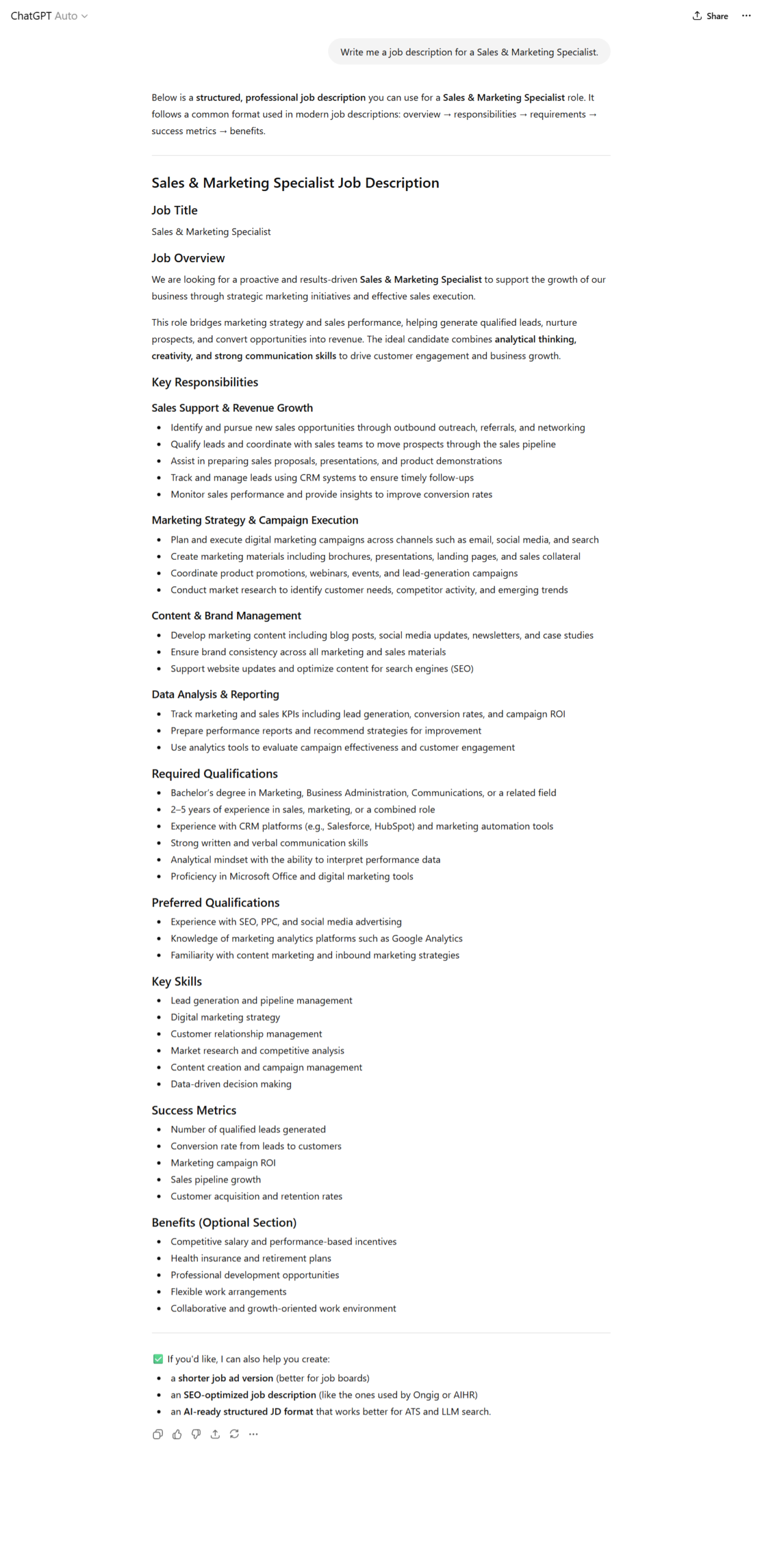
To evaluate how the newest models address a common request, I conducted an experiment employing OpenAI’s GPT-4o. My instruction was straightforward: “Create a job description for a Sales & Marketing Specialist.”
In less than 15 seconds, I received a complete draft encompassing a Job Overview, Key Responsibilities (tasks were organized into categories: Sales Support & Revenue Growth, Marketing Strategy & Campaign Execution, Content & Brand Management, Data Analysis & Reporting), Qualifications (divided into Required and Preferred) and Success Metrics (or KPIs), and Benefits.
AI models such as ChatGPT (now supported by the GPT-5 series) have transitioned from mere experimentation; they are crucial for producing natural language text that feels human, coherent, and captivating.
In 2026, amid genuine “AI-fatigue,” ChatGPT assists you in creating job descriptions that are finely adjusted to the particularities of your intended audience.
Additional advantages of employing ChatGPT for crafting job postings:
1. Review the grammar and style of your job description
ChatGPT excels at eliminating errors and “corporate jargon.” It can convert a hiring manager’s rough bullet points into refined, professional writing that consistently maintains an “Active Voice” throughout the document.
2. Enhancing for “AI Visibility” (The New SEO)
In 2026, ChatGPT aids you in optimizing for Generative Engine Optimization (GEO). By identifying specific “entities” and skills (e.g., “Prompt Engineering,” “Agentic Workflows,” or “Zero-Trust Security”) that AI search engines seek, ChatGPT guarantees that your job listing appears when applicants query AI assistants, “Locate high-growth remote roles in fintech.”
3. Infusing creativity to alleviate “AI-fatigue”
With a multitude of AI-generated job descriptions available, many postings sound alike. You can now utilize ChatGPT to incorporate storytelling. Rather than a monotonous list of duties, prompt it to: “Compose a ‘Day in the Life’ section for this role that underscores our dedication to sustainability and asynchronous work.”
4. Deep branding and Persona Harmony
Contemporary models (like OpenAI’s o1) can embody a distinct “Brand Persona.” You may supply it with your company’s cultural overview and direct it to: “Rewrite this JD in a ‘Challenger Brand’ tone—bold, straightforward, and slightly irreverent—while retaining stringent requirements.”
5. Accelerated global localization
If your operations are international, ChatGPT can swiftly translate your English job description into Spanish, Korean, or German.
Important!! Although the translation is grammatically correct, it often overlooks regional labor law details (like particular disability disclosures mandated in certain nations). Use ChatGPT for the initial draft, but always have a local specialist or a tool like Ongig verify for compliance.
Did ChatGPT Craft the Optimal Job Descriptions?
Upon my first attempt, my immediate reaction was, “wow that’s quick!”
However, when I pasted the text into Ongig’s Text Analyzer, I observed several issues/suggestions that wouldn’t be flagged by ChatGPT:
- The JD received a score of 53/100 for Readability — as it reads at an 11.8-grade level with sentences encompassing more than 20-30 syllables.
- The JD lacks important sections that candidates find valuable — Salary, DEI, EEO, About Us, Mission Statement, etc.
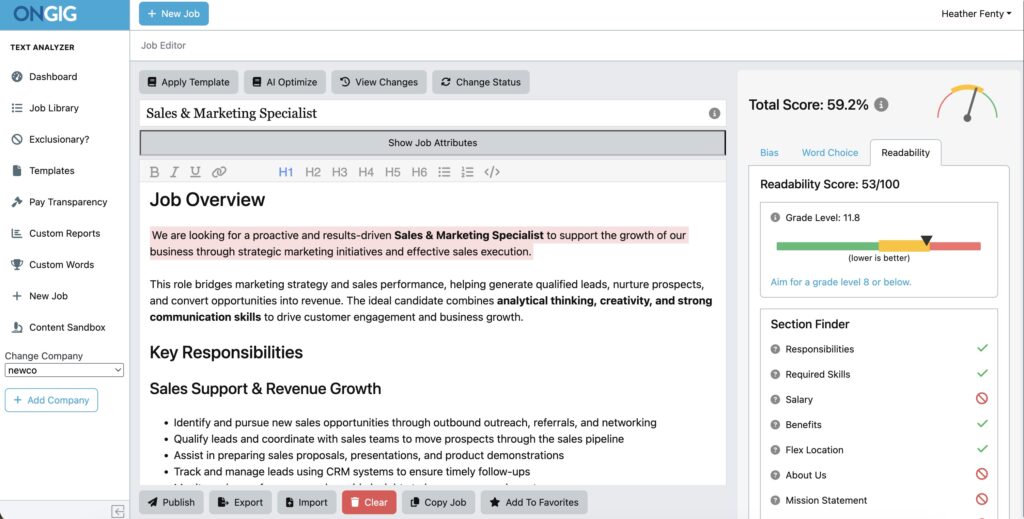
This illustrates why you should complement ChatGPT with a tool like Text Analyzer. Yes, ChatGPT is rapid, but missing components could negatively impact your application rates, particularly among diverse talent.
Following my initial evaluation, I delved deeper by providing ChatGPT with more prompts to refine the same job description.
For amusement, I employed the ChatGPT prompt “now express the same job description in the style of Snoop Dog.”
Here’s what I discovered from attempting to use AI for crafting optimal job descriptions…
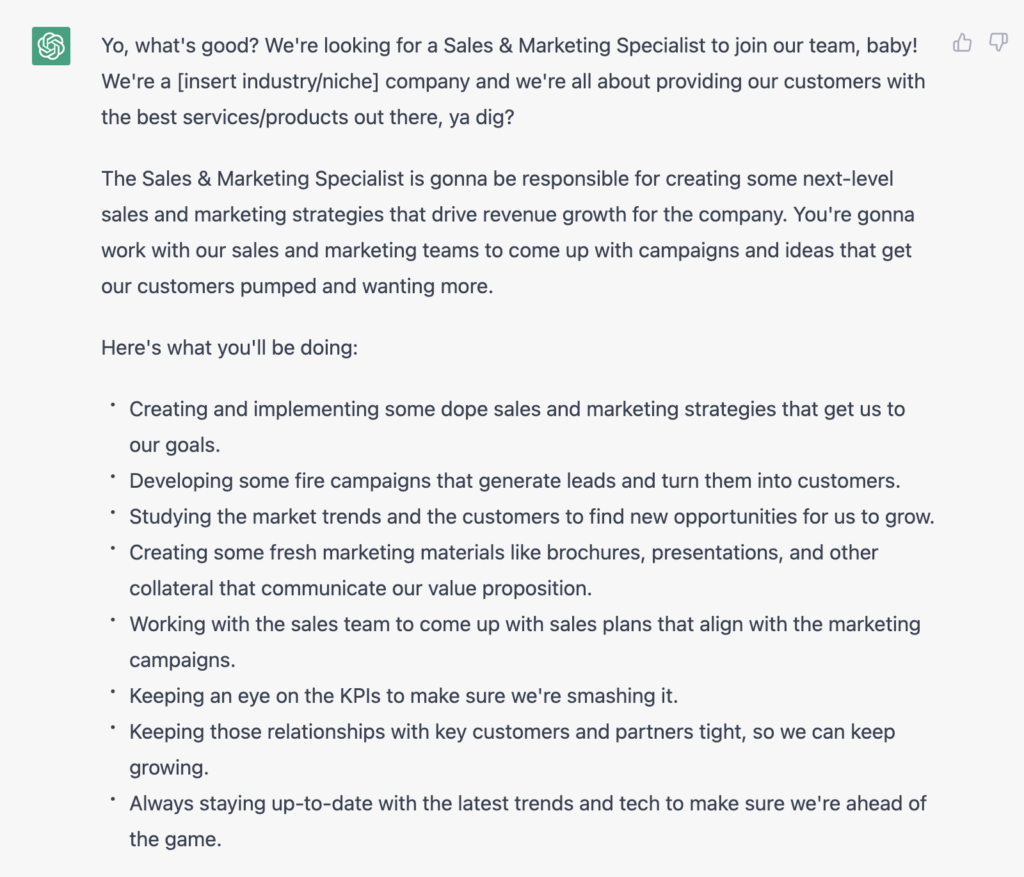
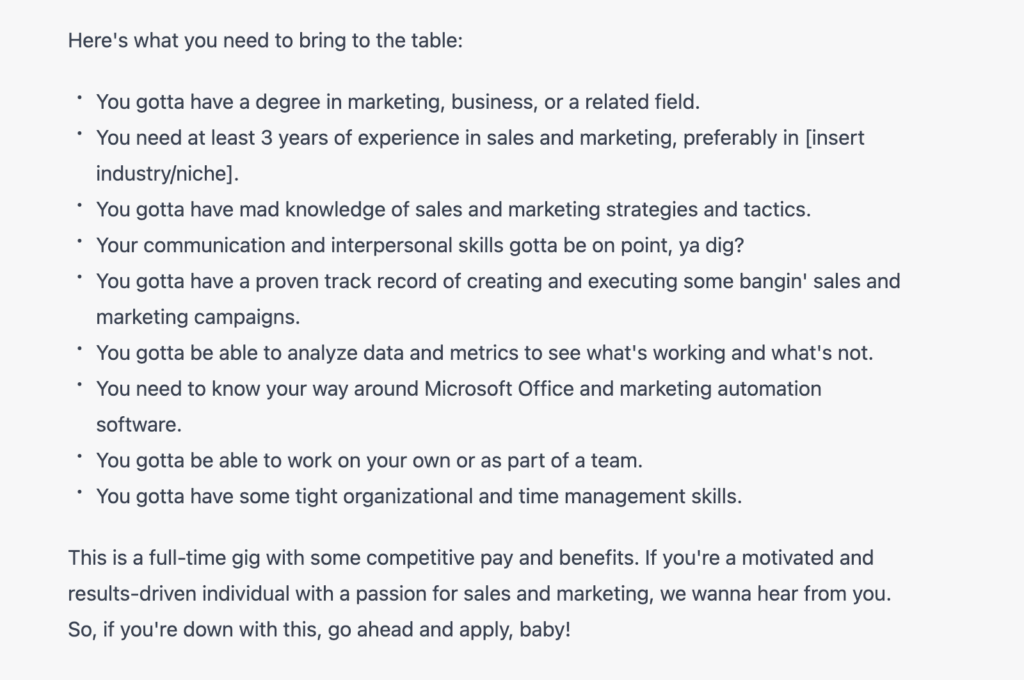
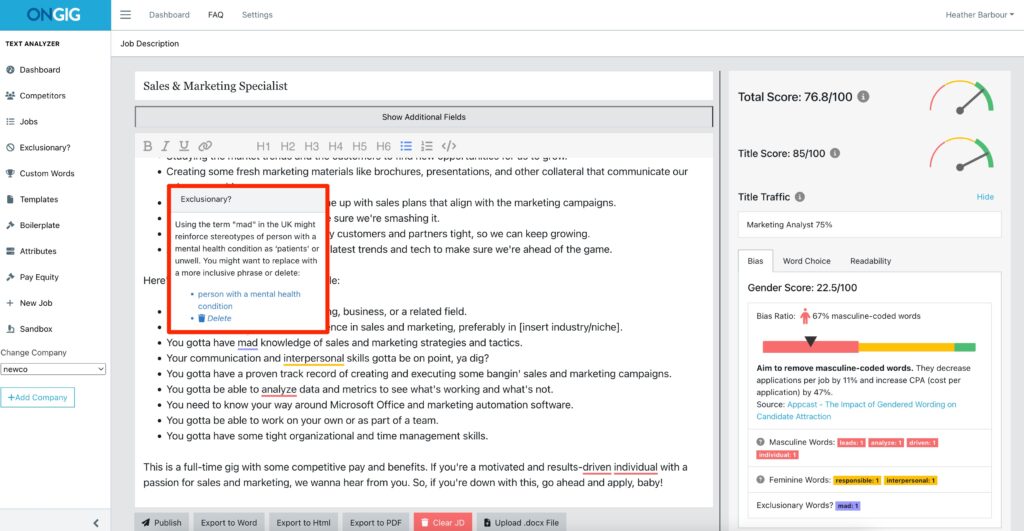
I found it intriguing that this ChatGPT job description achieved the highest overall score out of the 7 outputs I generated.
The total score was 76.8/100, and it attained a 100/100 for Readability because it reads at a 6.2-grade level (8th grade is optimal) and employs significantly fewer complex words and adverbs (the lesser these are used, the preferable).
However, Text Analyzer still uncovered several concerns:
- The JD received a score of 22.5/100 for Gender Bias — since 67% of the terminology used is identified as “masculine-coded.” This is merely a 2% reduction from the original JD.
- The “Requirements” segment contains over 7 points — Snoop Dog’s rendition may still discourage women and neurodivergent candidates from clicking “apply.”
- Some crucial sections that candidates value are still absent from the JD — Diversity & Inclusion, Flexible Location, Mission Statement, and others.
- The JD incorporates the potentially exclusionary term “mad” — Although Snoop intended “mad skills” to mean “a multitude of skills,” the term “mad” might perpetuate stereotypes about individuals with mental health conditions as “unwell” (particularly in the UK).
The other 5 prompts I employed to direct ChatGPT were:
- First prompt: “Please rephrase the original job description to be more succinct and user-friendly.”
- Second prompt: “Please revise this job description to eliminate masculine-coded terminology and biases.”
- Third prompt: “Please adjust this job description to incorporate a genuine salary range and fewer ‘requirements’.”
- Fourth prompt: “Please modify this job description to have between 300-700 words, free from gender-coded vocabulary and other biases, a concise list of requirements, and a section on salary and benefits.”
- Fifth prompt: “Please rewrite this job description to adopt a more conversational tone.”
The Conclusion? AI still needs a human (and a Specialized tool)
- The “Masculine-Coded” Feedback Loop
In spite of being instructed to eliminate bias, ChatGPT persisted in utilizing “agentic” phrases (e.g., lead, compete, driven).
LLMs are trained on countless existing JDs, most of which were crafted with conventional (and frequently biased) perspectives. By 2026, research indicates that AI often serves as a “bias echo chamber,” reflecting historical patterns instead of the inclusive ideals of the future. It can substitute “Salesman” with “Salesperson,” but it struggles to identify nuanced “coded” language that may discourage diverse candidates.
- Still reads at a grade level of 10 or higher
Most drafts continue to be assessed at a 10th-grade reading level or above.
AI favors “sophisticated” corporate jargon. Lacking a live readability assessment (like the one available in Ongig’s Text Analyzer), ChatGPT fails to recognize when it becomes overly complex. For optimal accessibility, JDs should strive for an 8th-grade reading level, but ChatGPT’s “professional” default is considerably higher, which can isolate a wider talent pool.
The drafts frequently lacked comprehensive salary ranges, precise diversity statements, or distinct hybrid/remote work “blocks.”
In 2026, it remains a shortfall because:
- Salary: In 2026, over 20 states now require salary transparency. ChatGPT is unaware of your particular internal budget or the latest state-specific “closed range” regulations (which now prohibit vague phrases like $50k and up).
- Benefits: Occasionally, AI “creates” benefits such as unlimited PTO or 401k matching simply because they are prevalent in its training data—leading to significant legal complications if those aren’t actually your organization’s policies.
- Diversity Statements: ChatGPT frequently generates ‘boilerplate’ diversity statements that feel generic. By 2026, candidates seek organizations that employ specific, culturally aware inclusive language. ChatGPT defaults to the ‘legal minimum,’ which may render your organization sounding uninspired.
- Flexible Location: While ChatGPT grasps ‘remote,’ it doesn’t comprehend your specific 2026 hybrid policy (e.g., ‘3 days in-office for collaboration, 2 days remote’). It also neglects the intricate tax and labor regulations that differ by state for remote employees—details a general AI simply isn’t programmed to verify.
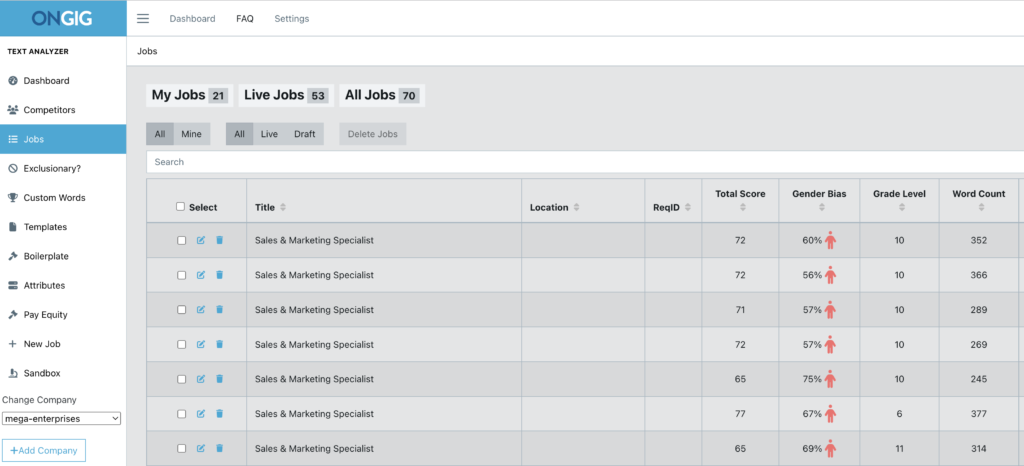
From my assessment, utilizing ChatGPT is satisfactory for JDs. However, I would not abandon all job description tools in favor of exclusively using ChatGPT. If you do use it, consider employing it alongside a tool like Text Analyzer to guarantee your JDs are comprehensible, effective, consistent, and free from bias.
Nevertheless, crafting the job description is merely one element of the equation.
Most organizations aren’t solely focused on producing a superior job post. They are trying to handle hundreds (sometimes thousands) of them across teams, systems, and layers of approval. This is where workflow and structure become just as vital as the content itself.
Transitioning from Draft to Publication: Mastering Job Content
Once you’ve crafted a robust job description draft — whether through AI or manually — the subsequent challenge is managing that content throughout your organization.
Rather than juggling Word documents, shared drives, and email approvals, platforms such as Ongig consolidate the entire process in one location.
Centralize and standardize job descriptions.
Numerous teams still navigate job descriptions across various folders, inboxes, and outdated files. A centralized job library enables teams to store, search, and manage all positions within a single system. With intelligent templates, customizable fields (like job families or req IDs), and version history, organizations can achieve consistency without hindering team efficiency.
Generate better job descriptions more rapidly.
AI-enhanced drafting and rewriting tools assist teams in quickly producing job descriptions while integrated guidance enhances readability and highlights exclusionary language. Rather than rewriting similar roles from scratch, recruiters can commence from standardized templates and concentrate on refining the role.
Maintain synchronization with your ATS.
One of the primary frustrations recruiters encounter is version inconsistency among job descriptions, ATS listings, and career sites. Integrations with ATS and HRIS platforms help eliminate redundant data entry and ensure updates remain aligned across systems.
Enforce compliance and approval processes.
Job descriptions frequently necessitate review from HR, legal, or leadership. Role-based workflows
make it more straightforward to navigate content through edit → review → approval phases with integrated notifications and audit trails. Aspects like salary transparency assessments and revision monitoring also assist teams in remaining compliant without the need to manually vet each posting.
Enhance job posting effectiveness at scale.
AI-driven editing and title evaluation can assist in enhancing job descriptions for clarity, inclusion, and search visibility. Teams can also make wholesale updates across numerous roles and preview modifications prior to publishing.
Provide an improved career site experience.
Ultimately, job descriptions should not merely reside in documents—they must function effectively on your career site. Contemporary platforms enable firms to transform job descriptions into mobile-optimized, SEO-friendly pages that synchronize directly with the ATS and enhance job search for applicants.
A Unified System Instead of Manual Disorder
From drafting to approval to publishing, modern job description platforms impose order on what is often a chaotic, manual procedure. AI can expedite the writing process, but the true advantage arises from merging AI with systems that enforce workflows, uphold compliance, and ensure job content uniformity across your organization.
Additional ChatGPT Limitations When Crafting Job Descriptions
Inability to grasp the context or essential specifics of the job role
ChatGPT’s lack of comprehension regarding the subtleties of a specific role may lead to ambiguous job descriptions or a failure to accurately communicate the position’s needs and expectations.
AI often defaults to technical terminology that can alienate unconventional candidates. Without human-directed context, it might neglect to state that a “Software Engineer” at your organization must also function as a “Product Thinker,” causing a disconnect in candidate expectations.
Ignorance of legal and compliance standards related to job postings
ChatGPT may not be aware of employment opportunity policies (EEO) concerning non-discrimination and diversity. It needs programming to grasp the complexities of employment laws, which differ by location or region.
Numerous jurisdictions now mandate specific Salary Transparency disclosures and AI-usage notifications in job postings. ChatGPT might utilize a generic template that excludes these vital legal disclaimers, leaving your company exposed to penalties ($500–$1,500 per violation in certain states). It also lacks an integrated “Equal Opportunity Employer” (EEO) verifier capable of identifying non-compliant wording in real-time.
Insufficient industry-specific knowledge
ChatGPT may lack expertise in particular or technical domains, resulting in ineffective job descriptions. It might also misinterpret job descriptions for positions requiring specialized knowledge. In niche or technical fields, additional insights from subject matter experts may be necessary to accurately outline job responsibilities and expectations.
ChatGPT may “hallucinate” or disregard specific industry demands—such as a particular nursing license (RN vs. LPN) or a specialized software certification. Without a specialized tool like Ongig, you risk attracting candidates who are technically unqualified but “appear suitable” to an AI-generated job description.
The descriptions may seem generic and not reflect your company’s culture, mission, and values
Large language models like ChatGPT are generally not granted access to internal information systems within a company, so they cannot directly access documents or blogs detailing your organization’s values or culture. ChatGPT typically relies on publicly accessible information such as your social media posts or news articles, which may be incomplete or outdated, leading to a misrepresentation of your culture, mission, and vision.
Because ChatGPT does not have access to your internal culture presentations or current “Day in the Life” employee testimonials, it cannot write with the authenticity needed to win the “War for Talent.” To stand out, you must align your text with your company’s distinct values and brand voice.
Mitigating ChatGPT’s Limitations
Fortunately, there are strategies to address ChatGPT’s shortcomings:
Utilize “Custom GPTs”
Upload your company’s actual Culture Code, Diversity Reports, and successful past job descriptions into a private ‘ChatGPT Project.’ This offers the model a ‘Source of Truth,’ ensuring it employs your distinct brand voice instead of a generic internet average.
Utilize straightforward language
Use plain and uncomplicated language when providing instructions. Stay away from technical jargon or complex terminology that might confuse the AI model and result in less comprehensible output.
Employ “System-Role” Prompting
Don’t just request a job description.
Assign the AI a role: ‘You are an Expert Inclusive Recruiter specializing in the Tech Industry.’ This compels the model to prioritize 2026 standards, such as skills-based hiring and neurodiversity-friendly language, which a standard prompt might overlook.”
Provide feedback and samples
Use “Few-Shot” Prompting.
Offer the AI 2-3 examples of your finest job postings. This grounds the AI in your specific brand voice and prevents the “hallucination” of generic corporate jargon.
Introduce a “Compliance & Bias Layer
Generic AI cannot monitor real-time labor laws. Make use of specialized tools like Ongig’s Text Analyzer to audit AI outputs for state-specific salary transparency regulations and “hidden” gender-coded language.
Evaluate your output
Under new 2026 regulations (such as the EU AI Act and various US state laws), companies bear legal responsibility for their AI outputs. Every job description should undergo a ‘Human Audit’ by a Hiring Manager to ensure the role’s ‘soul’ and technical correctness are preserved.
Optimization for GEO (AI Search)
Don’t just iterate for humans; iterate for search.
Ensure your job description incorporates the specific “entities” and skills that Generative Engines (like Perplexity or GPT Search) utilize to categorize your job for applicants.
The 2026 Recruiter’s Compliance Checklist
Before you click “Publish” on any AI-generated job description, confirm your job description:
1. Did the AI utilize “masculine-coded” proxies (e.g., ninja, rockstar, fearless)?
Use a specialized tool like Ongig to evaluate your text for gender and neurodiversity neutrality.
2. Does your job description include a specific, good-faith salary range (not a placeholder like $0-$999k)?
Always verify against your actual budget.
3. Is your job description composed at an 8th-grade reading level?
Avoiding intricate jargon ensures your job description is understandable for all candidates and easily summarized by the AI search agents (GEO)
4. Has a human hiring manager examined the “Responsibilities” section for technical accuracy?
Never allow an AI to “auto-publish” a job description without a manual endorsement.
5. Did you include a notification that AI was utilized in the recruitment process?
Numerous jurisdictions (like New York City and various EU member states) now necessitate employers to inform candidates if AI is employed to screen, rank, or draft the position they are applying for.
My Motivation for Writing This:
At Ongig, our mission remains unchanged: to create impactful and inclusive job descriptions.
We believe that while AI should undertake the “heavy lifting” of drafting, the resultant product must be focused on humans, legally compliant, and devoid of biases. We assist you in optimizing your workflow so you can compose the best job descriptions swiftly, at scale, without compromising the quality or diversity of your talent pool. Please request a free demo if you wish to discover more about Text Analyzer.