Is your HR team prepared for 2026?
The human resource function has experienced a notable transformation. The latest HR trends for 2026 underscore a significant shift in emphasis from administrative activities to strategic roles. This evolution, propelled by HR automation, is actively influencing business success and workforce dynamics. HR’s function is now crucial in developing agile organizations and enhancing employee experiences.
Key Overview
- » HR will emphasize human adaptability, ongoing reskilling, & skills-based recruitment.
- » Predictive analytics & AI will anticipate turnover, engagement, & productivity patterns.
- » HR leaders will harmonize global objectives with local regulations, manage hybrid teams, freelancers, and promote sustainable HRM.
- » AI, behavioral science, & ESG alignment will foster transparency & trust in contemporary workplaces.
- » CHROs are emerging as pivotal change leaders in enterprises.
- » Generative AI will enhance efficiency, while a holistic, human-centric approach to well-being fosters connection & belonging.
The pace of transformation is being hastened by digital advancements and the expectations of the workforce. Contemporary HR is now leveraging the latest technology to make choices that are genuinely data-informed. They are navigating the increasingly complex realm of global talent acquisition, retention, and compliance with the assistance of these innovations.
In this article, we will explore the recent HR trends for 2026 that will impact future workplace culture.
Recent HR Trends 2026: How Will Work Environments Evolve?
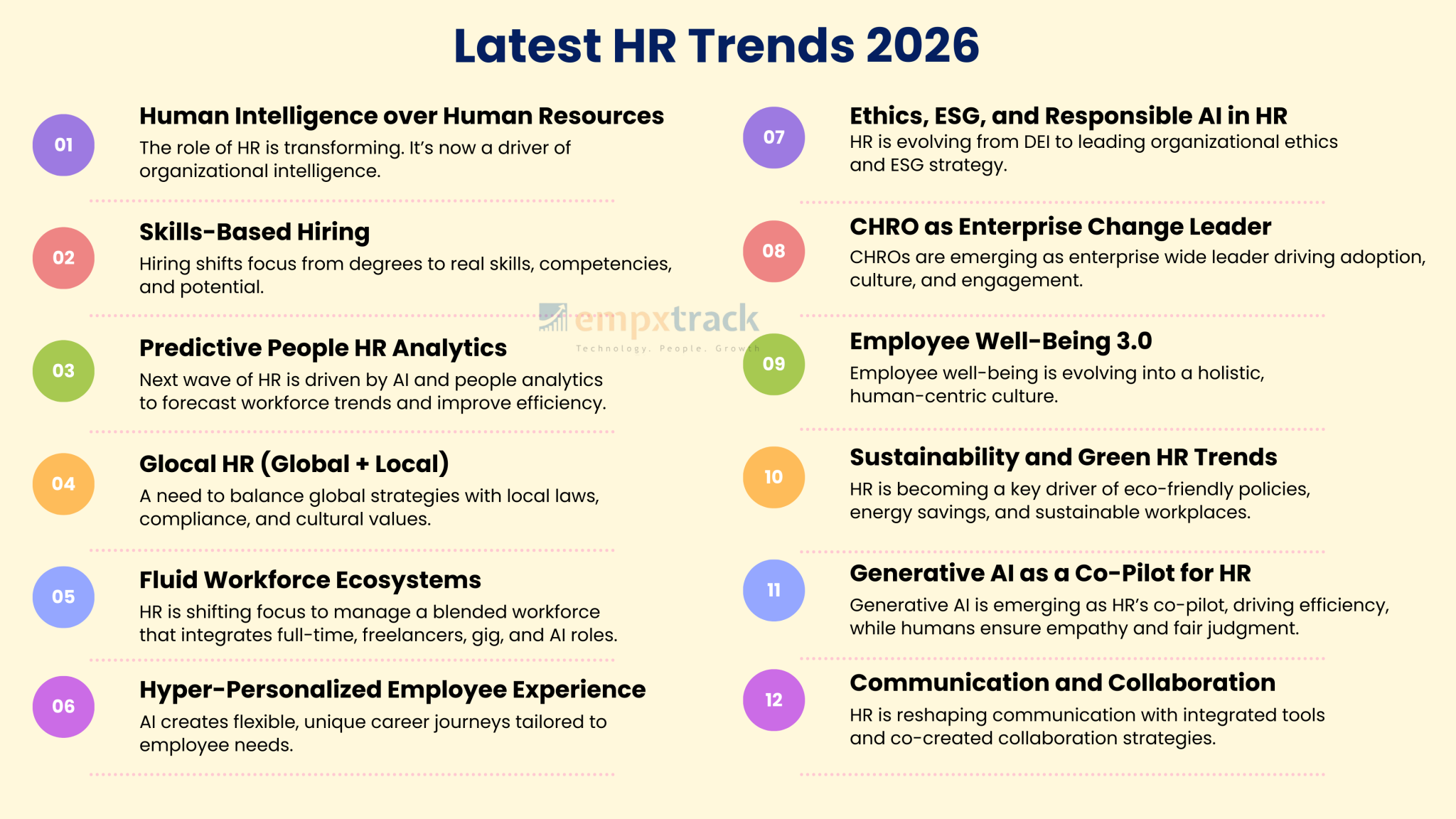
1. Human Intelligence over Human Resources
Human intelligence generally refers to the capacity to learn from experiences and adapt this knowledge to influence the surroundings.
Human intelligence provides a novel viewpoint on how work is actually performed, rather than relying solely on strict, hierarchical evaluations or transactional data.
Human resource professionals are now the catalysts of organizational intelligence. By 2026, HR will concentrate primarily on how individuals think, learn, adapt, and innovate.
2. Skills-Focused Recruitment and Reskilling
By 2026, ongoing education, reskilling, and upskilling will also become central business priorities. Organizations will emphasize skills over formal qualifications and implement skills-driven recruitment. This will allow them to access a wider talent pool and ensure that new hires are genuinely capable, thus shortening productivity turnaround time.
According to Forbes, employers acknowledge that skills-focused recruitment results in superior hiring decisions, with 90% asserting they make better hires based on proficiencies rather than educational credentials.
3. Predictive Human Analytics in HR
The forthcoming phase of HR will increasingly rely on people analytics platforms for contemporary business practices, such as sophisticated dashboards and reporting tools. By utilizing HR technology trends and human capital management innovations, data-driven decisions will enhance operational efficiency across sectors and improve workforce forecasting abilities.
So, what does this imply for HR leaders? They can forecast global trends like employee engagement or leave patterns using statistical models and machine learning algorithms. These insights will assist them in identifying patterns such as turnover or productivity trends and facilitate the anticipation of future needs.
According to MarketsandMarkets, the global market is projected to reach USD 28.1 billion by the close of 2026, expanding at a CAGR of 21.7%.
4. Glocal HR (Global + Local)
As 2026 approaches, companies and global leaders operating in APAC, EU, and the US will need to reconcile global strategies with local compliance standards, labor laws, and cultural practices.
What does this entail? This indicates that HR leaders must now invest in compliance intelligence and cultural fluency to ensure that policies are both legally sound and socially pertinent in every market. This also involves adjusting employee benefits and work hours to adhere to local laws and integrating cultural awareness into HR strategies. Organizations will develop performance evaluations and communication frameworks that honor local customs while maintaining alignment with global objectives.
5. Flexible Workforce Ecosystems
The workplace is no longer defined by a singular model as employees can work remotely, on-site, or in a hybrid arrangement. This reflects the hybrid workplace trends that are significantly influencing modern offices. Moreover, companies are adopting a fluid workforce, seamlessly integrating full-time staff, freelancers, gig workers, and AI-enhanced teams.
Organizations like Novartis and Cisco employ a substantial number of contingent workers alongside their full-time staff, underscoring the rising significance of a blended workforce in today’s business landscape.
HR leaders must formulate strategies that reflect emerging global HR trends and effectively manage and engage talent across various contract types. Furthermore, performance systems must adapt to accommodate the differing types of agreements.
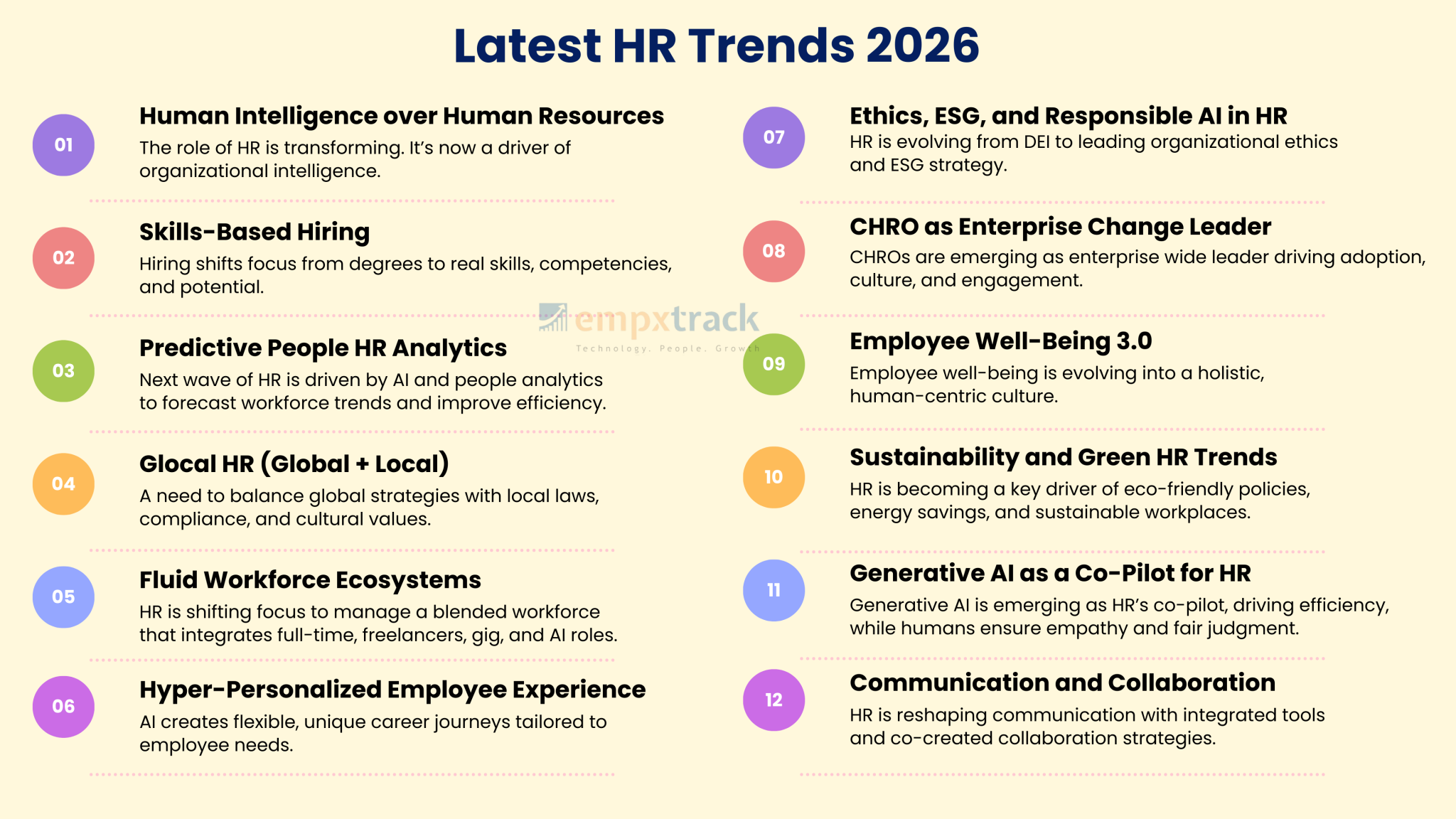
6. Hyper-Personalized Employee Journey
In the future, HR will increasingly leverage AI, behavioral science, and digital nudges to craft career paths that are flexible and tailored to each individual. The personalization will be informed by employee feedback and surveys, thereby creating distinct experiences based on generational variations, role categories, or career stages.
Employees who view their experience as tailored are significantly more engaged. They are 4.6 times more likely to excel when they feel acknowledged and treasured.
7. Ethics, ESG, and Responsible AI in HR
The HR function is evolving beyond traditional Diversity, Equity, and Inclusion (DEI) initiatives to encompass oversight of ethics and governance. As workplaces advance to a more digital environment, companies encounter heightened scrutiny surrounding labor rights, data privacy, sustainability, and the ethical use of technology.
What’s Distinct in 2026
» HR will collaborate with sustainability advocates to guarantee ethical labor practices and socially responsible policies, thereby aligning HR strategy with ESG objectives.
» There will be an imperative to establish guidelines for transparency, reducing bias, and ethical decision-making. Furthermore, privacy and equity need to be guaranteed while still utilizing analytics to enhance engagement and productivity.
» HR leaders will also be required to communicate transparently with employees regarding the use of their data and AI tools, thereby fostering robust trust in contemporary HR systems and decisions.
8. CHRO as Enterprise Change Leader
CHROs are evolving into change leaders, moving beyond merely having a “seat at the table.” Their specialization will continue to assist in retaining elite talent, merging teams, and maintaining productivity amidst transitions. CHROs are additionally crucial in strengthening organizational culture, upholding fundamental values, and spearheading employee engagement tactics.
Their responsibilities also involve addressing retirement challenges, promoting cohesion within a multigenerational workforce, and utilizing technology for equitable, unbiased performance assessments.
9. Employee Well-Being 3.0
Teams are now distributed across different time zones, contract types (full-time, freelance, gig workers), and even in human + AI partnerships. This leads to complexities in ensuring everyone remains aligned and engaged, directly correlating to the employee engagement trend.
Currently, well-being revolves around cultivating a human-centric culture where all individuals feel connected, appreciated, and supported. It matters not how or where they work. Employees exhibit greater engagement and productivity when they sense that they are digitally and socially connected.
10. Sustainability and Green HR Trends
The responsibility of sustainability will not solely lie with CSR or ESG. However, in 2026, HR will contribute to promoting sustainable workplaces and endorsing green HRM. This entails advocating for energy efficiency, decreasing paper usage, and providing hybrid/remote options to mitigate commuting emissions.
They will also partner with sustainability teams to weave carbon reduction goals into workforce strategies. For example, promoting virtual meetings in place of unnecessary flights, or rewarding employees who adopt greener commuting practices.
11. Generative AI as a Co-Pilot for HR
In 2026, Generative AI in human resources will serve as a genuine co-pilot for HR leaders, surpassing basic chatbots that address frequently asked questions.
Generative AI will assist organizations in refining hiring processes and endorsing unbiased evaluations. Additionally, it will be significant in workforce planning and recommending training initiatives.
While Generative AI as a co-pilot will enhance HR speed, intelligence, and strategic thinking, it cannot supplant the human element. Ultimately, its true significance is revealed when paired with human insight and emotional intelligence.

The successful formula for 2026 will merge AI for efficiency with human empathy. Hence, crafting HR processes that are both data-informed and profoundly human.
12. Communication and Collaboration
Effective communication is poised to become the foundation of workplace productivity and culture. Organizations will allocate resources toward integrated communication platforms that amalgamate chat, video, project management, and knowledge-sharing instead of managing multiple systems. This will ensure that all employees obtain uniform and accessible information.
HR will also adopt a researcher’s perspective, concentrating on collecting feedback, interpreting data, and testing methodologies. Consequently, they will gain a clearer understanding of which communication and collaboration strategies are truly effective. In turn, they will co-create workplace strategies alongside employees at every level.
Future of HR in 2030
Organizations are anticipated to leverage AI extensively in 2030 for functions such as employee onboarding, candidate evaluation, and predictive analytics for talent management trends, among many others.
Automation will manage routine tasks, permitting HR personnel to direct more focus toward strategic and human-centered dimensions of their roles. Employees will also be required to grasp automation and artificial intelligence to avoid the risk of being replaced.
Human resources trends in 2030 will also be characterized by data-driven decision-making approaches. It will zon in on employee experience and commitment to develop flexible and inclusive workplaces.
Organizations will be equipped to identify potential challenges and initiate proactive measures for resolution through predictive analytics. This will enable the HR department to be more responsive and agile. To navigate the evolving landscape successfully, HR professionals will need to embrace these emerging HR trends of 2026 and adopt innovative HR leadership skills and strategies.
Frequently Asked Questions
Q1. |
What are the leading HR trends for 2026? |
| Ans. | The leading HR trends for 2026 include:
● Human intelligence over human resources |
Q2. |
Why do HR trends matter? |
| Ans. | Current HR trends are vital because they enable organizations to remain competitive by improving employee
engagement, enhancing performance results, and aligning workforce strategies with evolving business goals. |
Q3. |
In what ways will AI alter HR in 2026? |
| Ans. | AI will revolutionize human resources in 2026 by streamlining repetitive tasks, predicting workforce demands, tailoring employee experiences, and encouraging continuous education. Furthermore, a primary challenge for HR will be achieving a balance between AI’s efficiency and the empathy and ethical governance of human interactions. |
Q4. |
What significance will employee experience hold in 2026? |
| Ans. | Prioritizing an excellent employee experience will emerge as a vital differentiator in acquiring and retaining talent as remote work and a global workforce gain traction. Organizations that emphasize employee experience in 2026 are likely to witness improved business outcomes overall, higher retention rates, and enhanced morale. |
Q5. |
Which skills will HR professionals require in 2026? |
| Ans. | In 2026, HR professionals will need a combination of strategic, digital, and interpersonal skills. Essential domains include:
● Digital literacy & AI proficiency |
Q6. |
Will hybrid work remain pertinent in 2026? |
| Ans. | Indeed, hybrid work patterns will continue to be pertinent in 2026. |
Q7. |
How can companies brace for upcoming HR trends? |
| Ans. | By investing in digital tools and artificial intelligence (AI), and establishing inclusive and flexible policies that cater to diverse workforces, companies can gear up for the changing demands of HR. Additionally, emphasizing continuous learning and reskilling to keep abreast of emerging skills will prepare organizations for future HR leadership developments.
Businesses can also get ready for new trends in human resource management by promoting holistic well-being, and integrating sustainability and ethics into HR operations. |
Q8. |
What role will employee experience constitute in 2026? |
| Ans. | Handling evolving remote and hybrid work frameworks, addressing the skills gap via training and AI implementation, and retaining premium digital talent are notable challenges. In addition to these, promoting employee mental health and well-being amid economic pressures and workforce instability are further hurdles that HR leaders will grapple with in 2026. |
Q9. |
How will people analytics influence decision-making in HR? |
| Ans. | People analytics in HR will enhance hiring, talent management, and employee development practices, shaping the future of work. This will be achieved by substituting intuition with objective, data-driven decision-making. |
Q10. |
What will HR’s future resemble in 2030? |
| Ans. | The future of HR in 2030 will be increasingly data-centric and AI-enhanced. Human resource departments will focus more on ethical workforce management, continuous employee skill advancement, and personalized employee experiences. In order to foster culture, engagement, and organizational resilience, HR will act as a strategic change partner by balancing technology with human empathy. |